Giovanni Benedetto Castiglione, called Il Grechetto
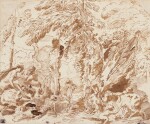
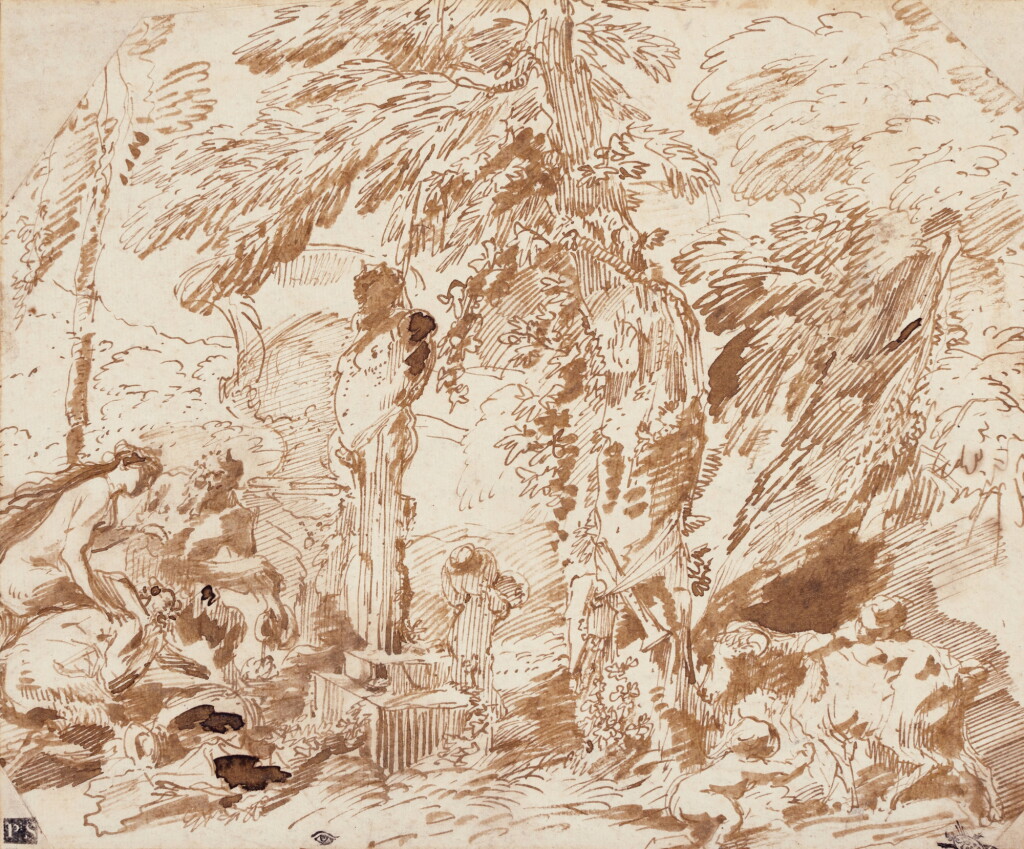
A nymph and two satyrs offering a libation before a statue of Pan, two children and a goat in the right foreground
Auction Closed
July 1, 11:00 AM GMT
Estimate
15,000 - 20,000 GBP
Lot Details
Description
Giovanni Benedetto Castiglione, called Il Grechetto
(Genoa 1609 - 1664 Mantua)
A nymph and two satyrs offering a libation before a statue of Pan, two children and a goat in the right foreground
Pen and brown ink and wash
191 by 233 mm
Nathaniel Hone (1718-1784), London (L.2793);
Jonathan Richardson Senior (1665-1745), London (L.2183), his mount with the attribution: Castiglion.e, on the verso his shelf mark zd., and No 76,
his sale 22 January 1747, lot 57, (Four Castiglione, rural sacrifice, Brauer, a brawl, and two landscapes of Claude; bears inscription on the backing, possibly in Pond's handwriting, the 17th night / lot 57);
Arthur Pond (c.1705-1758), London (L.2038);
Paul Sandby (1725-1809), London (L.2112);
sale, London, Sotheby's, 28 March 1968, lot 69 (to Agnew);
with Thomas Agnew & Sons Ltd., London;
Private collection
Characteristic of Castiglione's pen and ink style, this sheet combines lively and highly controlled strokes of the pen with loose and painterly use of the wash. Castiglione's dexterity in this combination of techniques achieves elegant and painterly effects, here enhanced by a lyrical subject inspired from the antique in the sort of arcadian setting much appreciated by his clients. It clearly shows the exposure of Castiglione to the paintings of Poussin. The artistic situation in Rome was very different from that of his native Genoa; when Castiglione first arrived in the city in the mid-1630s, he encountered the inspiring group of painters under the patronage of Cassiano dal Pozzo - Poussin, Testa and Mola.
Moreover, as has often been noted by art historians, the artist was at first influenced by Rubens and Van Dyck; both of these Flemish artists spent time in Genoa, and Castiglione must have studied their works at first hand. Castiglione remained outside the mainstream of early 17th-century painting in Genoa and developed his own highly individual style by experimenting, and absorbing the artistic trends around him while travelling much of the Italian peninsula.
As Timothy Standring and Martin Clayton noted in the introduction to their 2013 catalogue devoted to Castiglione's drawings in the Royal Collection, his biographers were fascinated by the artist's difficult and bizarre personality, while also praising his facility with the brush and his successful assimilation of a broad spectrum of styles and iconographic sources, which he absorbed ‘like an insatiable magpie – he could easily be called the Picasso of his time’.1
1.Timothy J. Standring and Martin Clayton, Castiglione. Lost Genius, exh. cat., London, The Queen’s Gallery, 2013, p. 12
You May Also Like