
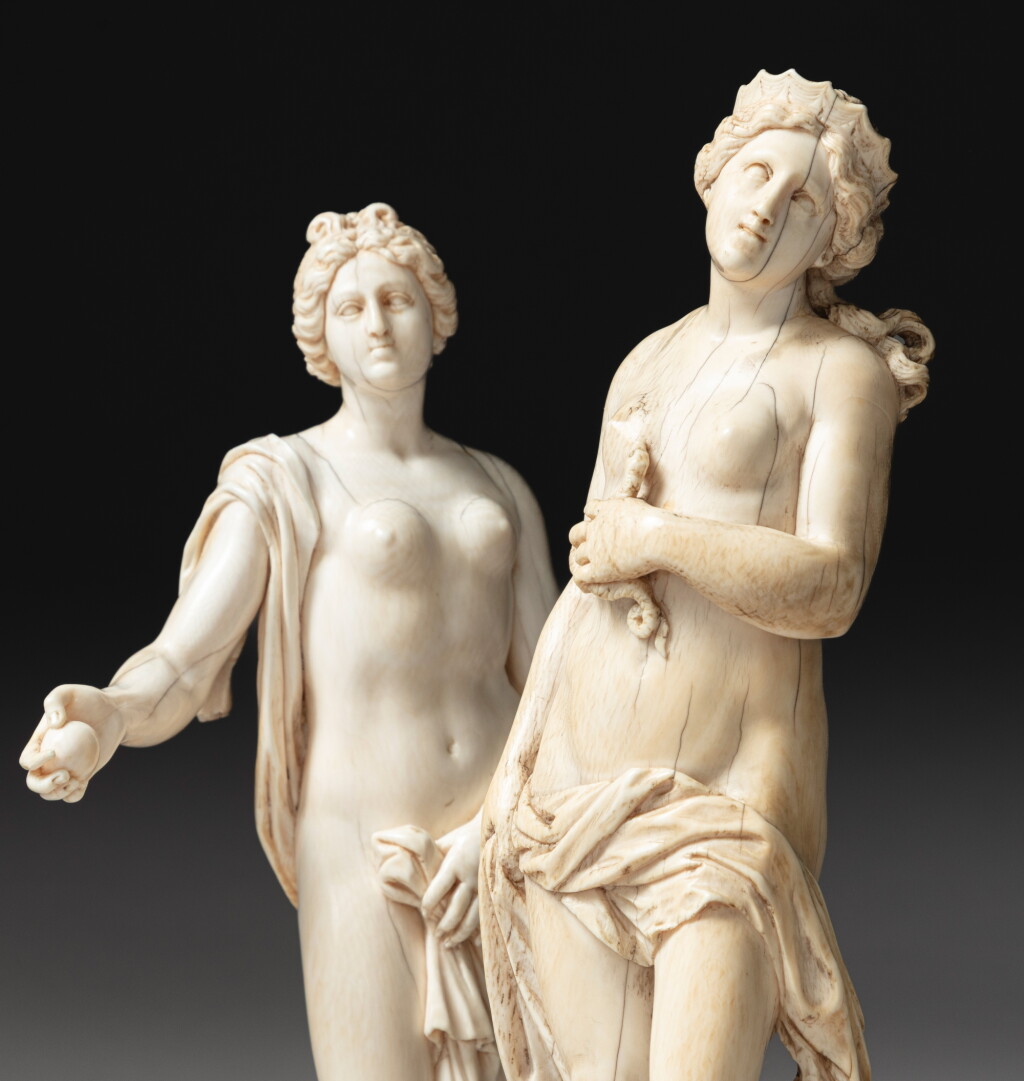
French, second half of the 17th century
Venus Victrix & Cleopatra
Estimate
8,000 - 12,000 EUR
Lot Details
Description
French, second half of the 17th century
Venus Victrix and Cleopatra
ivory, on octagonal terrasses; one on a wood base
Venus Victrix: 26cm., 10¼in.
Cleopatra : 25.5 cm, 10in; 27cm. high overall, 10⅝in.
(2)
Please note that this lot contains elephant ivory. Pursuant to the UK Ivory Act 2018, clients based in the United Kingdom are not able to bid on / purchase this lot. The export of lots containing ivory outside the EU is now prohibited pursuant to European regulation 2021/2280 of 16 December 2021. Sotheby's will be able to provide the buyer with the intra-community certificate attached to this item.
Cleopatra acquired from Galerie Hauteville, Brussels, January 1989;
Venus Victrix acquired from Sotheby’s London, 9 December 2005, lot 86;
both in the same private collection, Belgium;
thence by descent to the present owner, Belgian noble collection.
The model for the present Venus, victorious in the Judgement of Paris, is a free interpretation after the Antique. The movement of the body and of the left hand, modestly concealing her nudity, derive from the Medici Venus, while the outstretched left arm, showing the apple of discord, recalls the pose of the Flora Capitolina.
The figure of Cleopatra, mortally bitten by an asp, closely follows the composition of the marble formerly belonging to the French royal collections, documented in the park of the Château de Versailles in 1697 and at Marly the following year. Transferred to the Louvre Museum at a later date, this marble is now attributed to an Italian, probably Tuscan, sculptor and dated to the last quarter of the 16th century (inv. MR SUP 2). The model was sufficiently renowned in the 17th century for Hubert Lesueur to cast it in bronze for Charles I of England.
Although they come from different provenances, these two statuettes display striking stylistic similarities, particularly in their classicising proportions, facial features with unincised eyes, treatment of the hair and drapery, and identical small, integral octagonal terraces. These correspondences indicate that they almost certainly originated from the same artistic centre in the second half of the 17th century.
You May Also Like


