
Anne Seymour Damer
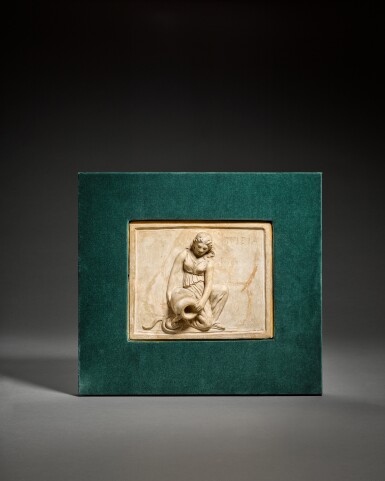
Relief with Hygieia
Auction Closed
July 1, 03:00 PM GMT
Estimate
20,000 - 30,000 GBP
Lot Details
Description
Anne Seymour Damer
Sevenoaks 1748 – 1828 London
Relief with Hygieia
signed: [A]NN[A] ΔAMEP / LONΔINEIA. EΠOI: and inscribed: ΥΓΙΕΙΑ
patinated plaster, in a velvet covered mount
relief: 21.5 by 27cm., 8½ by 10⅝in.
mount: 41 by 45cm., 16⅛ by 17¾in.
Christie's, London, 26 April 1979, lot 149A;
George Erasmus Darwin (1927-2017), London;
From whom acquired by the present owner in 2002
London, Royal Academy of Arts, 1787, no. 624
The Exhibition of the Royal Academy, M.DCC.LXXXVII, The Nineteenth, London, 1787, p. 19
This beautiful plaster maquette appears to be the cast of Hygieia which Damer exhibited at the Royal Academy of Arts in 1787, there described as 'a design for the fountain at Buxton, representing Hygia'. According to Damer's biographer, Richard Webb (op. cit., p. 106), the piece was commissioned by the Duke of Devonshire and intended for St Anne's Well, the fount of the healing spa waters at Buxton in Derbyshire. It is not known whether the final work was ever completed and installed in situ, as the well and its surrounding buildings were demolished in the 19th century.
Damer's bas-relief shows Hygieia, the Greek goddess of health and sanitation, as a young woman in antique dress pouring water from an urn. At her feet coils a serpent, the ancient symbol of medicine, which frequently appears in the goddess's iconography. Signed and inscribed in ancient Greek, the work's delicate modelling and classical restraint exemplify the Grecian purity of Damer's sculptural style.
Anne Seymour Damer was the daughter of Henry Conway, a prominent soldier and Whig politician, and Lady Caroline, née Campbell, the daughter of the 4th Duke of Argyll. From birth she enjoyed the occasional guardianship of Horace Walpole, her godfather and her father’s cousin, who held her in great affection, and whose house, Strawberry Hill, she would inherit for her lifetime after his death in 1797. Anne married John Damer, the eldest son of Lord Milton in 1767, but their unhappy marriage ended with her debt-ridden husband’s suicide in 1776. Following his death, Damer embarked on the highly unusual path of becoming a sculptor, then unheard of as a profession for women, even less those of aristocratic standing. With unwavering support from Walpole, Damer received lessons in modelling from Giuseppe Ceracchi (whose statue of Anne Seymour Damer as the Muse of Sculpture is in the British Museum) and from John Bacon, as well as embarking on various study visits to Italy. From 1784 Damer was an Honorary Exhibitor at the Royal Academy of Arts.
Despite being met with hostility from much of the establishment due to her outsider status, she proved herself as an accomplished portrait sculptor, as well as specialising in the representation of domestic animals. Her high social status afforded her access to the political elite, and she not only created portraits of Lord Nelson and Charles James Fox, but presented her bust of the former to Napoleon in 1815. Alongside her work as a sculptor, Damer had a passion for acting and the theatre. Her illustrious social circle included Georgiana, Duchess of Devonshire and Elizabeth Viscountess Melbourne, with whom she was famously depicted as the Witches in Macbeth by Daniel Gardner in 1775.
RELATED LITERATURE
I. Roscoe, A Biographical Dictionary of Sculptors in Britain, 1660-1851, New Haven and London, 2009, pp. 333-337, no. 54; R. Webb, Mrs D: The Life of Anne Damer (1748-1828), Brewin, 2013