After Adriaen de Vries
Hercules and the Hydra
Auction Closed
July 1, 03:00 PM GMT
Estimate
15,000 - 20,000 GBP
Lot Details
Description
After Adriaen de Vries (The Hague c. 1556 - 1626 Prague)
Netherlandish or Southern German, 17th/ 18th century
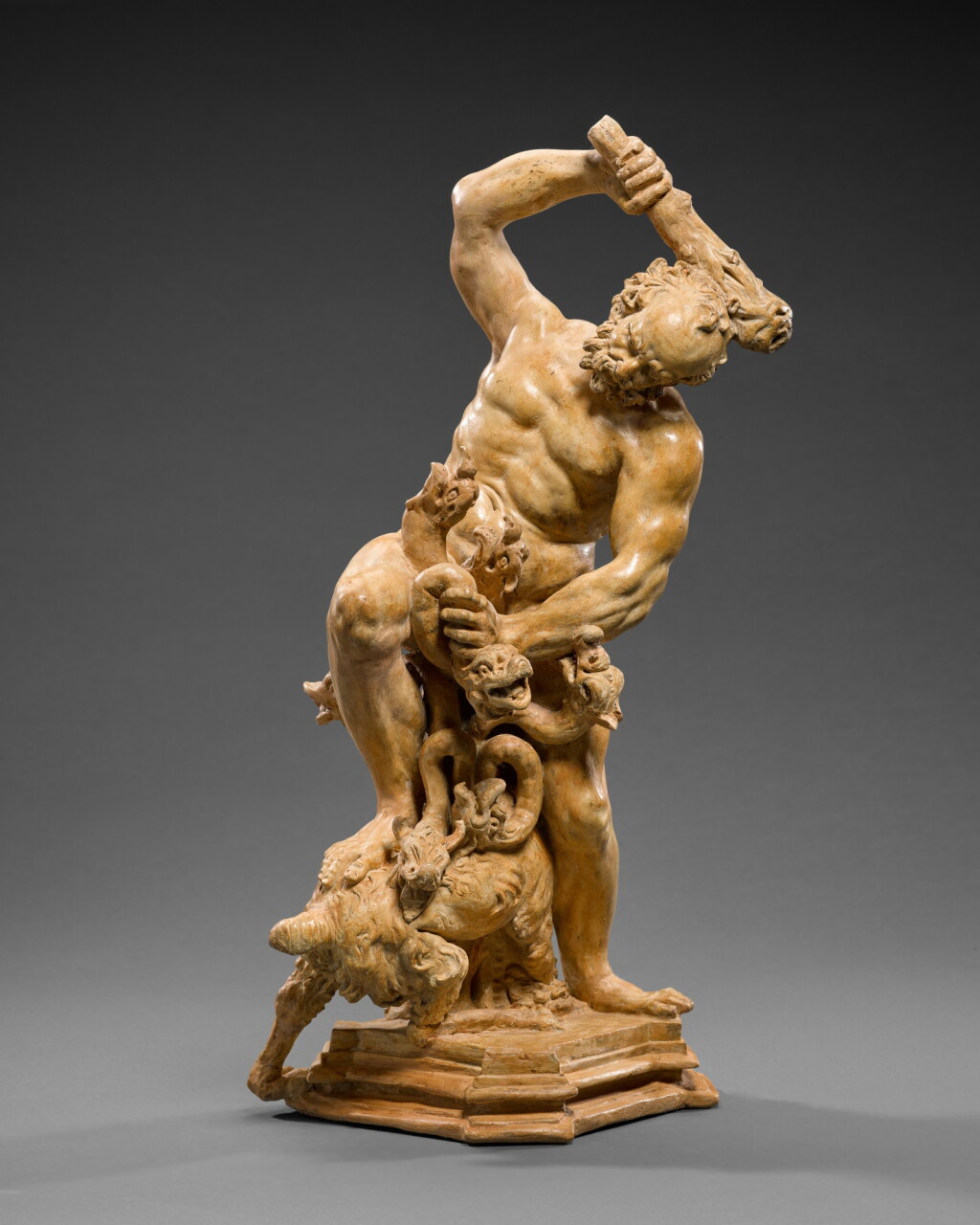
Hercules and the Hydra
terracotta
45cm., 17¾in.
Christie's, London, 9 March 2006, lot 64
Erected in 1602, the Hercules Fountain was one of three monumental fountains created by Adriaen de Vries for the city of Augsburg to commemorate its 600th anniversary. Surmounted by a bronze group of Hercules slaying the Hydra, which was completed in 1596, the fountain was dedicated to the city's craftsmen, while the fountains of Mercury and Augustus represented the merchants and masters of Augsburg.
The image of the Hercules Fountain was widely disseminated in the 17th century through prints, most of which ultimately depended on an engraving from 1602 by the Netherlandish artist Jan Muller (1571-1628) (op. cit., cat. no. 50). The appearance of the fountain's Hercules group in Muller's engraving, however, differs in several respects from the final bronze, notably in the hero's less upright stance, his attribute of a club instead of a burning torch, and the Hydra's lack of wings. It is therefore assumed that Muller's print, which may be based on a drawing by Hans von Aachen (1552–1615), was based on an earlier design for the monument by de Vries, of which there may have been a model available to other artists (op. cit., p. 136).
It is likely that it was Muller's engraving, rather than De Vries' final bronze group, which provided the basis for the present terracotta adaptation of the model. It too shows Hercules wielding a club and in a more hunched position, while the Hydra has no wings. The terracotta diverges further from the original in Augsburg in details such as the hero's hairstyle and the appearance of the Hydra, whose scales are here transformed into tufts of fur.
RELATED LITERATURE
Adriaen de Vries, 1556-1626: Augsburgs Glanz - Europas Ruhm, exh. cat. Städtische Kunstsammlungen, Augsburg, 2000, pp. 133-146 and 344-362
You May Also Like