
Simone Pignoni
Persephone
Auction Closed
February 6, 07:26 PM GMT
Estimate
20,000 - 30,000 USD
Lot Details
Description
Simone Pignoni
Florence 1611 - 1698
Persephone
oil on canvas
canvas: 38 ⅜ by 34 ¼ in.; 97.5 by 87.0 cm
framed: 44 ⅝ by 41 in.; 113.3 by 104.1 cm
Scrimgeour Collection, Stedham Hall, Midhurst, by the early 20th century;
Thence by descent until sold, London, Bonham's, 3 July 2024, lot 16;
Where acquired.
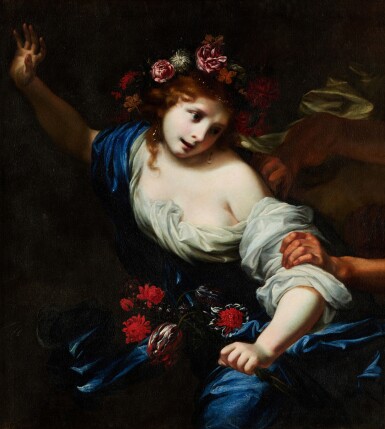
Painted in Florence in the 1670s or 1680s by Simone Pignoni, this dramatic mythological scene represents the Abduction of Persephone (or Proserpina), an episode described by Ovid in both the Metamorphoses and Fasti, in which the daughter of Ceres (or Demeter) is seized by Pluto, god of the Underworld. According to the ancient myth, Ceres’ grief at her daughter’s disappearance rendered the earth barren until Jupiter decreed that Persephone would spend half the year in Hades as queen of Tartarus and half on earth, her annual return heralding the renewal of nature and arrival of spring. The crown and bouquet of flowers—at once tokens of innocence interrupted and emblems of Persephone’s cyclical return—were painted by Andrea Scacciati, whose collaborative involvement further supports a date of execution in the later decades of the seventeenth century.
Pignoni captures the episode at its most psychologically charged instant. A brilliant light illuminates the fleeing figure twisting pose and accentuates her ivory complexion and voluptuous form. Pluto’s presence is conveyed only through his grasping hands and forearms, suggesting that the canvas may have been cut down. Indeed, Pignoni treated this subject on several occasions in compositions that include both figures, among the painting in the Musée des Beaux-Arts, Nancy (inv. no. 614), considered by Francesca Baldassari to be the prime version, after which Pignoni produced other autograph variants. These include a version formerly in the collection of Schloss Ambras, Innsbruck, now in the Kusthistorisches Museum, Vienna (inv. no. 7955), and another sold at Christie’s, New York, 23 January 2004 lot 127.1
We are grateful to Professor Sandro Bellesi for confirming his opinion that this work is by Pignoni, with Scacciati executing the floral elements.
1 For these, as well as another version that only features the figure of Persephone (without Pluto’s hands or forearms), see F. Baldassari, Simone Pignoni, Turin 2008, pp. 160-162, cat. nos., 102-105, reproduced.


