An Iznik Pottery Border Tile, Turkey, circa 1575
Auction Closed
October 22, 01:02 AM GMT
Estimate
25,000 - 35,000 USD
Lot Details
Description
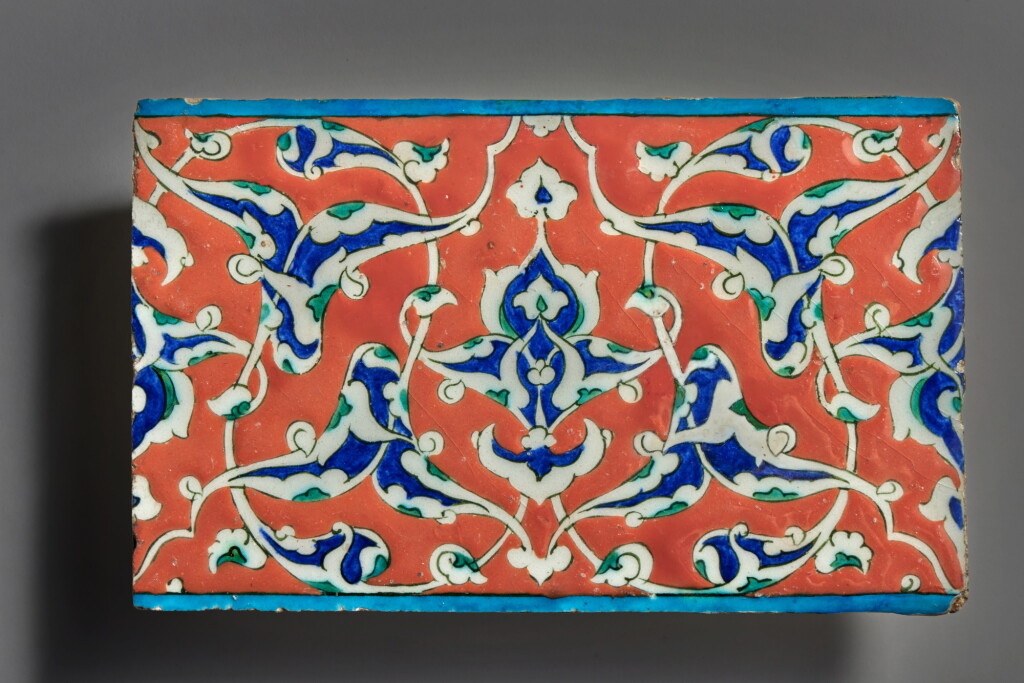
An Iznik Pottery Border Tile, Turkey, circa 1575
of rectangular form, decorated in bole-red, cobalt-blue, green, and white, outlined in black, with interlaced split-palmettes on a bole-red ground, narrow turquoise border above and below
6 by 9 ¾ in.
15.3 by 24.8 cm
Private collection, France, by 2001;
Anonymous sale, Christie's, London, 25 April 2024, lot 141;
Where acquired by the present collector.
The intricate overall split arabesque design of this tile was popular in the last quarter of the 16th century. In 1578, during the reign of Sultan Murad III (r. 1574-95), major renovations were undertaken to the private quarter of the Topkapi Palace, spurring extensive orders for newly designed tiles. Tiles of this design were used in the sultan’s bedroom, although the borders comprised friezes of half-palmettes rather than the narrow turquoise border here (J.M. Rogers (ed.), The Topkapi Saray Museum, Architecture, Boston, 1988, pl.64).
By the time these tiles were in production, Ottoman potters had mastered the bole-red glaze which was a notoriously difficult color to control and these arabesque tiles were the first to employ this distinct red as the ground color (W. Denny, 'Ottoman Court' in M. Ekhtiar, P. Soucek, S.R. Canby, and N. Haidar (eds.), Masterpieces from the Department of Islamic Art in The Metropolitan Museum of Art, 2011, p.309). The potter controls it here with ease, using the raised red to create a tactile surface that defines the contours of the intricate split arabesques, and achieving the rich coral tone that was so coveted by the Ottomans. Tiles of this group are now widely dispersed in museum collections, see an identical tile in the MET Museum, New York (acc. no.1971.235.2), and further examples with palmette borders in the Calouste Gulbenkian Museum, Lisbon (Türkische Kunst und Kultur aus osmanischer Zeit, exhibition catalogue, Frankfurt, 1985, vol.2, no, p.176), V&A, London (inv. no.1645-1892), LACMA (acc. no.AC1995.124.1), and the David Collection, Copenhagen (K. von Folsach, Art from the World of Islam, Copenhagen, 2001, no.266, p.189).
You May Also Like