Dankmar Adler and Louis Sullivan
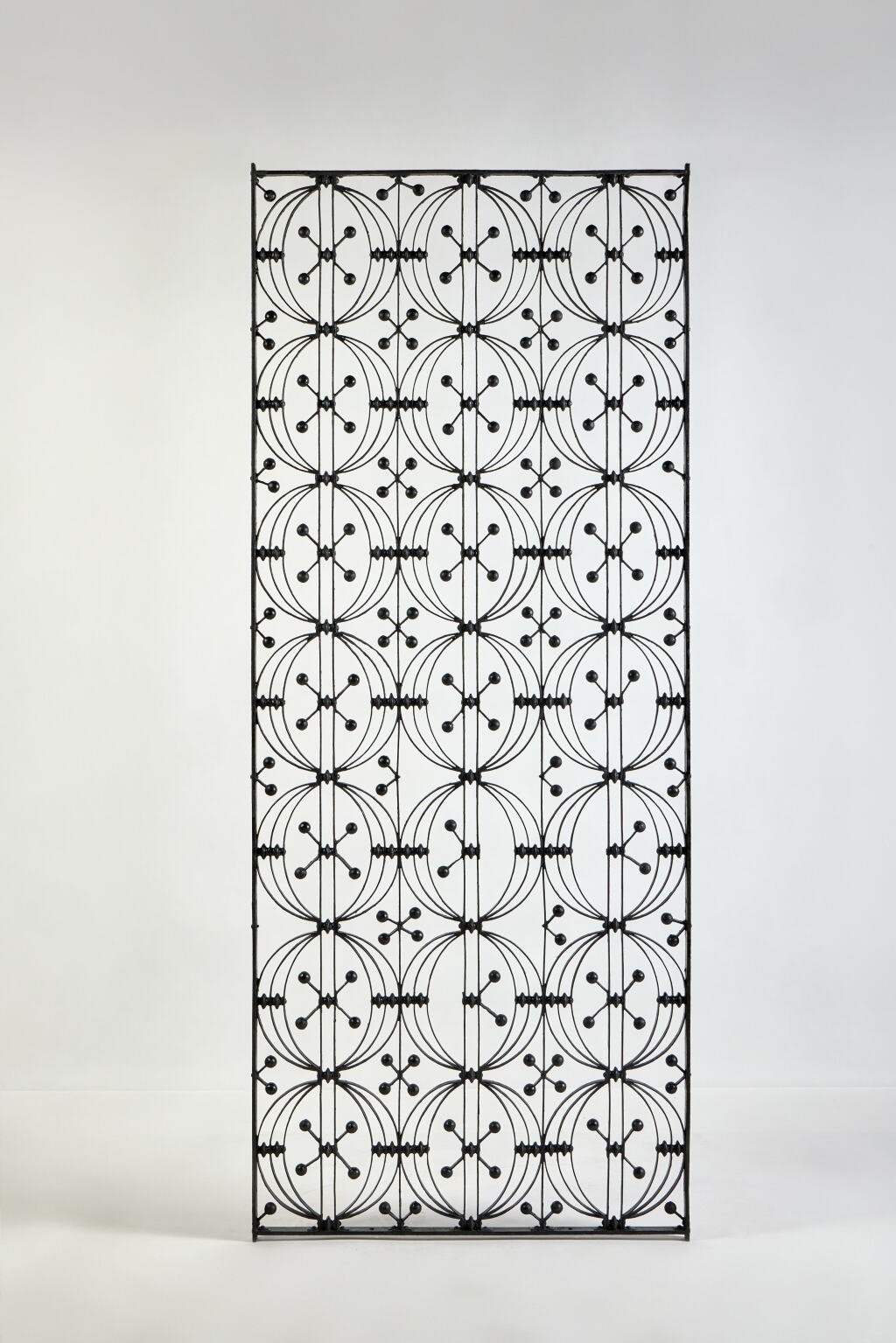
Elevator Door for the Chicago Stock Exchange, Chicago, lllinois
Live auction begins on:
October 23, 02:00 PM GMT
Estimate
15,000 - 25,000 USD
Bid
10,000 USD
Lot Details
Description
Dankmar Adler and Louis Sullivan
1844-1900 and 1856-1924
Elevator Door for the Chicago Stock Exchange, Chicago, Illinois
circa 1893
produced by Winslow Brothers, Chicago, Illinois
painted wrought iron
height 74 in.; width 29 ½ in.; depth 1 ⅛ in.
188 cm; 75 cm; 2.9 cm
Chicago Stock Exchange, Chicago, Illinois, circa 1893;
Thomas and Miriam Walsh, Chicago;
Killian C. Walsh, Chicago, thence by descent from the above;
Wright Chicago, June 7, 2018, lot 312;
Acquired from the above by the present collector.
Louis H. Sullivan: Architectural Ornament Collection, exh. cat., Southern Illinois University at Edwardsville, Edwardsville, 1981, p. 43, fig. 37
John Vinci, The Trading Room: Louis Sullivan and The Chicago Stock Exchange, Chicago, 1989, p. 23
John Szarkowski, The Idea of Louis Sullivan, Boston, 2000, p. 95
Richard Nickel and Aaron Siskind, The Complete Architecture of Adler & Sullivan, Chicago, 2010, p. 190
Designed for Adler & Sullivan’s Chicago Stock Exchange Building circa 1893, the present elevator screen reflects Louis Sullivan’s distinctive approach to architectural ornament, in which structure and decoration were closely integrated. Sullivan drew extensively on the natural world, adapting its rhythms and processes into an architectural vocabulary of geometric and vegetal forms. In his 1924 A System of Architectural Ornament, he compared the development of ornament to a seed unfolding into a plant. The present screen illustrates this principle with particular clarity: a disciplined geometric framework gives rise to an intricate vegetal pattern, creating a composition that is both ordered and dynamic.
The Chicago Stock Exchange was Adler & Sullivan’s largest and most ambitious office building, and a landmark in the emergence of the steel-framed skyscraper. Sullivan’s celebrated dictum that “form ever follows function,” articulated in 1896, would become a foundational principle of modern architecture and profoundly influence a generation of American designers, most notably Frank Lloyd Wright.
Following the building’s demolition in 1972, its surviving elements became important fragments of a lost architectural masterpiece. Related elevator screens are preserved in the collections of The Metropolitan Museum of Art, The Museum of Modern Art, The Art Institute of Chicago, and the Victoria and Albert Museum. The present screen is a rare surviving example of Sullivan’s integrated approach to architecture, ornament, and the natural world.
You May Also Like