
The Shapes of Cartier
Cartier, London
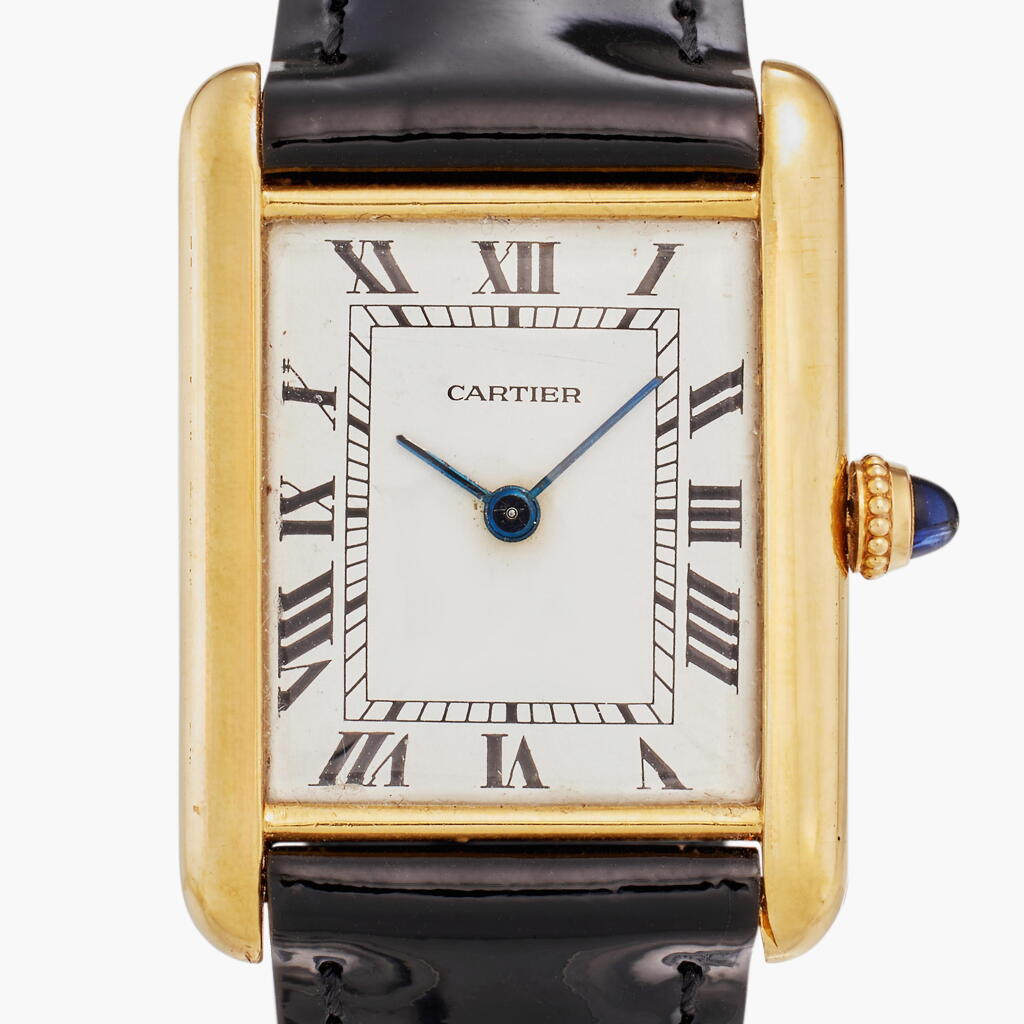
Tank Louis Cartier Extra Flat | A rare and slim yellow gold rectangular wristwatch with gold deployant buckle, 1977-78
Auction Closed
June 15, 08:08 PM GMT
Estimate
18,000 - 25,000 USD
Lot Details
Description
Dial: cream dial signed Cartier, stretched black radial Roman numerals, slim blued steel hands
Caliber: 9¼’’’ circular cal. 838/1 movement signed Jaeger-LeCoultre, damascened Côtes de Genève decoration, lever escapement, jeweled to the center, annular balance, flat hairspring, Kif Trior shock absorber
Movement number: numbered to main plate 2'218'293
Case: 18k yellow gold rectangular case, rounded brancards, slim crossbars, lugs with spring bars, case back with vertical satin finish, beaded cabochon sapphire-set crown, case back secured by four screws between lugs
Case number: 2'090, inside case back hallmarked London date letter ‘c’ 1977-78 with [JC] Jean-Jacques Cartier punch mark
Closure: 18k yellow gold deployant buckle, marked 18k, signed Cartier Swiss, Patent no. 246488
Size: 32 x 24 mm
Box: no
Papers: no
Franco Cologni, Cartier - The Tank Watch, Paris: Flammarion, 1998. See p. 230 for a black and white archival image of an extra flat gold Tank L.C. from 1964.
This watch is among the last made in the London Wright and Davies workshops. Notably, the sides of the brancards have a smooth, uninterrupted sweep, with no visible case or lug screws. While the case back is secured by screws, these are discreetly positioned between the lugs, concealed by the ends of the strap. Instead of screw-set bar lugs, spring bars have been employed for a cleaner appearance. Interestingly, another Extra Flat Tank L.C. made exactly ten years before this watch, also features screws concealed between the lugs for securing the case back, however, unlike the present watch, it still retains screw-set bar lugs. The later made Swiss workshop examples of this Cartier model have their case screws visible to the outside case backs.
Our research indicates that the Tank L.C. Extra Flat (or Extra Plate) was produced between circa 1965 and 1980, with versions crafted in the London, Paris, and Swiss workshops. Most known examples were made in Switzerland for Cartier Paris, while those from the Paris workshop itself are rarer. However, the rarest examples of all were produced at the Wright and Davies workshops in London.