
The Shapes of Cartier
Cartier, Paris
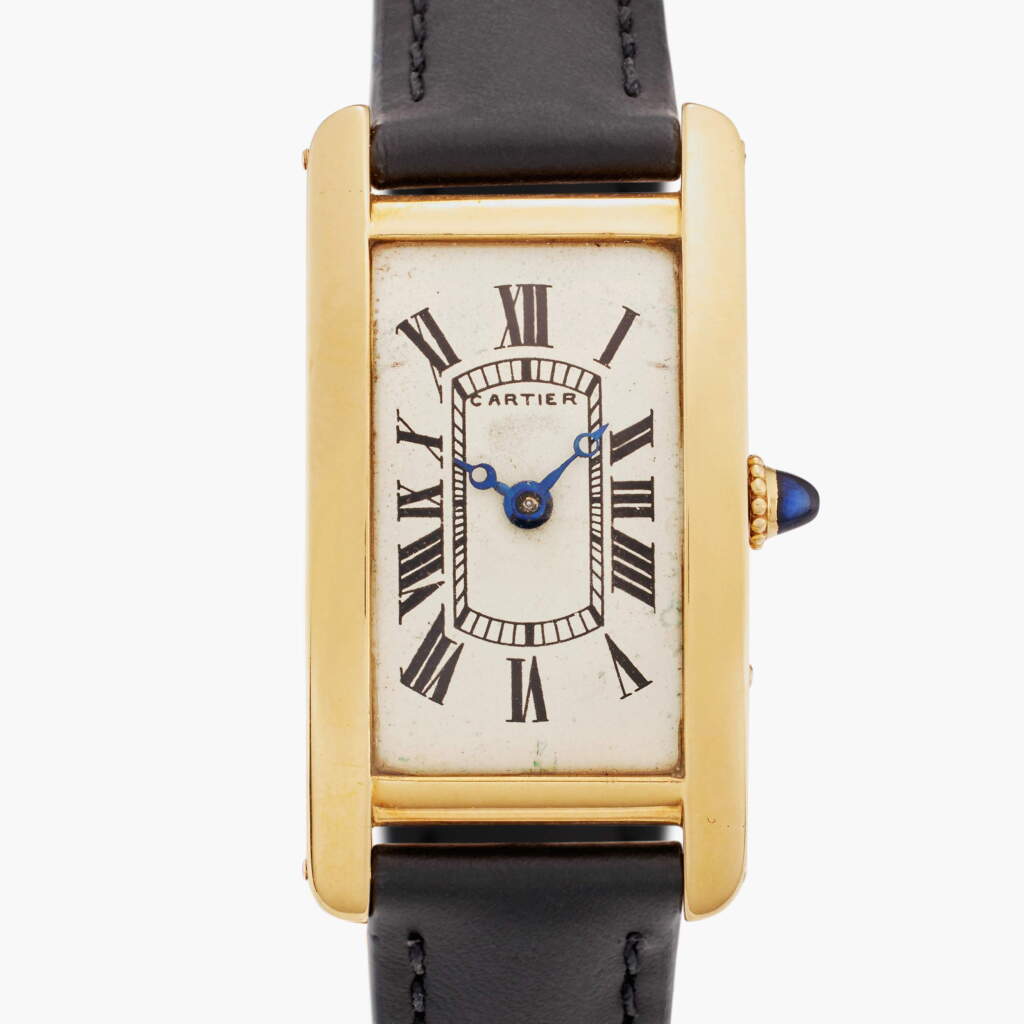
Tank Cintrée | A yellow gold curved rectangular wristwatch with gold deployant buckle, Circa 1926
Auction Closed
June 15, 08:08 PM GMT
Estimate
20,000 - 30,000 USD
Lot Details
Description
Dial: silvered dial, stretched black Roman numerals, inner chemin-de-fer minute track, blued steel Breguet hands
Caliber: 7¼’’’ circular LeCoultre calibre movement signed European Watch and Clock Co. Inc., damascened Côtes de Genève decoration, lever escapement, 19 jewels, bi-metallic compensation balance with timing and poising screws, 8 adjustments, Breguet hairspring
Movement number: numbered to movement beneath dial 20'527
Case: 18k yellow gold polished rectangular case, satin finished case back secured by four screws to case sides, gold screw-set bar lugs, beaded cabochon sapphire-set crown
Case number: case back exterior hand stamped 17'259, 20'527, inside case back and bezel interior numbered 17'259
Closure: 18k yellow and pink gold deployant buckle with D-shaped clasp, French eagle’s head assay mark, hand stamped 7'456
Size: 34.5 x 18.5 mm
Accessories: none
The Cartier Tank Cintrée was launched in 1921. A supremely elegant wristwatch, the model has an elongated, slim rectangular case that is curved to naturally follow the contour of the wrist. Three sizes of the Cintrée were available before 1940 and this is the medium sized version of the model. Few watches are as ergonomically designed or as comfortable to wear.
The Cintrée’s elegance is made possible by the use of the slim LeCoultre movement which was designed by Edmond Jaeger to Louis Cartier’s specifications and made exclusively by LeCoultre. Here Cartier’s innovative skill as a maker of high-end jewellery can be seen transferred into the design and construction of a wristwatch. Sharp clean lines follow the contours of the curved case and the case back meets and fits into the upper case with utter precision. Unlike many rectangular watch cases of the period, the Cintrée’s body is neither hinged nor friction fitted, instead the case back is pressed into the upper case and secured with small screws. This form of construction ensures a tight and secure fitting that allows the case back to sit entirely within the upper body’s framework; the case back meets with and sits flush within the ‘brancard’ sides of the upper case.