
Blancpain
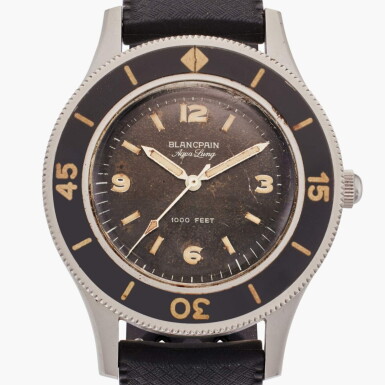
Fifty Fathoms Aqua-Lung | A stainless steel automatic wristwatch, Circa 1960
Auction Closed
June 15, 08:08 PM GMT
Estimate
20,000 - 40,000 USD
Lot Details
Description
Dial: black
Caliber: cal. AS 1361 N automatic, 17 jewels
Case: stainless steel, dust cover, two-piece screw down case back
Case number: 4'116
Size: 42 mm diameter
Signed: case, dial and movement
Box: no
Papers: no
As the post war decades ushered in the Cold War era of brinkmanship and militarization, governments worldwide invested heavily in research and development to maintain their own military supremacy and supply troops with the most technologically advanced equipment in order to stay ahead of the enemy.
Released in 1953, the original Fifty Fathoms was developed in collaboration with the French Combat Diving School in order to equip the French Navy with the best tool watches for military operations. Then Blancpain CEO Jean-Jacques Fiechter, who was a diver himself, developed the Fifty Fathoms model together with Captain Robert Maloubier, a British Special Operations secret agent during WWII, and Lieutenant Claude Riffaud to create the world’s first modern dive watch according to military specifications.
Soon after the release of the Fifty Fathoms, Blancpain began partnering with specialty diving equipment retailers to sell the Fifty Fathoms in the civilian market. Perhaps the most notable was filmmaker and oceanographer Jacques-Yves Cousteau's Aqua Lung, cementing Cousteau's chapter in the Fifty Fathoms story.
Cousteau, along with Emile Gagnan, co-developed a diving regulator they named the 'Aqua Lung', and its success lead to the Aqua-Lung name being used for their retail operations. Cousteau, being a fan of the Fifty Fathoms, partnered with Blancpain to sell the watch in their stores with a co-branded dial, and thus the Fifty Fathoms Aqua-Lung was born.
The present timepiece is an exceptionally well preserved example with thick lugs and case, a radium-impregnated bakelite bezel, its radium dial with puffy, cream-colored indices, and the case back engraving remains clear and crisp. It is highly unusual to see early Blancpains in such great condition, given that they were mostly owned and worn by serious divers. We are pleased to offer this outstanding example that represents a key chapter in Blancpain's history.