
Patek Philippe
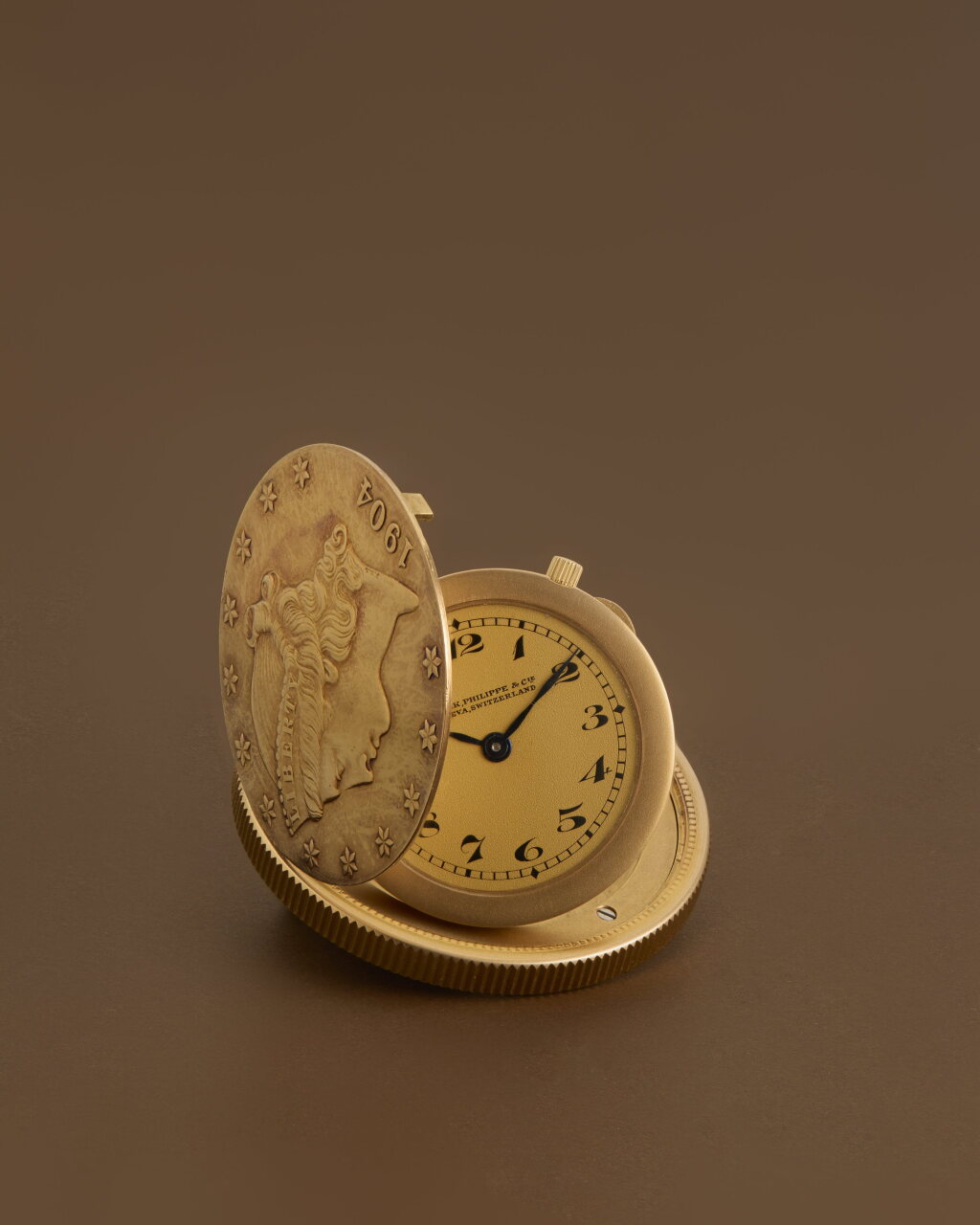
Made for Henry Graves Jr. 1904-S Twenty Dollar Double Eagle Coin | A rare and historically important yellow gold coin form watch, Made in 1925 and Sold in 1928
Auction Closed
June 15, 08:08 PM GMT
Estimate
300,000 - 500,000 USD
Lot Details
Description
Dial: champagne
Caliber: 10''' mechanical, 18 jewels
Movement number: 812'471
Case: 20k and 18k yellow gold, 1904-S Twenty Dollar Double Eagle coin, with hinged lid and snap on case back
Case number: 605'744
Size: 34.7 mm diameter
Signed: case, dial and movement
Box: no
Papers: no
Accessories: Patek Philippe Extract from the Archives confirming the year of manufacture in 1925 and the date of sale on 29 June 1928 and Tortella & Sons passport
Henry Graves Jr.
Gwendolen Fullerton (by descent from the above)
Reginald H. Fullerton Jr. (by descent from the above)
Sotheby's New York 14 June 2012, Lot 7 (consigned by the above)
Private Collection (acquired at the above sale)
FutureGrail 14 May 2025, Lot 89 (consigned by the above)
Acquired from the above by the present owner
The present watch is among the earliest known coin watches produced by Patek Philippe and was formerly a part of the collection of Henry Graves Jr., among the most important Patek Philippe collectors to ever live. Henry Graves Jr. commissioned the Supercomplication, the most complicated watch in the world for over 50 years, from its delivery in 1933 until 1989.
Patek Philippe is known just as much for its rare and unusual timepieces as it is for its complication prowess; the present coin watch is an excellent, rare, and early example of the brand’s ingenuity. Coin watches, or montres numismatiques (numismatic watches), are made from genuine gold legal tender, combining ultra-thin watchmaking with an ingenious case construction. Appearing as a regular coin when the lid is closed, a small latch concealed within the side of the coin activates the magic, revealing a watch inside. At least two mint condition coins were sacrificed to make each watch: one is hollowed out, maintaining its full height to serve as the base, another is milled to preserve only the face to serve as the lid. Inside, a solid gold carrier is inserted to house the movement, dial, hands, crystal and hidden mechanisms. A small hidden spring operates the cover via a discreet push-button, integrated into the edge of the coin.
Produced in 1925 and sold on June 29th, 1928, this is one of the first two Patek Philippe coin watches known to the market. Between 1925 and the 1980s, the brand produced a range of coin watches under defined references. Production of these coin watch references was mostly concentrated after WWII. Beginning in the 1950s, coin watches were apart of Patek’s regular offering. Those examples pre-dating this more regular production period, like the present watch, are extremely uncommon. This is the only known Patek Philippe coin watch with a full, long signature on the dial reading “PATEK, PHILIPPE & Cie. GENEVA, SWITZERLAND” – every comma and intricate detail of this signature is wonderfully preserved.
This coin watch can be categorized under the reference number 802 though the Patek Philippe Extract from the Archives confirms no reference number for this example. As an early coin watch, the logic of references numbers was not yet applied to these offerings. In the decades following, Patek Philippe would produce approximately 100 reference 802 coin watches – identifiable by the use of U.S. twenty-dollar Liberty Head gold coin, otherwise known as the Double Eagle.
The original purchaser of this watch, Henry Graves Jr. (1868-1953), was an American connoisseur with the utmost discerning eye, and naturally, an avid collector of Patek Philippe watches. Inherited by Gwendolen Fullerton, daughter of Mr. Graves, and subsequently by her son Reginald H. Fullerton Jr., known as “Pete,” the watch remained within the Graves family for 84 years before being sold at Sotheby’s New York on 14 June 2012. This landmark sale was entitled "Watches from the Collection of the Late Reginald H. Fullerton , Jr. and his Grandfather Henry Graves, Jr." The crisp condition of this coin watch attests to decades of careful ownership within the family. Pete Fullerton was a notable Patek Philippe collector in his own right, having inherited the Supercomplication – among other important pieces – from his grandfather, and going on to assemble a distinguished collection of his own. Fullerton’s collection was offered alongside the present watch in the same 2012 Sotheby’s sale.
Born in Orange, New Jersey to an influential banking family, Graves joined his father, one of the New York Stock Exchange’s governors, on Wall Street. The family firm, Maxwell & Graves, held major stakes and served as directors in a raft of interconnected industries that built the modern United States of America including the Jersey Central Railroad and Lehigh and Wilkes-Barre Coal Company. Maxwell & Graves provided the starting capital for the Liberty National Bank and the Atlas Portland Cement Company – the cement supplier for both the Empire State Building and the Panama Canal.
A collector spanning categories such as Chinese porcelains, Old Master engravings and drawings, American and naval battle prints, French paperweights, and, important to note given the present watch, rare and historically important coins, Graves followed a simple philosophy, “if it’s not the best, don’t bother.”
In the 1910s, Graves began acquiring Patek Philippe watches via Tiffany & Company in New York, where his family had been longstanding patrons. By the 1920s, his interest in Patek’s offerings evolved from minute repeaters and Observatory chronometers to timepieces that contained as many complications as possible. Famously, Graves commissioned and took delivery of the Supercomplication in 1933. This ultra-complicated pocket watch was sold twice at Sotheby’s, first in 1999 for $11 million and again in 2014 for $24 million, each time setting a world record as the most expensive watch ever sold at auction. Beyond the Supercomplication, Graves ultimately became one of the brand’s most notable patrons. Today, we know of 39 watches made by Patek Philippe for Henry Graves Jr. with the present coin watch being the only non-wristwatch and non-pocket watch. Other notable Pateks from the Graves collection include two legendary tonneau-shapes minute repeating wristwatches, one in platinum and another in yellow gold.
Without traditional complications or an Observatory chronometer caliber, the impetus behind the Graves coin watch is officially unknown. Though, if we observe this great collector’s spirit, we see his infatuation with Patek Philippe’s ability to create the world’s foremost watch and push boundaries.
Many of the watches delivered to Graves were the result of special commissions though when he did purchase non-commission watches, Graves would ask the brand to add his family’s coat-of-arms. The Graves coat-of-arms bears a central eagle motif along with a second eagle rising out of a ducal coronet above and below the motto: Esse Quam Videri (To Be, Rather than to Seem). The present coin watch is contained within a U.S. twenty-dollar Liberty Head gold coin, otherwise known as the Double Eagle. Given the limited surface area inherent to a coin watch, the absence of the Graves family coat-of-arms on the present piece was likely instead thoughtfully expressed through the careful and deliberate choice of a Double Eagle coin.
Given Graves’s reputation as a coin collector, and the choice of a Double Eagle, this exceptionally early coin watch by Patek Philippe may have resulted from a special commission by Henry Graves Jr. – possibly creating a category of watch the firm would produce for the ensuing 60 years.