
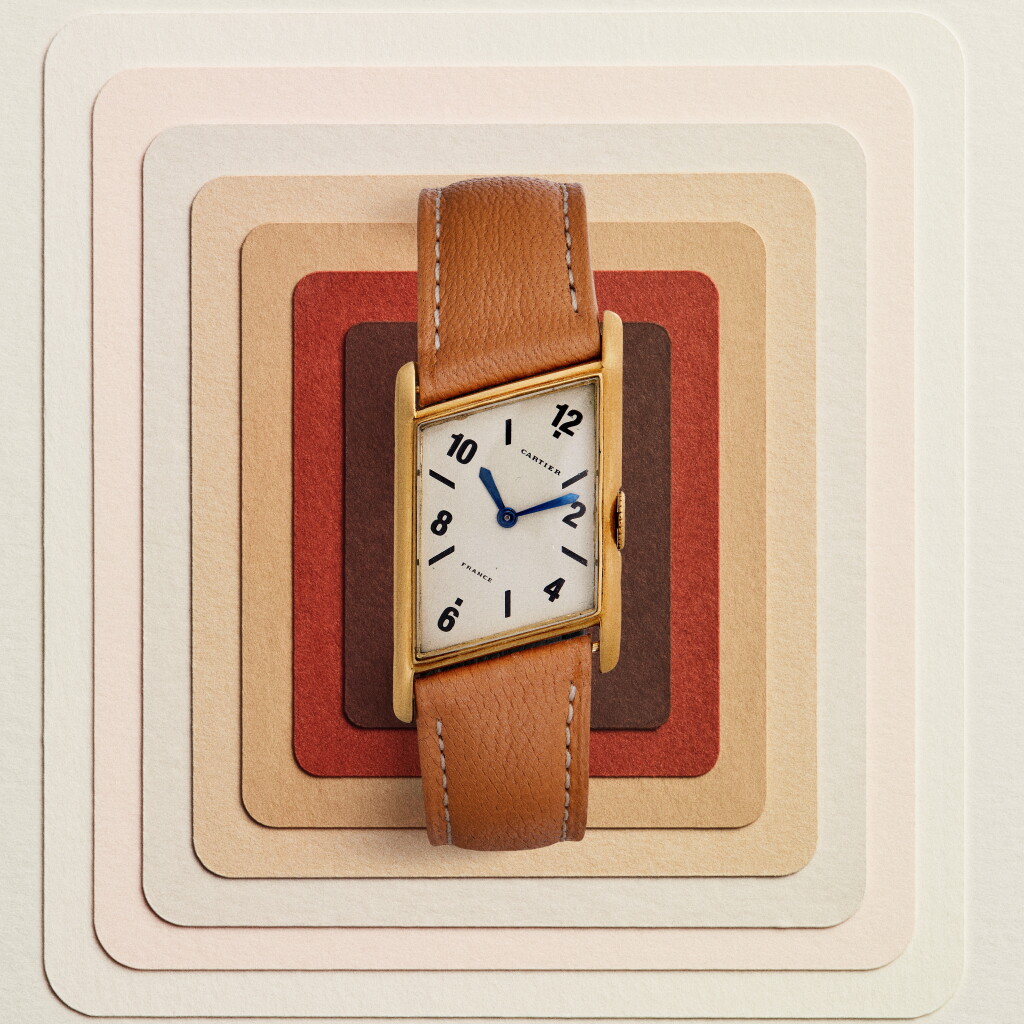
The Shapes of Cartier
Cartier, Paris
Parallélogramme | A rare yellow gold asymmetrical rectangular wristwatch with gold deployant buckle | Circa 1937
Auction Closed
May 10, 02:36 PM GMT
Estimate
55,000 - 80,000 CHF
Lot Details
Description
Dial: cream dial signed Cartier France, off-set black Arabic and baton hour indexes, squares beside 12 and 6 o’clock, blued steel épée hands
Calibre: 8’’’ tonneau-form movement signed LeCoultre, grained decoration, lever escapement, 15 jewels, annular balance, flat hairspring, unadjusted
Movement number: backplate numbered 43'823
Case: 18k yellow gold oblique rectangular case, slim bezel to retain crystal, long brancards with downturned lugs, satin finished case back secured by four screws to case sides, screw-set gold bar lugs, flat notched winding crown, outside case back numbered 76179, inside case back with Swiss Lynx import mark, 0.750 stamp for 18k gold, case mark 4/10 and hand stamped 29148, later London import marks, feint possible French eagle assay
Case numbers: 76'179, 29'143
Closure: later 18k gold deployant buckle
Size: 23.5 x 35.5 mm (width x length including lugs)
Box: no
Papers: no
Accessories: none
Franco Cologni, Cartier - The Tank Watch, Paris: Flammarion, 1998. See p. 218 where both early versions of the Asymmetric are shown: Parallélogramme and Losange à Brides. See also op. cit. pp. 104-105.
One of the most iconic designs from Cartier’s vintage production, the Parallélogramme, transforms the traditional rectangular Tank form case by twisting it to an oblique angle. The dial mirrors this off-set design, forming a lozenge shape with the 12 and 6 o’clock markers positioned at the top right and lower left corners of the case, respectively. This unconventional arrangement allowed the time to be quickly and easily read at an angle – for instance, when the wrist was outstretched in front of the wearer, such as resting on a table or on the steering wheel of a car. A similar angled layout was a popular feature of early driver’s watches.
Originally introduced in 1936, the Parallélogramme represents a modernist expression of the late Art Deco period. Its bold and innovative design can be seen as one of the final flourishes of this artistic movement before the onset of the Second World War, which ushered in a more austere and functional era in watchmaking, prioritizing simplicity and practicality over experimentation. Today, the position of 12 o’clock on a wristwatch dial is firmly established between the upper lugs of the case. However, it is important to remember that the introduction of the Parallélogramme occurred during the early development of the wristwatch genre, a time when Swiss wristwatch exports had only recently surpassed those of pocket watches. Without long-standing design precedents for wristwatches, this innovative approach reflected the experimental spirit of the era.
Although now commonly referred to as the Tank Asymétrique, this model was not originally part of the Tank line and was officially named the Parallélogramme. An extract from the Cartier Archives dated 24 September 1936 describes a “Bracelet Montre or Parallélogram, Modèle 385” with a leather strap and gold pin buckle. This aforementioned watch, numbered 74951 / 50668, was sold on 17 December 1936 for Fr. 2,200 (with the archives noting the production cost as Fr. 1,190). The Asymétrique was originally produced in two distinct styles: the Parallélogramme, matching the watch illustrated here, and the Losange à Brides, which featured an additional central lug that created a hinge-like formation and into which the strap was integrated.
This model’s striking design has inspired several re-releases over the decades. In her book The Cartiers, Francesca Cartier-Brickell notes that this design was one of her grandfather’s, Jean-Jacques Cartier’s, favourites and the London workshops produced a limited number of Parallélogramme watches. Later, new limited editions of the design, now popularly known as the Tank Asymétrique, were introduced in 1996, 1999, 2009, and most recently in 2020 as part of Cartier’s exclusive Collection Privé.