
The Shapes of Cartier
Cartier, Paris
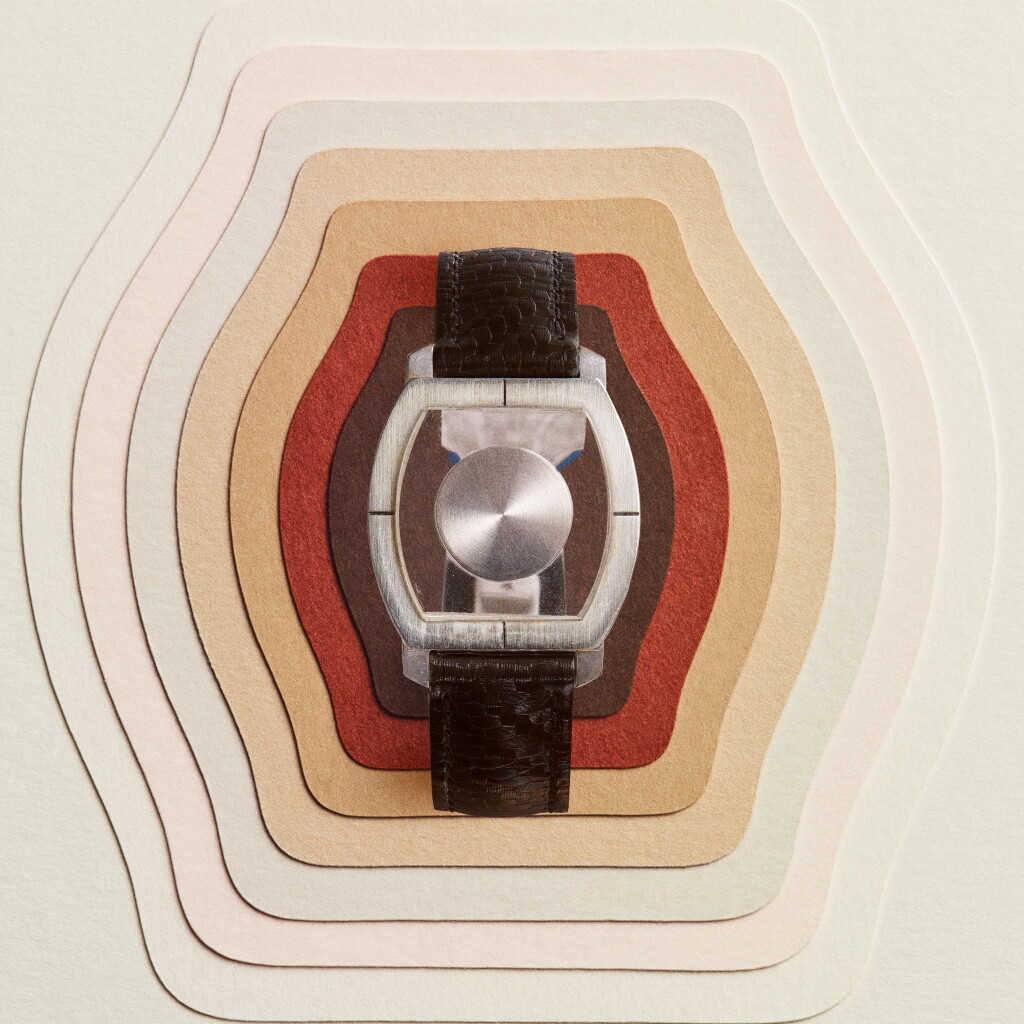
Mystère Tortue | An extremely rare and unusual white gold tonneau form rear-wound mystery wristwatch with white gold deployant buckle | Circa 1973
Auction Closed
May 10, 02:36 PM GMT
Estimate
40,000 - 60,000 CHF
Lot Details
Description
Dial: plain satin finished dial, blued steel epée hands
Calibre: 5½’’’ Jaeger-LeCoultre calibre 426 movement signed Cartier, lever escapement, grained decoration, 16 jewels, annular balance with poising screws, adjusted to 3 positions, flat hairspring,
Movement number: 1’079’955
Case: 18k white gold case, satin finished bezel with incised black batons at 12, 3, 6, and 9 o’clock, the bezel joined to the dial centre via transparent crystals, polished case sides, lugs with polished tops and spring bars, screwed-down polished white gold case back with notched rear-set winder, inside case back stamped 0.750, outside case back with French eagle’s head assay mark, signed Cartier, (SCA) punch mark for Cartier SA to inside and outside back further eagle’s head assay to case side and underside of lug
Case number: 177’953
Closure: 18k white gold deployant buckle with D-shaped clasp, stamped twice with French eagle’s head assay mark and numbered 21146, 46 Edmond Jaeger punch mark
Size: 26.5 mm diameter
Box: no
Papers: no
Accessories: spare set of crystal discs
With its unusual mystery display, this 1970s Tortue by Cartier presents a striking fusion of modernist aesthetics and Art Deco innovation. First introduced in 1912, the Tortue case had already become a hallmark of Cartier’s creativity, notably housing some of the maison’s earliest complicated wristwatches. The addition of a mystery dial in the 1970s brought a fresh and captivating dimension to this classic case design.
Interestingly, the Tortue shares its origins with Cartier’s celebrated Mystery Clocks, both introduced in 1912. Designed to captivate, these clocks created the illusion of hands floating in mid air. In the present watch, while the movement is discreetly concealed at the centre, transparent crystal discs recreate this same visual effect.
Unlike similar interpretations by Jaeger-LeCoultre, where the hands remain fully visible, Cartier introduces an additional disc that partially conceals them, heightening the sense of mystery and intrigue. This subtle yet ingenious detail enhances the illusion of floating, disconnected hands. Blending this technical illusion with clean, modernist lines, the design brings a contemporary edge to the Tortue’s classical form, demonstrating Cartier’s ability to reinterpret its heritage with enduring creativity.
The present example is one of the last models/cases to be produced in Paris before the maison’s watchmaking transitioned entirely to Switzerland, further enhancing its historical significance.