The Shapes of Cartier
Audemars Piguet | Cartier, New York
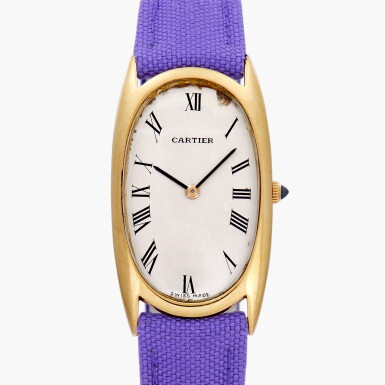
Made for Cartier New York: Forme d’Oeuf | A yellow gold oval wristwatch with original gold deployant buckle | Circa 1968
Auction Closed
May 10, 02:36 PM GMT
Estimate
5,000 - 8,000 CHF
Lot Details
Description
Dial: silvered dial signed Cartier, black stretched radial Roman numerals, blackened pointed baton hands
Movement: 9’’’ calibre 2003 movement signed Audemars Piguet, damascened Côtes de Genève decoration, 17 jewels, annular balance with poising screws, adjusted to heat, cold, isochronism and five positions, flat hairspring, US import code AYP
Movement number: 106’326
Case: 18k yellow gold, oval form with extended down-turned lugs, notched cabochon sapphire-set crown, satin finished snap-on case back numbered 48436, inside case back signed Audemars Piguet & Co. Swiss, poinçon de maître key 27, inside and outside case back with Swiss Helvetia head assay mark
Case number: 48’436
Closure: 18k gold deployant buckle, signed Cartier New York, numbered 15575 and stamped 18k
Size: 24 mm x 42.4 mm (width x length including lugs)
Box: no
Papers: no
Accessories: none
By the 1960s, Cartier had a long established relationship with Audemars Piguet and had retailed a number of different models by the company, including complication watches such as repeaters, calendars and chronographs. Audemars Piguet shared a similar design aesthetic to Cartier and were especially focused on the development of ultra-thin dress models. Like Cartier, Audemars Piguet also worked with LeCoultre for the supply of super-slim ébauches that could be used in dress watches.
The model shown here incorporates Audemars Piguet’s calibre 2003 which was developed by Maurice Audemars at LeCoultre in 1953. An extra slim movement, upon its release, it was the world’s thinnest manually wound movement. Measuring 20.8mm in diameter, its depth is a mere 1.64mm. A spectacular movement both in terms of its engineering and execution, by the late 1950s, the calibre 2003 was being incorporated into more than 75% of Audemars Piguet’s wristwatches. Indeed the movement was so successful that it would later form the basis of LeCoultre’s calibre 920, one of the most important automatic movements of the 20th century.
This watch is fitted with its original Cartier New York deployant buckle. A refined and historically significant timepiece, it offers a compelling glimpse into a period when collaboration, innovation, and elegance defined the very best of Swiss watchmaking.