
The Shapes of Cartier
Cartier, London
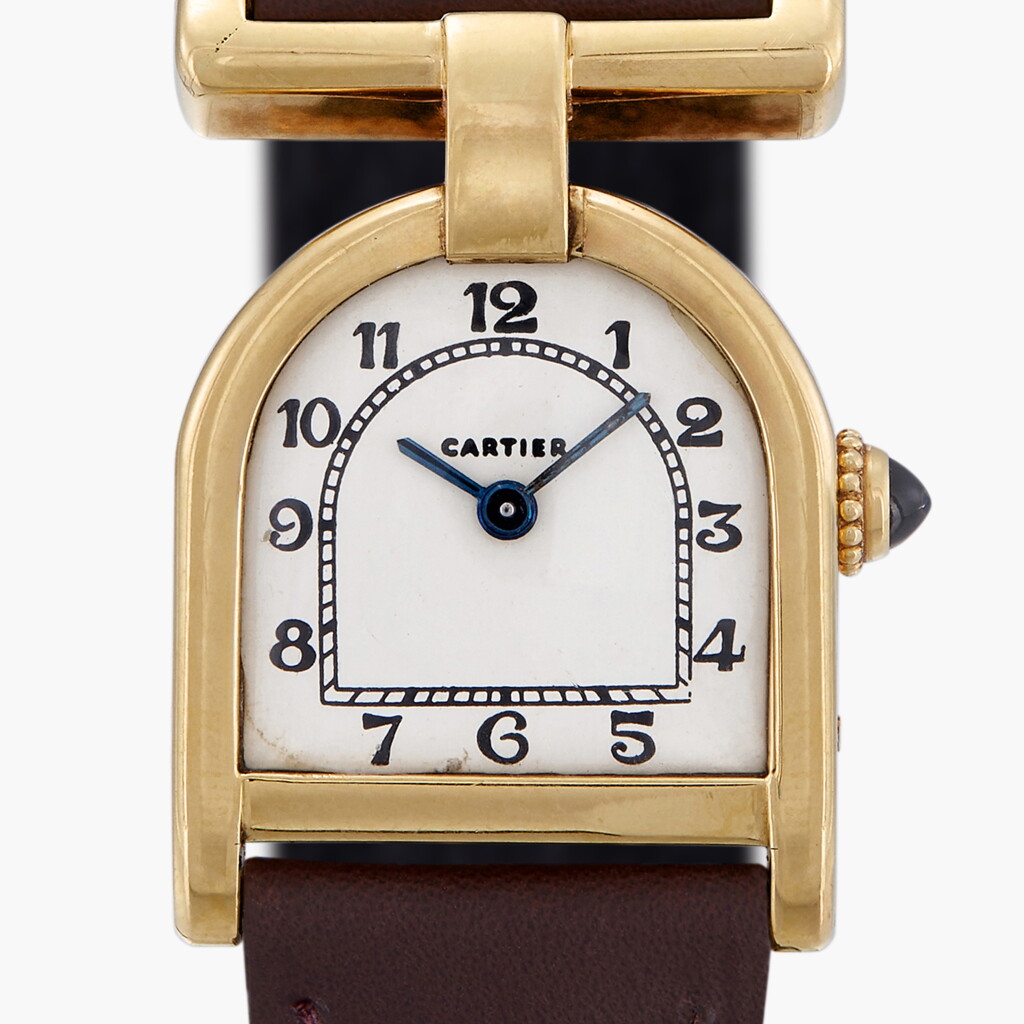
Stirrup | A yellow gold stirrup-form wristwatch with a gold deployant buckle | Made in 1976-77
Auction Closed
May 10, 02:36 PM GMT
Estimate
20,000 - 30,000 CHF
Lot Details
Description
Dial: white dial, Arabic numerals, inner arch-form chemin-de-fer minute track, blued steel hands
Calibre: 5¾’’’ oval calibre 841 movement signed Jaeger-LeCoultre, grained decoration, lever escapement, 17 jewels, annular balance
Movement number: 18
Case: 18k yellow gold polished stirrup-form case, the ‘eye’/stirrup loop forming the upper t-bar lug with screw-set bar, arch-form case body with screw-set lug bar to base, gold case back secured by 4 screws to case sides, beaded cabochon sapphire-set crown, inside case back with London hallmarks and date letter ‘B’ for 1976-77, [JC] Jean-Jacques Cartier punch mark
Case number: 1’906
Closure: 18k gold Cartier deployant clasp, London hallmarks with date letter ‘B’ for 1976-77, [JC] Jean-Jacques Cartier punch mark and hand-stamped numbering 1906
Size: 22 x 33.5 mm (width x length including lugs)
Box: no
Papers: no
Accessories: none
The Étrier (stirrup) model, also referred to as the Calandre, was introduced by Cartier in 1921 and took advantage of the growing interest in the fashionable sport of horse racing.
In the 1920s, horse racing was highly popular in Europe, particularly in the UK and France, where prestigious events like the Epsom Derby and Prix de l'Arc de Triomphe attracted large crowds. The sport benefitted from the economic prosperity and growing leisure culture of the “Roaring Twenties”. It was associated with social status and became a fashionable activity, drawing both elite and everyday spectators. Betting played a major role in its appeal, with wagering systems enhancing the excitement.
In the U.S., races like the Kentucky Derby and the Triple Crown series also gained prominence, with legendary horses such as Man o' War bringing international attention to American racing.
Hallmarked for 1976-77, this is one of the last wristwatches to be made in the Wright and Davies workshops. Watches made at Cartier in London were handmade in very small numbers and as the Étrier does not appear to have been a model in general production at the time, this watch may well have been a special order. Following the takeover of Cartier London in 1974, it appears that production of the iconic and unique London designs all but ceased, with production instead focusing on the traditional Cartier Paris designs.