
The Shapes of Cartier
Cartier, Paris
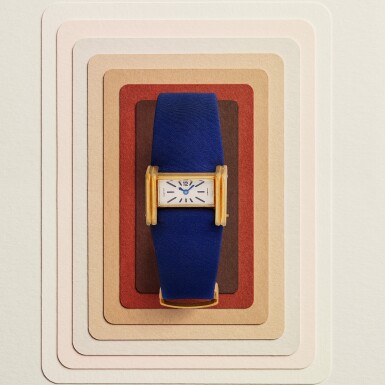
Driver | A very rare yellow gold triangular prism-form driver’s rear-wound wristwatch with gold deployant buckle | Circa 1945-46
Auction Closed
May 10, 02:36 PM GMT
Estimate
45,000 - 65,000 CHF
Lot Details
Description
Dial: cream dial signed Cartier France, stretched radial black baton hour indexes, Arabic 12 o’clock, blued steel épée hands
Calibre: 3 ¾’’’ calibre 24 baguette-form duoplan movement signed European Watch Co., grained decoration, lever escapement, 15 jewels, annular balance with poising screws, flat hairspring, unadjusted
Movement number: 35’191
Case: 18k yellow gold prism-form case the triangular case sides with curved bases and ridged upper edges, gold screw-set bar lugs, notched winding crown to case back, outside case back stamped Made in France and with rubbed French eagle’s head assay and Edmond Jaeger punch mark, eagle assay to side, outside case back and bezel interior each hand stamped 82122, soft metal movement cover numbered 35191
Case number: 82’122
Closure: 18k gold deployant buckle signed Cartier New York
Size: 24.5 x 18.5 mm (width x length including lugs)
Box: yes
Papers: no
Accessories: Copy of Cartier Insurance valuation dated 23 October 1997 and presentation box
George Gordon, Cartier - A Century of Cartier Wristwatches, Hong Kong: Timeless Elegance, 1989. See pp. 148-149, image no. 84 for a similar example of the model but with Roman numerals. See also op. cit. p. 460 image no. 174 for a black and white (possibly archival) photo of a similar watch.
The Pilote Baguette à cadres incliné, also known as a driver’s watch, represents one of the most unusual and inventive designs by Cartier. First introduced around 1936, during a period of remarkable innovation in watchmaking, it reflects a time when the wristwatch emerged as the primary focus of creativity despite the economic challenges following the Wall Street Crash. By the mid-1930s, wristwatch production had surpassed that of pocket watches, alongside the emergence of icons such as the Rolex Oyster Perpetual, Patek Philippe Calatrava, and Jaeger-LeCoultre Reverso.
Conceived for motorists, the model features a distinctive triangular prism-shaped case with an inclined dial, allowing the time to be read while keeping both hands on the wheel—an elegant fusion of practicality and design. Crafted in 18ct yellow gold and dating to circa 1945–46, the present example is further distinguished by its rare rear-wound configuration, preserving the purity of its geometric form, and is accompanied by its gold deployant buckle.
Produced only in very small numbers, with limited examples made in the 1930s and even fewer in the following decades, these driver’s watches remain exceptionally rare. The present watch stands as a striking testament to the ingenuity and experimental spirit that defined one of the most creative eras in 20th-century horology.