
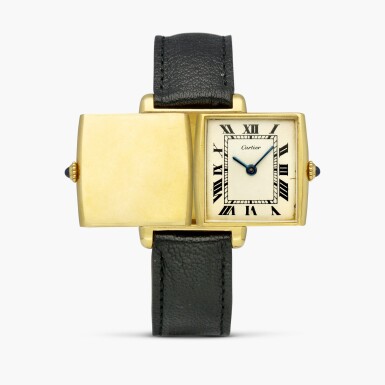
Cartier, London
Tank Reversible | A yellow gold rectangular reversible wristwatch with original gold deployant buckle, Circa 1972-73
Auction Closed
April 24, 04:23 PM GMT
Estimate
95,000 - 140,000 HKD
Lot Details
Description
Cartier, London
Tank Reversible
A yellow gold rectangular reversible wristwatch with original gold deployant buckle, Circa 1972-73
Dial: white dial signed Cartier, black stretched radial Roman numerals, inner chemin-de-fer minute track, blued steel épée hands
Calibre: 9¼’’’ circular calibre P838 movement signed Jaeger-LeCoultre, damascened Côtes de Genève decoration, lever escapement, jewelled to the centre, annular balance, flat hairspring, Kif Trior shock absorber
Movement number: 2'058'935
Case: 18k yellow gold, the tonneau-form inner case sliding within the gold outer case and reversing to a plain back, lugs with spring bars, beaded cabochon sapphire-set crown, sliding case interior with London hallmarks for 18k gold, date letter ‘r’ for 1972-73, [JC] Jean-Jacques Cartier punch mark, interior of outer case with hallmarks for 18k gold and [JC] stamp
Case number: back of outer case numbered 1'004
Closure: black unsigned leather strap and 18k gold deployant buckle with London hallmarks for 18k gold, date letter ‘r’ for 1972-73, [JC] Jean-Jacques Cartier punch mark, numbered 1'004
Size: 32 mm length x 23 mm width
Accessories: Cartier presentation box and travelling pouch
The Reverso case was developed by the designer René-Alfred Chauvot, who filed his patent in France under no. 712.868 on 4 March 1931. The patent application was described as being for: ‘[Une] Montre susceptible de coulisser dans son support et pouvant se retourner complètement sur elle-même’ – that is, a watch that could slide within a holder and turn completely upon itself. The French patent was granted on 14 October 1931, and the rights were purchased, before publication, by the Swiss businessman César de Trey. In November the same year, de Trey formed a marketing company with Jacques-David LeCoultre called Spécialités Horlogères in order to market the Reverso.
During the early years of the Reverso’s production, a small number of Reverso cases were sold to other companies, including Cartier, Patek Philippe and Vacheron Constantin. However, in 1934, Spécialités Horlogères was renamed the Société de Vente des Produits Jaeger-LeCoultre, and it was this firm that acquired the Reverso patent. The Reverso’s primary aim was to protect the glass of the watch, and from the outset the model was aimed at the sportsman. It is said that César de Trey had originally approached Chauvot to design a watch that could withstand the rough and tumble of a game of polo – de Trey had apparently seen a gap in the market when challenged to produce a shock-proof watch by a polo player whose watch glass had just been broken during a match. With its elegant, clean lines and rectangular shape, the watch’s design was perfectly suited to the Art Deco period. Reversing to a plain back, the watch also offered the tempting possibility for the buyer to personalise their watch with their own initials, their family crest or a unique decorative motif. Early advertisements for the model already showed examples with monochrome, enamel-decorated initials and monograms.
At the time this watch was produced, Cartier London was at the height of its most experimental era, creating distinctive and unconventional wristwatches. Yet, the firm also continued to offer a variety of classic models from its past. This particular model, typical of Cartier’s reversible wristwatch production, is an especially slender interpretation of the original LeCoultre Reverso concept, but in keeping with Cartier’s signature style of slim, elegant dress watches
François Chaille & Franco Cologni, The Cartier Collection: Timepieces, Paris: Flammarion, 2006. See p. 448 for a similar Cartier London reversible wristwatch dating to 1974.
Jader Barracca, Giampiero Negretti, Franco Nencini, Le Temps de Cartier, Milan: Publiprom, Second Edition, 1993. See p. 251 for a Cartier Paris example dated 1970.
卡地亞 倫敦
Tank Reversible
黃金長方形腕錶,備原裝金錶扣,約1972-73年製
附帶盒子及旅行袋子