
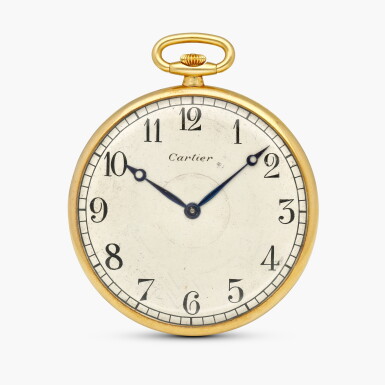
Cartier, New York
A slim yellow gold open-faced keyless lever dress watch, Circa 1913
No reserve
Auction Closed
April 24, 04:23 PM GMT
Estimate
32,000 - 48,000 HKD
Lot Details
Description
Cartier, New York
A slim yellow gold open-faced keyless lever dress watch, Circa 1913
Dial: silvered dial signed Cartier, black Arabic numerals, outer chemin-de fer minute ring
Calibre: 17’’’ movement signed European Watch and Clock Co. Inc., damascened Côtes de Genève decoration, lever escapement, 19 jewels, bi-metallic compensation balance with timing and poising screws, 8 adjustments, flat hairspring
Movement number: movement beneath dial with pearled finish and numbered 13'244, 5
Case: 18k yellow gold polished case, back centred with symmetrically arranged dark blue champlevé enamel monogram, pendant with oval bow
Case number: inside case back stamped 18k and numbered 216'856
Size: 45 mm diameter
Accessories: none
Without European assay marks, the case of this watch was almost certainly made in the United States under the direction of Cartier New York, while the movement was supplied via Cartier Paris and Edmond Jaeger. The case reflects the slim and elegant design aesthetic pioneered by Cartier in Paris, with refined proportions that result in a remarkably slender profile. The monogram on the case back is a bold, geometric design that skilfully interweaves the letters P, B, A, and a central W. The W acts as the structural framework, unifying the composition with its sharp, angular lines, while the vertical and diagonal elements create a striking sense of symmetry and balance. Rendered in deep blue, the monogram exudes a modernist aesthetic that anticipates the Art Deco style, combining precision, elegance, and visual impact. Such monograms were particularly fashionable in the United States during this period, where the growing wealthy elite embraced personalised designs as a mark of status, individuality, and refinement. Unlike Europe, where monograms often retained traditional, ornamental forms, American monograms of the 1910s reflected a shift towards sleek, modernist interpretations, aligning with the emerging design sensibilities of the Art Deco era.
卡地亞 紐約
黃金薄懷錶,約1913年製