Cartier
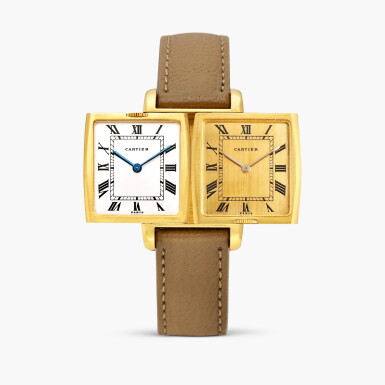
Reverso | A yellow gold reversible dual time wristwatch, Circa 1970
Session begins in
September 18, 03:00 AM GMT
Estimate
220,000 - 350,000 HKD
Lot Details
Description
Cartier
Reverso
A yellow gold reversible dual time wristwatch, Circa 1970
Dial: gilt; white
Calibre: mechanical, 18 jewels
Case: 18k yellow gold reversible
Case number: 032'511
Closure: beige brown unsigned leather strap and 18k yellow gold Cartier folding clasp
Size: 35 mm length x 23.5 mm width
Signed: case, dial and movement
Accessories: none
The present watch was gifted in the early 1970s by Shaikh Rashid bin Isa bin Salman Al Khalifa to Lewis Morland-Abrahams and has remained within the family ever since.
The Reverso case was developed by the designer René-Alfred Chauvot, who filed his patent in France under no. 712.868 on 4 March 1931. The patent application described a watch capable of sliding within its support and turning completely upon itself.
The French patent was granted on 14 October 1931, and the rights were purchased, before publication, by the Swiss businessman César de Trey. In November of the same year, de Trey formed a marketing company with Jacques-David LeCoultre called Spécialités Horlogères in order to market the Reverso.
During the early years of the Reverso’s production, cases were supplied to a number of other firms, including Cartier, Patek Philippe and Vacheron Constantin. In 1934, Spécialités Horlogères was renamed the Société de Vente des Produits Jaeger-LeCoultre, which acquired the Reverso patent. The Reverso was conceived primarily to protect the glass of the watch and, from the outset, was closely associated with sporting use.
It is said that César de Trey had originally sought a solution for a watch capable of withstanding the rigours of a game of polo, having reportedly been challenged by a polo player whose watch glass had been broken during play.
With its elegant, clean lines and rectangular form, the design was perfectly suited to the Art Deco period. When reversed, the watch presented a plain case back which could be personalised with initials, a family crest or a decorative motif. Early advertisements for the model already showed examples decorated with enamelled initials and monograms.
The reversing inner case also allowed for the introduction of a secondary dial on its back. Cartier took advantage of this possibility by the 1970s, producing versions with two dials, such as the present example: one on the front and one on the reverse of the revolving inner case, each powered by its own movement and set by an individual winding crown. The contrasting dials allow the two displays to be readily distinguished and the watch to indicate two independently set time zones.
The winding crowns are subtly recessed into the case so that only the crown corresponding to the visible dial is exposed at any given time. Although thicker than Cartier’s slimmer reversible wristwatch with a single dial, the addition of a second movement and dial increases the thickness by little more than 2.5 mm.
卡地亞 Reverso
黃金可翻轉兩地時間腕錶,約1970年製