
PROPERTY OF AN IMPORTANT COLLECTOR
Patek Philippe
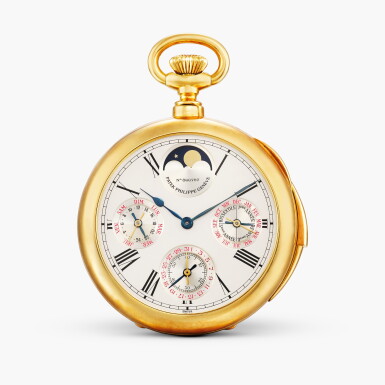
Reference 961 | A yellow gold minute repeating instantaneous perpetual calendar openface keyless chronometer watch with moon phases, 24 hour, leap year indication and Earnshaw-type spring detent escapement, Made in 1990
Auction Closed
September 19, 06:56 AM GMT
Estimate
1,600,000 - 3,200,000 HKD
Lot Details
Description
Patek Philippe
Reference 961
A yellow gold minute repeating instantaneous perpetual calendar openface keyless chronometer watch with moon phases, 24 hour, leap year indication and Earnshaw-type spring detent escapement, Made in 1990
Dial: silvered, Roman numerals, blued steel spade hands, four satin-finished silvered subsidiary dials indicating date with constant seconds, day in French combined with 24 hour indication, month in French combined with leap year indication, moon phases
Calibre: cal. 21''' RMDQ damascened nickel movement with Earnshaw-type spring detent escapement, 29 jewels, bi-metallic compensation balance, wolf's tooth winding, minute repeating on two steel gongs
Movement number: 866'797
Case: 18k yellow gold, hinged back to reveal transparent crystal dust cover
Case number: 2'837'630
Size: 58 mm diameter
Signed: case, dial and movement
Accessories: Patek Philippe Extract from the Archives confirming production in 1990 and sale on 13 December 1990 and presentation box
Introduced in 1989 to mark the brand's 150th anniversary, the Patek Philippe Reference 961 combines the most classic complications, a minute repeating and perpetual calendar. It is powered by the Cal. 21''' RMDQ movement, where "RM" stands for minute repeater, "D" for spring detent escapement, and "Q" for perpetual calendar. Its predecessor, the Cal. 21''' RMD, was based on the classic curved bridge layout designed by Victorin Piguet for Patek Philippe.
The project development began in 1985, and the movement made its debut at the Baselworld watch fair in 1986. It is the brand's only modern pocket watch movement to use a spring detent escapement, paired with a helical balance spring that enhances timekeeping precision while minimising mainspring energy loss and system wear. The strong bi-metallic balance wheel perfectly recaptures the features of Patek Philippe pocket watches from a century ago.
Apart from the Cal. 89, the Cal. 21''' is the largest modern pocket watch movement produced by the brand, with dimensions more commonly associated with a deck watch or small carriage clock. A larger size not only gives components greater durability but also allows ample room for the intricate chiming mechanism. The perpetual calendar also incorporates a leap year display and a 24 hour indicator. Hidden quick-set pushers on the case band enable adjustment of both the moon phases display and the entire perpetual calendar system, a design that Patek Philippe has retained from vintage pocket watches to the present day, avoiding calendar confusion caused by independent adjustments.
The silvered dial features sandblasted and matte finishing, giving the monochromatic dial a two-tone appearance and a strong sense of depth. The movement number printed on the moon phases disc at 12 o'clock is another traditional feature. As each handmade vintage perpetual calendar pocket watch has slight variations in the drilling of hand holes and corresponding apertures, every dial is individually fitted to its movement; to prevent mismatching, the movement number is printed on the dial. The 58 mm diameter case perfectly demonstrates the highest standards of Patek Philippe case-making craftsmanship during the 1990s.
According to our research, Cal. 21''' RMD and Cal. 21''' RMDQ movements were assigned movement numbers within the range 866'790 to 866'802. From 1985 to 1990, only two to three examples were produced annually, two of which are permanently preserved in the Patek Philippe Museum. In the nearly 30 years since 1989, only two Reference 961 examples have reappeared on the market.
百達翡麗
型號 961
黃金三問瞬跳萬年曆天文台懷錶,備月相、24小時及閏年顯示,Earnshaw式彈簧衝擊擒縱,1990年製
附帶後補資料庫精粹及盒子
型號961于1989年問世,時值品牌成立150年周年之際,融合了最經典的萬年曆與三問報時功能。搭載Cal.21’’’RMDQ機芯,其中RM代表三問報時,D代表衝擊式擒縱,Q則為萬年曆。其原型為Cal.21’’’RMD,借鑒了Victorin Piguet為百達翡麗設計的經典弧形板路,研發始於1985年,於1986年瑞士巴塞爾鐘錶博覽會首次面世,是品牌唯一使用衝擊式擒縱的現代懷錶機芯,搭配桶狀遊絲,在走時精度提高的同時,亦將發條的能量損耗與系統磨損降至最低,粗壯的雙金屬擺輪則完美地複刻了百年前百達翡麗懷錶的風貌。除Cal.89外,Cal.21’’’是尺寸最大的現代懷錶機芯,嚴格上已屬於甲板錶或小型臺鐘的尺寸。更大尺寸不僅讓零件擁有更好的耐用度,大空間也可以合理佈局複雜的報時元件。萬年曆增加了閏年顯示與24小時顯示。錶殼側面的隱藏式快調分別對應月相與整套萬年曆系統,從古董懷錶至今,百達翡麗一直沿用該設計,避免了因獨立調節帶來的曆法混亂。銀質錶盤借助噴砂與亞光工藝,使單色錶盤呈現出雙色調效果,頗具立體感。印在12點月相盤中的機芯編號,亦是傳統設計之一,手工製作的古董懷錶每一枚萬年曆針孔都有些許差別,因此其對應的每一張錶盤都是量身製作,為了防止混淆,機芯編號被印在了錶盤之上。直徑58毫米的錶殼完美呈現了90年代百達翡麗最高品質的製殼工藝。
根據已知的資訊,Cal.21’’’RMD或Cal.21’’’RMDQ均包含在機芯編號866‘790至866‘802的範圍中,從1985年至1990年,每年僅製作2至3枚,其中兩枚已被永久收藏於百達翡麗博物館。自1989年至今的近30年間,僅兩枚型號961重新回到市場。