
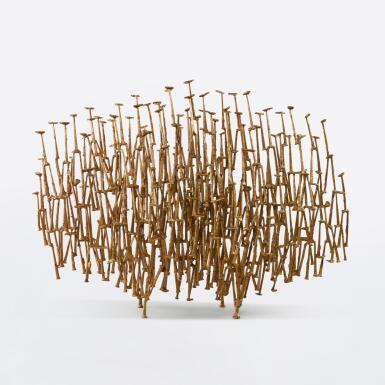
Property from an Important Private Collection, United States
Harry Bertoia
Untitled (Screen)
Auction Closed
June 11, 05:50 PM GMT
Estimate
150,000 - 200,000 USD
Lot Details
Description
Property from an Important Private Collection, United States
Harry Bertoia
Untitled (Screen)
1957
brass-coated steel
34 x 46 ½ x 7 ¼ in. (86.3 x 117 x 18 cm)
Fairweather Hardin Gallery, Chicago
Stanley Marcus, Dallas, Texas, 1958
Sotheby’s New York, A Passion For Collecting: The Eye Of Stanley Marcus, November 16, 2002, lot 115
Private Collection, Paradise Valley, Arizona
Christie's New York, July 31, 2020, lot 15
Acquired from the above by the present owner
Irons in the Fire: An Exhibition of Metal Sculpture, Contemporary Arts Association, Houston, October 14–December 1, 1957
This lot is included in the Harry Bertoia Catalogue Raisonné and assigned the catalogue raisonné number S.NF.6.
Harry Bertoia’s sculptural practice transformed in the late 1950s, shifting from the architectonic rigor of his earliest wire constructions toward the more organic, atmospheric forms that would define his mature work. During this decade, he developed a distinctive vocabulary of linear metal elements organized within geometric frameworks. Often described as “screens,” these works embodied modernist ideals of structure, transparency, and spatial order, reflecting his deep engagement with architecture, design, and engineering.
Created at a pivotal point in this evolution, the present work bridges Bertoia’s early structural investigations and the increasingly natural forms that emerged in the early 1960s. While it retains the commanding presence and formal discipline of the screen sculptures, it also shows a growing interest in natural growth patterns and expansive spatial relationships. Elements radiate and proliferate from a central framework, anticipating the botanical imagery soon expressed in his celebrated *Bush*, *Tree*, and *Dandelion* sculptures.
Beyond formal innovation, this period broadened Bertoia’s intellectual concerns. Building on questions that followed Cubism and Futurism about form, movement, space, and time—and encouraged by his friendship with visionary thinker Buckminster Fuller—Bertoia began to conceive sculpture not simply as an object, but as a means of visualizing larger universal forces. Space itself became active, with the intervals between metal elements taking on as much importance as the structure they defined.
In the present work, mass and void exist in dynamic equilibrium. A dense metallic framework anchors the sculpture physically, while its open construction projects outward into the surrounding environment, creating an impression of expansion that extends beyond measurable dimensions. Grounded yet seemingly infinite, the work engages viewers in a constantly shifting dialogue between object and atmosphere.
Executed before Bertoia fully embraced the ethereal copper-wire constructions of the early 1960s, it keeps the visual weight and tactile presence of his earlier sculptures while foreshadowing the dematerialization of his mature practice—making it a rare synthesis of solidity and transparency. As one of the finest examples of this transitional moment, it captures the instant when Bertoia’s language expanded from structure into spatial experience.