Property from a Private European Collection
Edgar Brandt
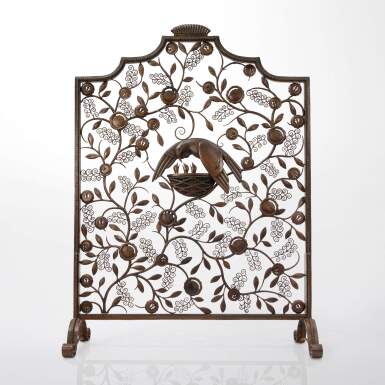
"Le Nid" Firescreen
Auction Closed
June 11, 05:50 PM GMT
Estimate
180,000 - 240,000 USD
Lot Details
Description
Property from a Private European Collection
Edgar Brandt
"Le Nid" Firescreen
circa 1925
patinated wrought-iron
40 x 29 x 10 ½ in. (101.6 x 73.7 x 26.7 cm)
Christie’s New York, April 1, 1995, lot 148
Acquired from the above by the present owner
Henri Clouzot, La Ferronnerie Moderne, Paris, 1925, p. 5, no. 2 (for a related example)
Joan Kahr, Edgar Brandt: Master of Art Deco Ironwork, New York, 1999, p. 142 (for the present lot illustrated)
Joan Kahr, Edgar Brandt: Art Deco Iron Work, New York, 2010, p. 124 (for the present lot illustrated)
Sotheby’s would like to thank Joan Kahr for her assistance with the cataloguing of this lot.
A master of harmoniously marrying ironwork with poetic and naturalistic themes, Edgar Brandt remains one of the most accomplished metalworkers of the twentieth century.
Exhibited at the groundbreaking 1925 Parisian Exposition Internationale des Arts Décoratifs et Industriels Modernes, the present “Le Nid” (The Nest) fire screen is a masterpiece in its treatment of animalistic motifs and innovative technique. “Le Nid” displays a mother bird hovering over her three chicks in their nest, enveloped by stylized roses, buds, and leaves. Borrowing from the undulating and organic lines of Art Nouveau, the screen’s iron swirls and leaves are softened from the traditional whiplash curves, and there is a hint of the modernism to come in the execution of the complex shapes.
These delicate details are an example of a vital modern aspect of Brandt’s ironwork technique, the utilization of the newly designed oxyacetylene blowtorch, allowing various petite ironwork elements to easily be soldered at minute points. The 1925 Exposition reestablished Paris as the design capital of the world, with “Le Nid” positioned as a focal point of Brandt’s presentation, which solidified his reputation as a master ironworker. The artist’s display featured a number of exceptional new pieces highlighting his mastery over technique as well as his skills as a visionary craftsman.
The fire screen’s illustrious history is further enhanced through its inclusion in a 1926 exhibition at the Musée du Louvre in Paris on the American Cheney Brother silk company. The motif was also extended into a larger vignette for a door in 1927, attesting to its popularity. “Le Nid” now figures amongst Edgar Brandt’s most iconic forms and motifs. This scarce work, the very example illustrated in the seminal monograph of the designer, has been held in the same private European collection for over thirty years.
You May Also Like