
From Royère to Lalanne: Property from a Private New York Collection
Jean-Michel Frank
Cabinet
Auction Closed
June 11, 05:50 PM GMT
Estimate
200,000 - 300,000 USD
Lot Details
Description
From Royère to Lalanne: Property from a Private New York Collection
Jean-Michel Frank
Cabinet
circa 1930
executed by Chanaux & Co., Paris
parchment over wood, sycamore, silvered metal
stamped twice J.M. FRANK, MADE IN FRANCE and CCIE, and numbered 14562
47 ⅜ x 35 ½ x 13 ⅜ in. (120.3 x 90.2 x 34 cm)
Galerie L'Arc en Seine, Paris
Acquired from the above by the present owner, 2021
Léopold Diego Sanchez, Jean-Michel Frank, Paris, 1980, p. 167
Léopold Diego Sanchez, Jean-Michel Frank, Paris, 1997, p. 173
Pierre-Emmanuel Martin-Vivier, Jean-Michel Frank, l'étrange luxe du rien, Paris, 2006, p. 279 (for a related example)
Jean-Michel Frank, Un décorateur dans le Paris des années 30, exh. cat., Fondation Pierre Bergé-Yves Saint Laurent, Paris, 2009, p. 97 (for a related example)
This lot is offered together with a certificate of authenticity from the Comité Jean-Michel Frank.
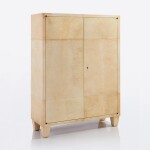
Created around 1930 through the joint efforts of Jean-Michel Frank and Adolphe Chanaux, this two-door cabinet stands as a prime example of their celebrated partnership during the early twentieth century. Their collaboration began in 1929, when Frank brought Chanaux on to craft the furnishings for his personal apartment — a working relationship that would deepen and evolve over the next ten years. Drawing on the storied French tradition of marrying exceptional craftsmanship with luxury, the two assembled a distinguished team that included cabinetmakers trained in classical methods, Boulle-trained draftsmen, and artisans skilled in vellum and shagreen. Their studio thrived on the strength of both Frank’s boldly modern aesthetic and an unwavering commitment to quality. Among their innovations were a series of novel surface techniques: sandblasting wood to produce textured grooves, introducing ceruse and lead carbonate to shift the wood’s tone, and applying thin layers of material in carefully considered patterns to finish furniture, panels, and walls. By 1933, demand for their work had grown sufficiently to open a gallery at 140 Rue du Faubourg Saint-Honoré, where they also forged creative alliances with artists including Alberto and Diego Giacometti. Their practice continued to serve a sophisticated and discerning clientele until World War II forced both men into exile and brought their partnership to a close.
While Frank produced case pieces — cabinets, wardrobes, and related forms — across a wide range of sizes, proportions, and materials, a quiet visual unity runs through all of them. Stripped back to their essential geometry, the pieces feel deliberate and resolved. This particular cabinet, expertly constructed from sycamore and finished with a richly textured parchment surface, represents the duo’s craft at its most accomplished. The carefully placed seams in the parchment echo the cabinet’s architectural lines, while the material’s subtle tonal shifts lend it an air of quiet opulence. Taken together, the piece is both a measure of Frank’s refined design sensibility and a testament to what he and Chanaux were capable of producing in concert.
You May Also Like