
Thomas Alva Edison
Thomas Edison Reveals His Finances in Letter
Auction Closed
July 15, 07:23 PM GMT
Estimate
6,000 - 9,000 USD
Lot Details
Description
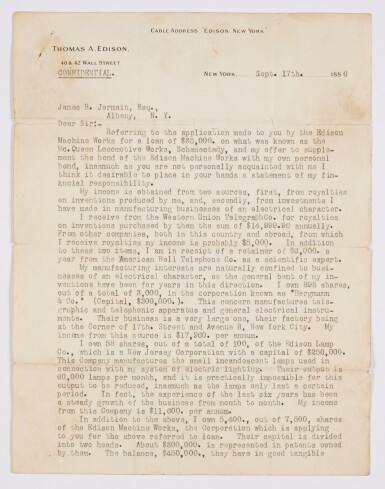
THOMAS EDISON. Typed Letter Signed (“Thomas A. Edison”) and with Autograph Postcript Initialed (“T.A.E.”), New York, September 17, 1886, 3 pp, to James B. Jermain, on Edison 40 & 42 Wall Street letterhead; fold creases with some separation, light stains, toned.
EDISON AND THE ORIGINS OF GENERAL ELECTRIC.
The Edison Machine Works New York City factory had been subject to multiple issues – from striking and unionizing workers to overcrowded conditions. A new location was found in Schenectady, NY: The McQueen Locomotive Works factory complex was midway through construction when the financial backing fell through. It was a perfect opportunity to acquire 12-acre site below market rate and Edison arranged for a personal loan from Drexel, Morgan & Co, which he then loaned the Edison Machine Works. The present letter to James Barlay Jermain (1809-1893), one of the wealthiest men in America at the time, petitions for a loan to pay the likely high-interest Drexel, Morgan & Co loan. Edison and Jermain were, apparently, not acquainted and the former provides a detailed financial record including a list of the companies in which he has shares and their values, his factories, the nature of each business, his income and even Orange, NJ house and other real estate values are provided in the postscript.
He concludes his list: “I have spoke thus candidly of my position because I am anxious that any one doing business with me, more especially in the way of accepting my obligation, should know exactly how I stand. / Should you decide to consider the application of the Edison Machine Works favorably, if you find it convenient to make the amount $45,000. instead of $35,000., we should very much prefer the latter amount.” Of course the latter amount would have covered the full loan amount.
Edison’s finances were in constant turmoil throughout much of his life. It was only later in life that he was an actual millionaire. He reinvested most of his money into new ventures and often he could barely make household expenses. Henry Ford is attributed as calling Edison “the world’s greatest inventor and the world’s worst business man.” Edison had been in the midst of a battle between his chosen direct current method of distributing electricity and alternate current, the format used by rival Westinghouse. It was a battle that he lost – AC power is still currently the standard – and led to his diminishing interest in the field. His top stockholders, who had been arguing to also incorporate AC power, moved to consolidate several of the power-related business and merge with rival Thomson-Houston. Edison had been slowly cashing out of the power business and by the time of the merger in 1892, his name was even taken out of the new company name: from Edison General Electric to General Electric Company. The new company would headquarter in Schenectady and become one of the most dominant American businesses.