Phantom Photographic Unit
Camera Prototype by Noel Pemberton Billing
No reserve
Auction Closed
July 15, 07:23 PM GMT
Estimate
30,000 - 50,000 USD
Lot Details
Description
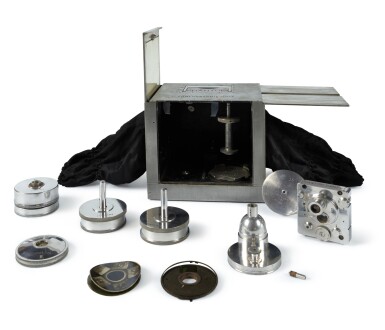
Polished aluminum camera, ca. 1948, engraved “PHANTOM CAMERA,” measuring 3.75 x .75 (2 inches with lens extended) x 3.25 inches, with letters painted in red on the top. Camera features built-in and labeled rangefinder, extinction light meter, shutter-setting wheel, and bulb and rear buttons marked “TIME.” The lens is on a rotating mount. Two numbered dials on recto notated with small engraved arrows.
Enclosed in custom metal case with pivot carrying handle measuring 8.4 x 8.9 x 6.9 inches. “PHANTOM PHOTOGRAPHIC UNIT” engraved and painted in red on the outside of the metal case. Includes two removable metal panels: one side panel extends to lock into an open position to be used as a copy board with internal cover glass; the other can be removed completely and includes a track for camera mounting bracket. Elastic black-cloth arm covers inside the metal case. Front panel with engraved instruction: “PRESS CENTRE.” A custom metal mounting bracket for the camera is inside, labeled S.
Processing equipment includes a developing tank with exit drain, engraved "D Developing Tank;" segment engraved "P CONTACT PRINTS AND POSITIVES; two containers, engraved "Q PAPER HOLDER" and "F FILM HOLDER" respectively; two chemical tanks, engraved "H FIXING" and "G DEVELOPER."
Accompanied by three 3 inch (75 mm) diameter film discs with what seem to be interior shots, and two photographs developed on postcard. With black Hakuba metal carrying case measuring 17 x 9.25 x 12.5 inches.
Purchased from A. J. Rollason, 1 February 1980, by a British private collector and thence to his widow, the vendor; Lot 454 in Christies Auction 9002 “Cameras and Photographic Equipment” 16 January 2001.
A ONE-OF-A-KIND INSTALLMENT IN THE HISTORY OF SPY CAMERAS
Designed by controversial inventor, aviator, entrepreneur, and politician Noel Pemberton Billing shortly before his death in 1948, the Phantom Photographic Unit exists as a prototype but was never mass produced.
Like its predecessor the Compass, the Phantom Photographic Unit was meant for clandestine operatives with the added proposed benefit of a portable dark room and developing lab.
Launched in 1937, the Compass was a camera small enough to fit in a pack of cigarettes. Its small size, complexity, and precision required its manufacture by Swiss watch company LeCoultre & Cie. While the Compass remains an engineering marvel, its complexity ensured it was not feasible to use in the field. It is estimated that 4,000 Compass cameras were made before production was halted due to the outbreak of World War II.
The present lot represents an inventor’s attempt to solve for the logistical challenges of clandestine photography by including the capability to develop film on the spot. The compact Photographic Unit includes the camera and components to develop the film with sliding side panels that can also serve as a camera stand. The prototype also made use of disc film, which was not popularized until decades later by Eastman Kodak in the 80’s.
Unlike its predecessor, the Phantom Photographic Unit never advanced beyond prototype.
Noel Pemberton Billing (1880-1948) is perhaps most known for his political career and fanning the flames of spy hysteria during the Second World War. A colorful eccentric, he was also a strong advocate for aviation in the UK and was issued over 500 patents over the course of his lifetime. His interest in national security primarily rested in air defense rather than clandestine operations. In 1913, he acquired the capital to establish his own aviation company through a bet in which he wagered aviation pioneer Frederick Handley Page £500 he could get a pilot’s license within a day of first flying an aircraft. Pemberton Billing won the bet and used the proceeds to establish the company Supermarine that same year. Decades later, after Pemberton Billing sold the company, Supermarine would make aviation history with the legendary Spitfire aircraft.