
Cartier
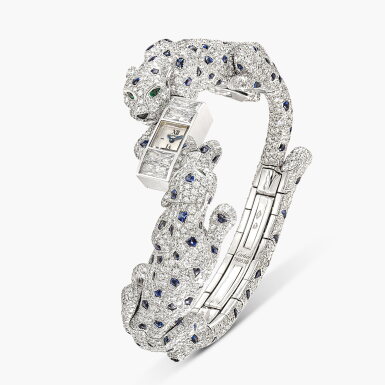
Diamond, Sapphire, Emerald and Onyx ‘Baby Panthère Riviera’ Wristwatch | 卡地亞 | 鑽石 配 藍寶石 配 祖母綠 及 縞瑪瑙 ‘Baby Panthère Riviera’ 腕錶
Auction Closed
September 17, 11:55 AM GMT
Estimate
1,800,000 - 2,800,000 HKD
Lot Details
Description
The rectangular dial set throughout with brilliant-cut and rectangular diamonds, emeralds and carved sapphires and onyx buff top, 18 karat white gold, manual movement, signed Cartier, numbered, French and Swiss assay marks, maker’s mark.
Approximate Gross Weight: 99 grams
Approximate Inner Circumference: 160mm
Certificate of Authenticity from Cartier
Among Cartier’s most enduring and recognizable motifs is the panther. The animal entered Cartier’s design vocabulary in 1914, when the maison evoked the feline through the abstract pattern of its spotted coat on a wristwatch. That same year, Cartier commissioned illustrator George Barbier to create Dame à la Panthère, depicting an elegant woman accompanied by the animal; the image was subsequently used in the maison’s advertising. The motif took on a more personal significance through Jeanne Toussaint (1887-1976), appointed as the firm’s director of haute joaillerie in 1933, whose fascination with the panther would shape its enduring place within the firm’s aesthetic repertoire.
The panther’s appearance quickly evolved from an abstract pattern to more fully realized forms. In 1917, Louis Cartier gifted Toussaint an onyx cigarette case featuring the first known figural representation of a panther. As Toussaint’s influence within Cartier grew, so too did the presence of the feline in the maison’s jewels and objects. Toussaint’s vision was further developed in collaboration with designer Pierre Lemarchand, who studied panthers at the Paris Zoo at Vincennes on his lunch breaks, observing their anatomy, expressions and movement. Together, they developed an increasingly sculptural interpretation of the panther, leading to the creation of the first three-dimensional jewels. In 1948, Toussaint designed a gold and black enamel panther poised upon a 116.74 carat cabochon emerald, commissioned by the Duke of Windsor for his wife. The next year, the Duchess acquired a second panther, this time in platinum and sapphires, crouching upon a 152.35 carat cabochon sapphire. This was followed by a spectacular fully articulated diamond and onyx bracelet acquired in 1952 which, when it appeared at Sotheby’s London in 2010, achieved the highest price ever achieved for a bracelet at auction.
These celebrated commissions launched the panther as one of most recognizable and desirable motifs in the world of jewelry. Over the past century, the great cat has been continually reimagined, with each jewel retaining the distinctive character and allure of Toussaint’s original creations.
美洲豹(Panther)是卡地亞(Cartier)最歷久彌新且具代表性的經典意象之一。這隻靈動的猛獸於 1914 年首次進入卡地亞的設計語彙中,當時該世家在一隻手錶上以斑駁的豹紋抽象圖案來呈現象徵意象。同年,卡地亞委託插畫家喬治·巴比耶(George Barbier)創作了《淑女與美洲豹》(Dame à la Panthère),畫中描繪一位優雅女性與美洲豹相伴;該影像隨後被用於世家的廣告之中。
1933 年,貞·杜桑(Jeanne Toussaint,1887–1976)獲任命為品牌的高級珠寶總監,美洲豹意象進一步賦予了更具個人色彩的深遠意義。她對美洲豹的沉醉,形塑了該圖騰在卡地亞美學寶庫中永恆不朽的地位。
美洲豹的形象迅速從抽象圖案演變為更加具象生動的型態。1917 年,路易·卡地亞(Louis Cartier)贈送給杜桑一個黑瑪瑙煙盒,上面帶有已知首個具象化呈現的美洲豹圖樣。隨著杜桑在卡地亞內部的影響力日益提升,這隻靈貓在世家珠寶與器物中的身影也愈發鮮明。
1948 年,杜桑應溫莎公爵(Duke of Windsor)之請為其夫人設計了一款作品:一隻黃金與黑色漆面美洲豹雄踞於一顆 116.74 克拉的糖塔山切面(cabochon)祖母綠之上。次年,公爵夫人又購入了第二隻美洲豹作品,這次則以鉑金與藍寶石打造,盤踞於一顆 152.35 克拉的糖塔山切面藍寶石之上。
隨後於 1952 年,公爵夫人再度入手一款令人驚嘆的全關節可動鑽石配黑瑪瑙美洲豹手鍊。該手鍊於 2010 年在倫敦蘇富比拍賣會上亮相時,創下了當時手鍊拍賣史上的最高成交價紀錄。
這些馳名遠播的委託訂製作品,奠定了美洲豹作為珠寶界最知名且最令人嚮往的經典意象之一。在過去的一個世紀裡,這隻靈動的大型貓科動物不斷被賦予全新的演繹,而每一件珠寶依然保留著杜桑原創作品中特有的獨特個性與沉醉魅力。