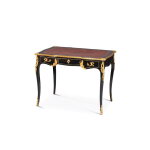
A pair of Italian gilt-bronze-mounted tulipwood and rosewood commodes, probably Sicily, mid-18th century
Lot Closed
September 17, 01:36 PM GMT
Estimate
3,000 - 5,000 EUR
We may charge or debit your saved payment method subject to the terms set out in our Conditions of Business for Buyers.
Read more.Lot Details
Description
opening with three drawers, on cabriole legs
80cm high, 51cm wide, 30cm deep; 31 ½ in., 20in., 11 ¾ in.
Please note that this lot contains endangered or restricted species. Sotheby's may not be able to assist Buyers with the shipment of lots containing such materials. Bidders are advised to make their own enquiries to determine what requirements apply to a given lot before bidding. A Buyer’s inability or delay in obtaining an export or import licence or permit, where required, will not be a legitimate basis for sale cancellation or a delay in payment.
Bibliographie comparative :
M. Giarrizzo, A. Rotolo, Mobili e Mobilieri nella Sicilia del Settecento, Palermo, 1992, p.76.
M. Giarrizzo, Il mobile siciliano : dal barocco al liberty, 2004, fig 61, 62 et 72 p 58 à 63
This pair of commodes is characteristic of Sicilian cabinet-making from the middle of the 18th century, particularly in its form. We can find some similar examples illustrated by M. Giarrizzo and A. Rotolo, in Il mobile siciliano : dal barocco al liberty, fig. 61 et 62, p 58. The use of some similar bronzes can also be found on the commode (op.cit fig 72, p 63).