
Property from the Estate of Bryan P. Hiler, Indiana
Breguet
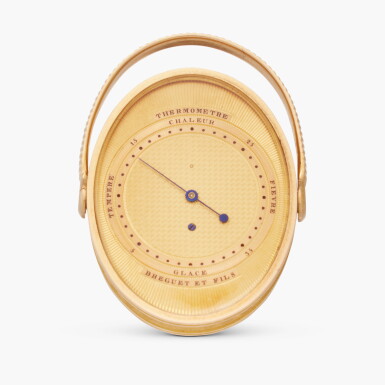
No. 2119 | A very rare yellow gold oval ring thermometer, Sold by Moreau of La Maison Russie to Count Potocki on 1 May 1810
Lot Closed
June 17, 04:08 PM GMT
Estimate
6,000 - 12,000 USD
We may charge or debit your saved payment method subject to the terms set out in our Conditions of Business for Buyers.
Read more.Lot Details
Description
Dial: gold with contrasting engine turning by Tavernier - radial to the outer edges and cross hatched to the centre, slim blued steel hand indicating to a satin finished ring, the cardinal points marked Chaleur, Fievre, Glace, Tempéré, banner to the base signed Breguet et fils
Mechanism: gilded, circular bi-metallic strip operating rack and pinion system
Case: gold oval, polished bezels, decoratively engraved band, glazed back, milled shank
Size: 29 x 22mm, ring size 7
Box: no
Papers: no
Accessories: Breguet Extract from the Archives confirming the sale of the present lot by Moreau of La Maison Russie to Count Potocki on 1 May 1810
Comte Potocki
Antiquorum Geneva, The Art of Breguet, 14 April 1991, lot 43
Breguet, E. , Breguet, Paris 1997, pp. 263
The accompanying Breguet certificate notes that the present ring thermometer was sold for FF 336 by Moreau of La Maison Russie to Count Potocki to whom Moreau had been introduced by Count Ozarovsky.
Count Stanislas Kostka Potocki (1755-1821) was born in Lublin in Poland and married Princess Aleksandra Lubomirska (1760-1836), the daughter of Stanislaw Lubomirski, a Grand Marshall of the Crown, in 1776. Count Potocki held the Knighthood of the White Eagle and Saint Stanislaus Merits and was Great Master of the Polish Freemasons. He founded the University of Warsaw in 1816 and was elected President of the Senate in 1818. He devoted his fortune to promoting literature, sciences and the arts. He built up a beautiful collection of paintings, Etruscan vases and engravings in his Wilanów castle near Warsaw which he put on view to the public in a portion of the castle, making it one of Poland’s earliest museums. In addition to the present lot, Count Potocki also owned Breguet no. 1176, a four-minute tourbillon, which was purchased a year prior to this ring thermometer.
Breguet devoted considerable time to developing the thermometer. The present ring thermometer's indicating hand is attached to the arbor of a pinion which engages with two brass racks. A bi-metallic strip in the form of a double ring is connected to one of the brass racks. A rise in temperature causes the bi-metallic strip to curl inwards, with a fall in temperature the strip uncurls. This action moves the rack back and forth thereby causing the indication hand to move along the dial's scale. The second brass rack ensures that there is no backlash in the pinion teeth. A similar thermometer ring, numbered 2484, is illustrated in G. Daniels, The Art of Breguet, 1975, p.216, figs. 222a-c. For further information on Breguet's thermometers see op. cit. p.91 and E. Breguet, Breguet, p. 262.