
Auguste-Germain Cadet-Picard | Gustave Trouvé
Gold, Enamel and Diamond Skull Stickpin
No reserve
Lot Closed
June 3, 02:20 PM GMT
Estimate
3,000 - 5,000 GBP
We may charge or debit your saved payment method subject to the terms set out in our Conditions of Business for Buyers.
Read more.Lot Details
Description
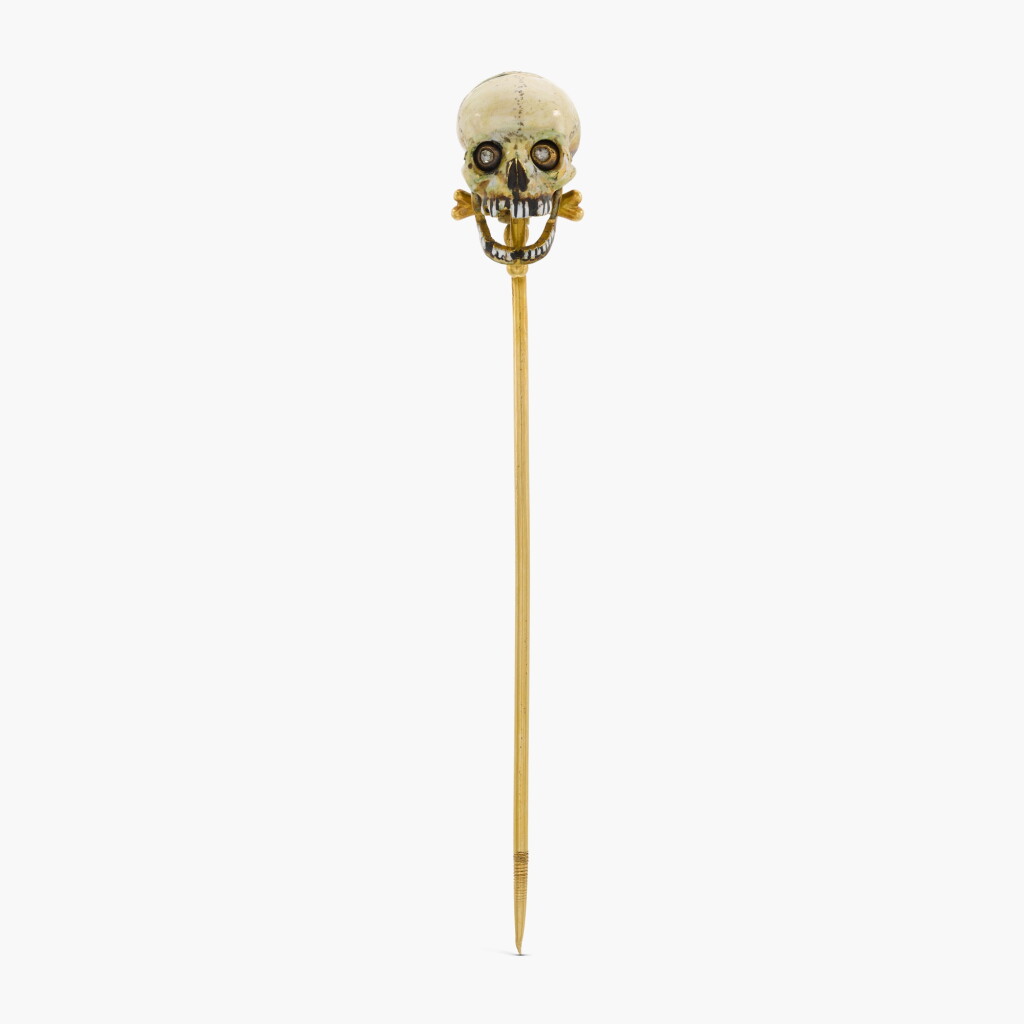
A naturalistically modelled skull terminal enamelled in graduated tones of cream, brown, and black, with hinged lower jaw and rolling rose-cut diamond eyes, mounted on a gold bone.
- Length approximately 93mm
- Maker's mark
- French assay mark for 18-carat gold
- Circa 1870
- Gross weight approximately 9.0 grams
V&A Collection no.M.121-1984, a stick pin of similar design.
Georges Barral, The Story of an Inventor, France, 1891, for illustrations on the mechanics of the stickpins.
Henri Vever, French Jewellery of the 19th Century, translated by Katherine Purcell, London, 2001, pp. 779–780, for Henri Vever's description of a similar skull stick pin
Clare Phillips, Jewels and Jewellery V&A Publications, 2000, p. 91
Charlotte Gere and Judy Rudoe, Jewellery in the Age of Queen Victoria, London, 2010, pp. 210–211
Kevin Desmond, Gustave Trouvé, French Electrical Genius (1839–1909) London, 2015
This skull stickpin represents a rare survivor from an extraordinary group of animated novelty jewels devised by Gustave Trouvé and realised in collaboration with the Parisian jeweller Auguste-Germain Cadet-Picard. Trouvé, an inventive and highly accomplished experimenter, was renowned for his pioneering applications of portable electricity and for his ingenuity with miniature electromechanics. In 1865, at the age of twenty-eight, he patented a compact “pile lilliputienne portée sur soi” (“wearable Lilliputian battery”), described as inexhaustible. This pocket-sized power source enabled the production of a series of mechanically animated stickpins, in partnership with Cadet-Picard.
The repertoire of designs was both whimsical and technically ambitious. Subjects included a drummer in uniform, a violin-playing monkey, a rabbit beating a tiny drum, an electro-spherical doorbell, Harlequin and Columbine performing a ballet, a monkey in spectacles grimacing, a hummingbird in flight, a fluttering butterfly, and a skull like this example whose eyes rotated and whose jaw snapped shut in a macabre display. When secured to a gentleman’s cravat, the jewel was connected by a fine, nearly imperceptible wire to a sealed battery concealed within the breast pocket. Activation was achieved discreetly by tilting the battery, allowing the wearer to animate the device and astonish observers with its unexpected movement.
These electromechanical ornaments were exhibited to considerable acclaim at the Exposition Universelle. The distinguished jeweller and historian Henri Vever later characterised them as “jewels of near-terrifying originality,” a phrase that captures both their technical audacity and their theatrical effect. In 1879, they were the subject of a detailed illustrated article in the French scientific periodical La Nature. Given the precision engineering required for their manufacture, production appears to have been extremely limited; by 1891, such pieces were already regarded as desirable collectors’ items.
An almost identical skull stickpin is preserved in the jewellery collection of the Victoria and Albert Museum, London (museum no. M.121-1984). Comparable examples have appeared on the art market, including one sold at Sotheby's, London, in the “Jewels” sale of 16 December 2003 (lot 106), and another variant—depicting a skull smoking a cigar and wearing an emerald monocle—offered at Phillips, London, in the “Fine Jewellery” auction of 27 March 1990 (lot 14).