Property from The Schlumberger Collection
Smith, Adam | First edition of the "first and greatest classic of modern economic thought"
Lot Closed
June 25, 07:31 PM GMT
Estimate
40,000 - 60,000 USD
We may charge or debit your saved payment method subject to the terms set out in our Conditions of Business for Buyers.
Read more.Lot Details
Description
Smith, Adam
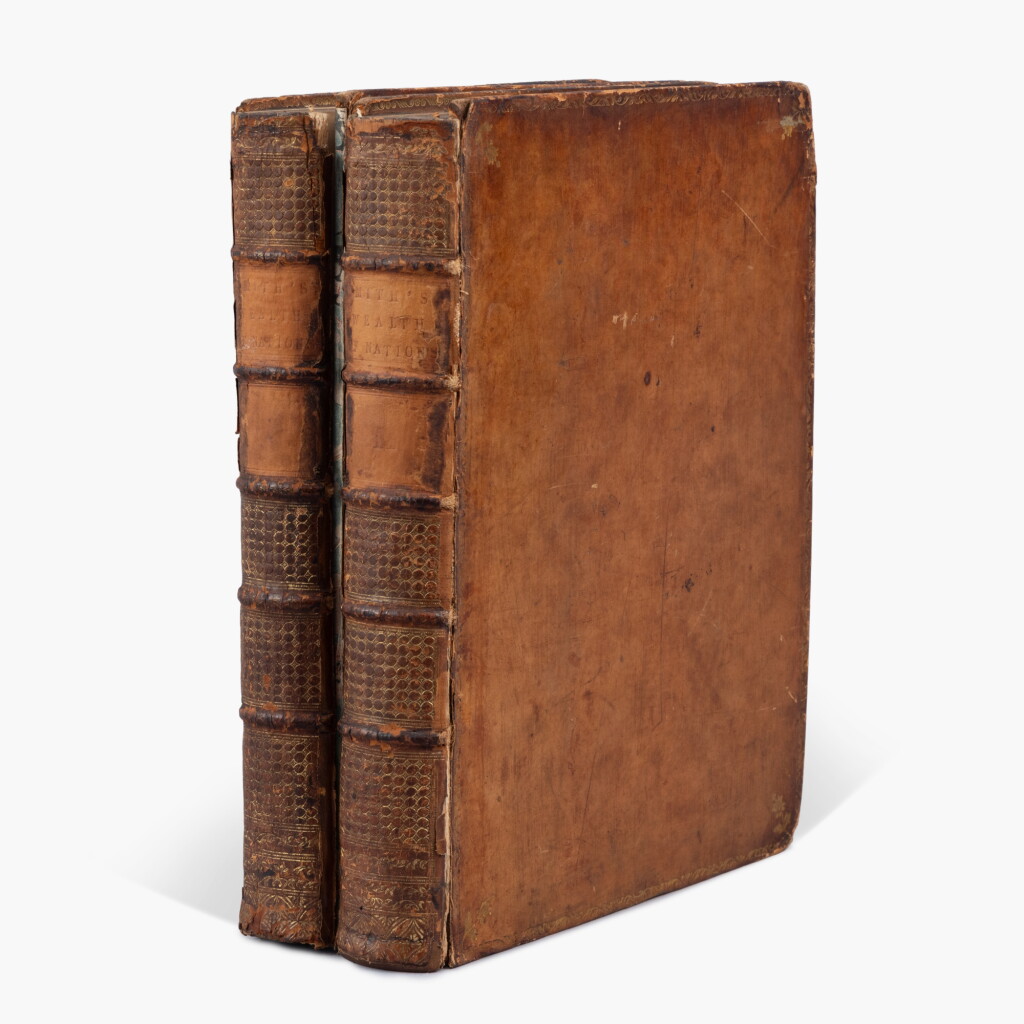
An Inquiry into the Nature and Causes of the Wealth of Nations. London: W. Strahan and T. Cadell, 1776
2 vols., 4to (280 x 216 mm). Half-title to vol. II only, as issued, with final blank in vol. I, publisher's advertisements at end of vol. II, cancels as usual (vol. I: M3, Zz3; vol. II: D1, Zzz4); instances of scattered toning and foxing, faint offsetting, a few stray stains and smudges, vol. I leaves L1 and L2 dampstained, small paper flaws to Mm2 and Mm3 costing one letter, vol. II with a few short closed tears not affecting text, instances of pencil markings. Contemporary calf bordered in gilt with fleurons, spines with raised bands in six compartments, remnants of original gilt-lettered leather spine labels to second and third compartments; upper cover and front free endpaper to vol. I detached, upper hinge to vol. II weak with cords just holding, others exposed, repair to corner of lower cover of vol. II, extremities rubbed and bumped, covers lightly scuffed, remnants of spine labels to vol. II laid in.
First edition of the "first and greatest classic of modern economic thought" (PMM), commemorating its 250th anniversary this year.
Arguably the most important work in the history of economic literature, Smith's prescient The Wealth of Nations was instrumental in shaping the course of the quarter-millennium since its publication in 1776. Smith's principles of free market competition, specialized labor, and the "invisible hand" continue to influence global economic policy; indeed, the work is arguably more relevant now than ever, in a political moment dominated by debate surrounding global networks of capital and trade.
Smith argued that individual industry is responsible for historical progress and improving conditions at large: "Every individual ... generally, indeed, neither intends to promote the public interest, nor knows how much he is promoting it. By preferring the support of domestic to that of foreign industry he intends only his own security; and by directing that industry in such a manner as its produce may be of the greatest value, he intends only his own gain, and he is in this, as in many other cases, led by an invisible hand to promote an end which was no part of his intention" (Book IV, Chapter II, p. 35).
REFERENCES
Goldsmiths' 11392; Kress 7621; PMM 221; Rothschild 1897; Sabin 82303
PROVENANCE
Anne Schlumberger, Houston — thence by descent to the present owner
You May Also Like
![Darwin and Wallace | On the Tendency of Species to form Varieties ... [1858–1859], in: Journal of the Proceedings of the Linnean Society, Vol. III, No. 9., 1859, Darwin announces the theory of natural selection](https://sothebys-md.brightspotcdn.com/dims4/default/0ae5d5e/2147483647/strip/true/crop/2000x2000+0+0/resize/150x150!/quality/90/?url=http%3A%2F%2Fsothebys-brightspot.s3.amazonaws.com%2Fmedia-desk%2Fwebnative%2Fimages%2F18%2F98%2Fd0ba6d9f4fada55611b512c2635f%2Fn12451-bkh45-t1-01.jpg)

![Kepler, Johannes | Harmonices Mundi Libri V, Linz, 1619, first edition, [bound with:] Prodomus dissertationum cosmographicum …, Frankfurt, 1621–1622](https://sothebys-md.brightspotcdn.com/dims4/default/d54d010/2147483647/strip/true/crop/2000x2000+0+0/resize/150x150!/quality/90/?url=http%3A%2F%2Fsothebys-brightspot.s3.amazonaws.com%2Fmedia-desk%2Fwebnative%2Fimages%2F63%2F0b%2Fa27794664ee78085e15afe3c5535%2Fn12451-58tmv-t1-05.jpg)