
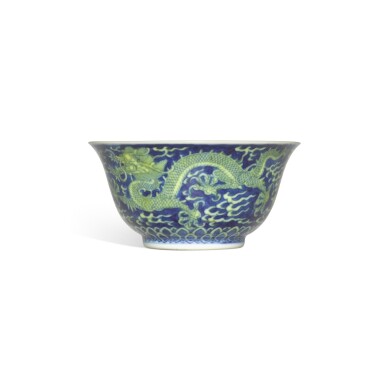
A fine blue and white and yellow-enameled ‘dragon’ bowl, Seal mark and period of Qianlong
Live auction begins on:
September 16, 01:00 PM GMT
Estimate
40,000 - 60,000 USD
Lot Details
Description
the base with a six-character seal mark in underglaze blue
Diameter 4 in., 10.1 cm
Marchant, London, 1965.
Collection of Anthony Evans (1954-2008), collection no. 425.
Imperial Chinese Porcelain, Ceramics & Works of Art, Marchant, London, 2013, cat. no. 33.
Stuart Marchant, Marchant - One Hundred Years, volume II: 2001 - 2025, London, 2025, p. 292 (not illustrated).
Within the Qing Court, the use of porcelain was governed by a strict hierarchical system in which forms, motifs and colors reflected the rank of the intended recipient. According to the Guochao Gongshi (國朝宮史; Compilation of Qing Court History), vol. 17, compiled in 1742, bowls decorated with yellow dragons reserved against a blue ground, such as the present example, formed part of the official allotment for imperial consorts of the fourth rank (pin, 嬪), who were entitled to receive four such bowls. The striking combination of imperial yellow dragons and deep cobalt-blue ground therefore served not only as an auspicious decorative scheme but also as a visible expression of court status and protocol.
Compare a closely related blue and white and yellow-enameled 'dragon' bowl, also Qianlong seal mark and period, preserved in the Qing Court Collection, Palace Museum, Beijing (accession no. 故00159782-6/33). The pair to this bowl was sold in our Hong Kong rooms, 11th July 2020, lot 3105. A similar bowl was included in the exhibition Qing Mark and Period Monochromes and Enamelled Wares, Marchant, London, 1981, cat. no. 21. Also compare a slightly larger example, first sold at Christie's Hong Kong, 25th October 1993, lot 820, and again in the same rooms, 28th November 2012, lot 2140.
You May Also Like


