
Letters and documents from a distinguished collector
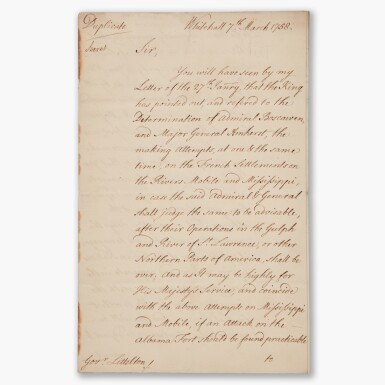
William Pitt, the Elder | Letter signed, planning an attack on French Louisiana, 1758
Lot Closed
April 17, 02:47 PM GMT
Estimate
5,000 - 7,000 GBP
We may charge or debit your saved payment method subject to the terms set out in our Conditions of Business for Buyers.
Read more.Lot Details
Description
William Pitt, Earl of Chatham (Pitt the Elder)
Letter signed, to William Lyttelton, Royal Governor of South Carolina, concerning a proposed attack on the colony of French Louisiana to be commanded by Admiral Edward Boscawen and General Amherst, advising that "it may be highly for His Majesty's Service [...] if an attack on the Albama Fort should be found practicable”, to take place in coordination with their planned attack on French settlements on the Mobile and Mississippi rivers, and that he should ally with “any of the Indian Nations” when advancing on the French, 3 pages, folio (305 x 195 mm), headed "Duplicate / Secret", Whitehall, 7 March 1758, docketed ("Rec'd Sepr 7th 1758 per post"), light staining at margin
“…the Determination of admiral Boscowen and Major General Amherst, the [sic] making attempts, at one and he same time, on the French settlements on the Rivers Mobile and Mississippi, […] after their Operations in the Gulph and River of St Lawrence, or other Northern Parts of America, shall be over…”
PITT THE ELDER ON MILITARY OPERATIONS IN NORTH AMERICA DURING THE SEVEN YEARS’ WAR. Pitt had taken control of British strategy late in 1757, and this letter shows his global ambition. Fighting between the British and the French in North America mostly took place in the northern part of the continent, and this letter refers to operations in the Gulf of St Lawrence that would lead to the successful British siege of Louisbourg in the summer of 1758. However, Pitt here advises the royal governor of South Carolina that Boscawen and Amherst, respective commanders of the navy and the army in British North America, will turn their attention to French Louisiana once Canada has been won. Fort Alabama was an alternative name for Fort Toulouse, the easternmost military outpost of French Louisiana.
Pitt is careful to leave the final decision on the attack to Lyttelton, knowing that he would have a better understanding of the facts on the ground. He would also have known that a letter written from London could be outdated by the time it reached South Carolina: indeed, docketing by the recipient shows that it did not reach him for nearly six months. This letter is marked as a duplicate, which almost certainly means that another copy of the letter was sent to Lyttelton by another route, to increase the chances of the message reaching its distant destination. In any case, Pitt’s suggestion of an attack on the garrison was never acted upon, but the fort was ceded to the British in the Treaty of Paris of 1763.
PROVENANCE:
The Lyttelton Papers: Property of The Viscount Cobham, sale in these rooms, 12 December 1978, lot 69; Sale in these rooms, 18 July 1991, lot 462