
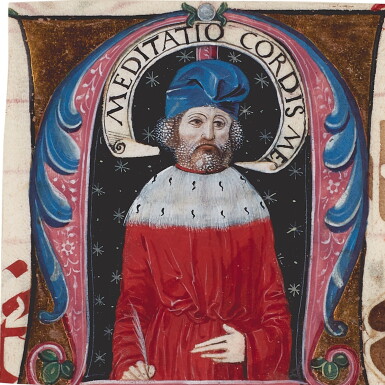
Illuminated initial M from a Choirbook depicting a Prophet beneath an unfurling Scroll by the Master of the Archimboldi Missal (fl.1480–1500), on vellum, in Latin, (Italy, Milan), c.1500
Lot Closed
July 9, 12:10 PM GMT
Estimate
5,000 - 8,000 GBP
We may charge or debit your saved payment method subject to the terms set out in our Conditions of Business for Buyers.
Read more.Lot Details
Description
An illuminated initial M from a Choirbook depicting a Prophet beneath an unfurling Scroll by the Master of the Archimboldi Missal (fl.1480–1500)
on vellum, in Latin, (Italy, Milan), c.1500, 80 × 80 mm; within a pink and blue initial M set against a highly burnished gold ground; a prophet holding a quill standing beneath a scroll curving around his head reading: Meditatio cordis mei, the prophet is clothed in a sumptuous garb of red with an ermine collar and a blue chaperon-like headdress; he is depicted in front of a black background dappled with stars; gold minutely flaked, otherwise outstanding condition.
PROVENANCE
- Made around 1500 as part of a lavish choirbook by the Master of the Arcimboldi Missal. Likely excised after the introduction of the leggi eversive (eversion laws) to the Kingdom of Italy in 1866.
- In 1900, four sister leaves were bought by the Berlin State Museum and entered the Kupferstichkabinett: inv. nos. 4209–4212 (Wescher, p.103, ill.), while our leaf seemingly remained in private ownership.
COMMENTARY
Framed by the pink body of an initial M stands the figure of a bearded prophet. He is dressed in a precious red garb with an ermine collar and wears a fashionable blue chaperon headdress. A banderole curls around his head like a literary halo, bearing the words: Meditatio cordis mei, the meditation of my heart. The figure, likely King David based on his sartorial splendour and the quotation from Psalm 18 or 48, is depicted holding a quill and gazing contemplatively at the viewer. An elegant black backdrop mottled with fine stars contrasts with the colourful body of the initial and the figure of King David within.
The composition of the initial, the way of modelling the face, the banderole, as well as the black background dotted with stars enables us to attribute the initial securely to the artist identified as Maestro del Messale Arcimboldi by Cristina Quattrini. This hitherto anonymous artist was active in Milan, the capital of the region of Lombardy, between 1480 and 1500, and is named after a luxurious manuscript he illuminated for the Archbishop of Milan, Guido Antonio Arcimboldi (Milan, Bibl. Capitolare del Duomo, MS II. D. 1.13).
The artist belongs to the Milanese tradition of manuscript illumination, which combined the Lombard approach to naturalism with the decorative richness of northern Italian manuscript production, and already exhibited a spatial awareness that would fully develop during the heights of Renaissance illumination. The artist and his workshop had strong ties to the Sforza court, whose taste and patronage dictated manuscript production in its sphere of influence.
Our artist is closely associated with major Milanese illuminators, such as Matteo da Milano, the Master of Anna Sforza, and the Master of Crescenzago, as well as the Master of the Landriani Hours, with whom he had been amalgamated in the past.
The style of this master or workshop, as exemplified by our initial, is defined by the elegant, often elongated figures with calm but expressive faces and their smooth modelling. His initials are often set against highly burnished golden backgrounds filled in with a black ground and stars or “snowflake” motif.
SISTER LEAVES
Works by the Master of the Arcimboldi Missal can be found in many major public institutions, such as the Musée Marmottan in Paris (inv. 36, 37, and 39), three in London in the British Library (Add. MS 18797 d–g–i), Saint Stephen in the Wallace Collection in London (MS 330), a Marlay cutting in the Fitzwilliam Museum in Cambridge (inv. 1.19), and an Assumption in the Victoria and Albert Museum (MS 1005, no. 4145). The works mostly stem from large choirbooks or liturgical codices which were, in many cases, cut up in the course of the 19th century and sold from Italy to collectors in Europe and the US. Exciting research remains to be done on the exact relationship of the extant cuttings and their chronology within the artist’s œuvre.
LITERATURE
Bauer-Eberhardt, Ulrike. Die italienischen Miniaturen des 13.–16. Jahrhunderts. Munich: Staatliche Graphische Sammlung, 1984.
Levi d’Ancona, Mirella. The Wildenstein Collection of Italian Illuminations. The Lombard School. Florence, 1970.
Mariani Canova, Giordana. Miniature dell’Italia settentrionale nella Fondazione Giorgio Cini. Vicenza: Neri Pozza, 1978.
Wescher, Paul. Beschreibendes Verzeichnis der Miniaturen, Handschriften und Einzelblätter des Kupferstichkabinetts der Staatlichen Museen Berlin. Berlin, 1931.
Quattrini, Cristina. “Maestro del Messale Arcimboldi.” In Dizionario Biografico degli Italiani, edited by Mario Bolatti, vol. 23, 619–20. Milan, 2004.