
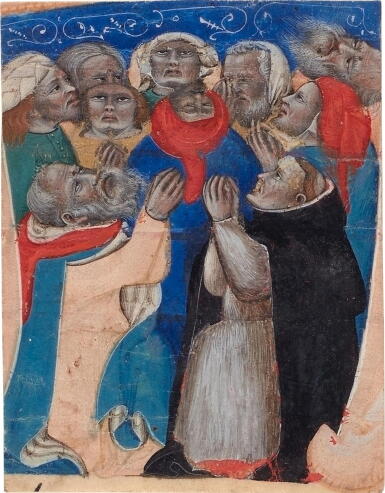
An illuminated cutting showing a group of ten men at prayer, by Niccolò di Giacomo da Bologna, on vellum, (Italy, Bologna), c.1370
Lot Closed
July 9, 12:08 PM GMT
Estimate
7,000 - 10,000 GBP
We may charge or debit your saved payment method subject to the terms set out in our Conditions of Business for Buyers.
Read more.Lot Details
Description
An illuminated cutting showing a group of ten men at prayer, by Niccolò di Giacomo da Bologna
on vellum, (Italy, Bologna), c.1370, 110 × 90 mm; an illuminated cutting of the lower part of a large initial, ten male figures of various ages are shown at prayer, their gazes lifted to heaven, depicted by the artist using different perspectives; most of the men are dressed in beige, green, and blue hues accentuated by red headdresses; in foreground to the right a Canon Regular is depicted; miniature cut close so that nothing distracts from the group at prayer, slight cracking of paint, red underpaint visible revealing the artist’s approach to painting the scene; red pigment rubbed in places but colour quality is strong and vibrant.
PROVENANCE
- Likely excised from an Antiphonal illuminated for the Chiesa di San Giacomo Maggiore by Niccolò di Giacomo da Bologna and his collaborator Stefano di Alberto Azzi. The miniature was likely part of a series of choirbooks created under the priorate of Andrea Artusi (1368–71) on the behest of Domenico II Isolani, a member of a prominent Bolognese family of silk merchants and patron of the arts. The manuscript survived the Napoleonic occupation of the 1790s as the friars hid it when the monastery was suppressed and the Augustinian community expelled. While the community returned in 1824, they left for good in 1860, when an important law change was enacted in the Kingdom of Italy, the leggi eversive, which curtailed the immense power and wealth of the Catholic Church. The manuscripts were only rediscovered by pure chance in 1885 and the manuscripts are still recorded at the monastery in 1866 before many of them were illegally sold by the Augustinian friar Luigi Mazzoni, who was accused of cutting out and selling the miniatures. 73 of the cut-out miniatures and 15 choirbooks were then transferred to the Municipality of Bologna on 23 July 1887.
- France, private collection.
- Switzerland, private collection.
- Private collection.
A PRECIOUS SCENE OF UTMOST DEVOTION ILLUMINATED BY NICCOLO DI GIACOMO DA BOLOGNA
COMMENTARY
This intriguing initial reveals a fascinating tale of endurance and defiance, with the manuscript surviving the Napoleonic invasion of the Italian Kingdom unscathed, hidden by the community of Augustinians who had lived, prayed, and served at San Giacomo Maggiore for centuries.
The miniature was created by one of Bologna’s leading artists of the 14th century. Active between 1349 and 1403, Niccolò di Giacomo da Bologna’s works are characterised by his expressively modelled figures and densely populated narrative scenes, which is exemplified in the miniature before us. His prolific workshop illuminated a wide range of manuscripts; one of his first signed works are copies of the Decretum Gratiani, the central compilation and textbook of canon law, created for the University of Bologna, one of the driving forces of the high demand for illuminated manuscripts in the region. The artist and his workshop were commissioned to illuminate a variety of manuscripts; besides texts for the use at university, this included high-profile devotional books but also secular works and guild registers (Getty Museum, Ms. 82) and statutes for various bodies in the city of Bologna. His success as an artist is codified in his appointment as illuminator to the city in the 1380s, which he served as a member of the city administration and government as well. With his death in 1403, he left his son Onofrio with an impressive workshop and the region of Bologna with a highly influential artistic legacy.
The scene is set within a beige initial; its stems can be seen gently curving around the group. These remnants are likely the legs of a double-storey A or H with the original composition being constructed in two parts. If the initial was indeed a letter A, the miniature might have introduced the matins response for the first Sunday in Advent, which was known as Aspiciens a longe Sunday, as it contained the first chant of the Christian liturgical year that was sung with the Schola Cantorum. In this case, the lower part, which is formed by our cutting, depicts a group of praying men and the Old Testament prophet Isaiah, while the upper part would have contained a depiction of Christ in Majesty. The iconography as well as the surrounding text would have referred to the prophecy of Isaiah, who foretold the birth of Christ Aspiciens a longe, ecce, video potentiam (Long had I been watching. Behold, now do I see God coming in power as in a cloud of light, ).
The faces of the men are modelled diligently and with great detail, with the artist striving to create a dynamic and diverse group using different angles and perspectives to render the angular faces. Fine layers of colour and brushstrokes that are reminiscent of fine hatchings give the faces plasticity.
Yet, the overall depiction of the group diverges from the expected iconography, as the potential figure of the prophet Isaiah does not hold a scroll containing the prophecy. The praying men could also be interpreted as God’s people praising the Lord after the arrival of the Saviour. By depicting a diverse group, showcasing differing ages and origins through the variety of the headdresses, the artist visualises the omnipresence and omnipotence of God.
Noteworthy is the presence of the figure in the right foreground in black and white, a Canon Regular, an ordained priest living under the Rule of Saint Augustine. The presence of this figure hints at a possible origin of the miniature. The miniature might once have been part of a set of choirbooks belonging to the Bolognese Canons Regular in San Giacomo Maggiore. Commissioned by Domenico II Isolani, Niccolò di Giacomo da Bologna and his collaborator and rival, Stefano di Alberto Azzi, created a series of lavish choirbooks, as evidenced by the testament of Domenico. The Isolani family wished to be buried in the church of the Bolognese Canons Regular and hoped to secure this privilege through a very generous commission in favour of the foundation.
The Museo Civico Medievale now houses the 15 choirbooks from the monastery of San Giacomo Maggiore. Massimo Medica (Medica 2002) noted that the miniature for the first Sunday of Advent is missing from the antiphonal covering the liturgy from First Sunday of Advent to Christmas Eve, which would also have encompassed our initial. The manuscript, MS 609, is now held in Bologna at the Museo Civico Medievale. His research suggests that our initial A could be identified with the now lost initial from fol.5r. This would date our miniature to the late 1360s. Our miniature exhibits great similarities to an initial from ms 1409, fol.179r, with a similar two-part composition (cf. Alessandri 2003, p.41).
We kindly thank Prof. Dr. Gaudenz Freuler for his expertise.
LITERATURE
Alessandri, Vania. “I corali di San Giacomo Maggiore.” Kermes: La rivista del restauro, no. 52 (October–December 2003): 37–46.
Benevolo, Giancarlo, and Massimo Medica, eds. I corali di San Giacomo Maggiore: Miniatori e committenti a Bologna nel Trecento. Exhibition catalogue. Bologna: Museo Civico Medievale, 2002.
Medica, Massimo. “I miniatori dei corali agostiniani: Nicolò di Giacomo e Stefano di Alberto Azzi.” In I corali di San Giacomo Maggiore: Miniatori e committenti a Bologna nel Trecento, edited by Giancarlo Benevolo and Massimo Medica, 63–107. Bologna: Museo Civico Medievale, 2002.