
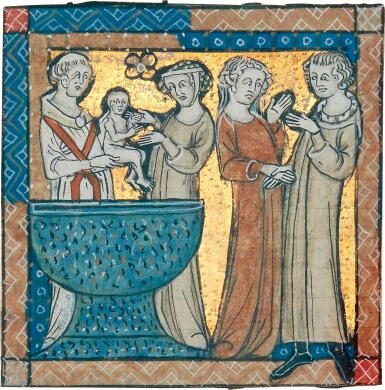
A miniature from the Decretum Gratiani depicting a baptism and marital vows, on vellum, illuminated by an artist of the Milemete Workshop (England, London?), c.1320–30
Lot Closed
July 9, 12:06 PM GMT
Estimate
7,000 - 10,000 GBP
We may charge or debit your saved payment method subject to the terms set out in our Conditions of Business for Buyers.
Read more.Lot Details
Description
A miniature from the Decretum Gratiani depicting a baptism and marital vows
illuminated by an artist of the Milemete Workshop, on vellum, England, c.1320–30, 68 × 67 mm; the miniature combines two scenes in a church interior: a baptism on the left, with the priest dressed in white with an orange stole handing the child to the mother or godmother above the baptismal font, while on the right a couple is exchanging their marital vows; the figures are executed on a gold ground embossed with a minute pattern of dots, the scene is set within a bi-coloured frame of blue and rose embellished with white geometrical tracings; overall good condition.
PROVENANCE
- Likely taken from a copy of the Decretum Gratiani created in England, c.1320–30, illuminated by an artist of the Milemete group.
- Private Collection.
A BEAUTIFUL EXAMPLE OF ENGLISH MANUSCRIPT ILLUMINATION BY THE MILEMETE WORKSHOP
COMMENTARY
The Decretum Gratiani, as the work is known today, from which our miniature most likely originates, was one of the fundamental legal texts of the Middle Ages. Compiled around 1140 by the Italian lawyer and cleric Gratian, his concordance of canon law was in use until 1234, when it was superseded by the Decretals of Pope Gregory IX compiled by Raymond of Peñafort. Soon after its conception, the Decretum Gratiani became the standard textbook for students and lawyers of canon law in Bologna, as it was one of the first European legal treatises to offer a comprehensive and systematic approach to its chosen legal framework. From Bologna, the work spread and rose to the status of a medieval best-seller — a status it inhabited for centuries. Gratian’s legal compilation and scholarly approach helped cement the understanding of law as a profession, requiring training and expertise, and shaped the shared legal culture of medieval Europe.
Not much is known about the author of one of the West’s fundamental legal texts. Gratian was a canon lawyer, native of Etruria, and likely worked in some of Europe’s leading cities in matters of jurisprudence, including Rome and Bologna. The Decretum Gratiani shaped both canon as well as secular law, particularly in matters of contracts, wills, and marriage, as secular courts began to adopt canon law principles.
The concept of marriage put forth by the Decretum Gratiani is one of its most influential, as it helped redefine marriage in Western Europe as a legal and consensual union, rather than primarily a familial or economic arrangement. Gratian’s compilation highlighted the mutual consent of both parties. While not always adhered to in practice, his work did institute women with legal standing and their own independent agency in forming a marriage. The compilation also discusses impediments to a valid marriage as exemplified in the miniature. These include, besides consanguinity (blood relations) and affinity (relations through marriage), spiritual kinship, such as godparenthood, establishing that a godparent cannot marry a godchild, therefore equating spiritual relationships and biological ones.
ILLUMINATION
On a burnished gold ground, two central and closely related subjects of Gratian’s work are presented side by side. On the left, a priest is handing back a child after its baptism to the mother or godmother, while on the right, a couple is exchanging their marital vows. The priest is dressed in white vestments accentuated with an orange stole. The shade of orange is picked up by the wedding dress of the woman to the right of the baptismal fountain while the other two figures are dressed in light beige. Both women are wearing their hair in elaborate braided styles with the bride wearing a fine almost translucent veil.
This scene was likely used to illuminate the beginning of Causa XXX (Melnikas 1975, p.941), which grappled with impediments to marriage, particularly on the basis of spiritual kinship as exemplified in the miniature. For the Middle Ages, spiritual ties were as strong as blood relationships and were a vital factor in deciding the eligibility of a marriage partner. The four-leaf clover, a symbol of good luck, was understood to signify the cross and Christ’s blessing (Michael 1994, p. 38). Its inclusion above the head of the child as a protective symbol to keep evil spirits at bay offers a touching detail.
The palette is characterised by hues of rose and terracotta paired with a muted azurite. The figures are long and slender, with alabaster complexions and softly curling locks. The composition is balanced and symmetrical; yet, the feet of the soon-to-be husband cheekily extend beyond the constraints of the allocated space, and in doing so, add a dynamic detail.
Our miniature offers similarities to a most luxurious English manuscript and royal dedication copy of the 13th century, the treatise De nobilitatibus, sapientiis et prudenciis regum (On the Nobility, Wisdom, and Prudence of Kings) written by the courtier and clerk Walter Milemete. The beautifully decorated copy was given to King Edward III between 1325 and 1327. A full digitisation of the manuscript can be enjoyed on the Bodleian’s website. Sandler, in her fundamental work, identified five artists, of whom Hand IV seems to offer the most resemblance (Sandler 1986) to the miniature at hand. Two other law manuscripts can seemingly be attributed to these hands: Oxford, Bodleian Library, MSS E. Mus. 60 and MS Lat. misc. B 16. The Milemete workshop and its exact workings are still subject to research, yet the atelier specialised in creating illuminated works for a university context, including Oxford and Paris (Voelkle and Wieck, p.90). The survival of a Decretum Gratiani manuscript of English provenance is enticing, as these are rarer than their Italian counterparts.
LITERATURE
Alexander, J. J. G. “Painting and Manuscript Illumination for Royal Patrons in the Later Middle Ages.” In Medieval Art, Architecture and Archaeology at Canterbury, 141–62. London: British Archaeological Association.
Brundage, James A. Law, Sex, and Christian Society in Medieval Europe. Chicago: University of Chicago Press, 1987.
Gubernatis, A. de. La Mythologie des plantes ou légendes du règne végétal. Paris, 1878; repr. Milan, 1976, ii, p. 360.
Hanna, Ralph, and David Rundle. A Descriptive Catalogue of the Western Manuscripts to c. 1600 in Christ Church, Oxford. Oxford: Oxford University Press, 2017.
Melnikas, Anthony. Corpus of the Miniatures in the Manuscripts of the Decretum Gratiani. 3 vols. Rome, 1975.
Michael, Michael. “The Iconography of Kingship in the Walter of Milemete Treatise.” Journal of the Warburg and Courtauld Institutes 57 (1994): 35–47.
Sandler, Lucy Freeman. Gothic Manuscripts, 1285–1385. 2 vols. London: Harvey Miller, 1986.
The Treatise of Walter de Milemete, De nobilitatibus, sapientiis et prudentiis regum. Facsimile of the manuscript preserved at Christ Church, Oxford, together with selections from De secretis secretorum Aristotelis (Holkham Hall). Accessed June 4, 2026. https://archive.org/details/cu31924032172029/page/n1/mode/2up
Bodleian Libraries, University of Oxford. “MS 3966.” Medieval Manuscripts Catalogue. Accessed June 4, 2026. https://medieval.bodleian.ox.ac.uk/catalog/manuscript_3966
Voelkle, W. H., and R. S. Wieck. The Bernard H. Breslauer Collection. New York, 1992, no. 16.