
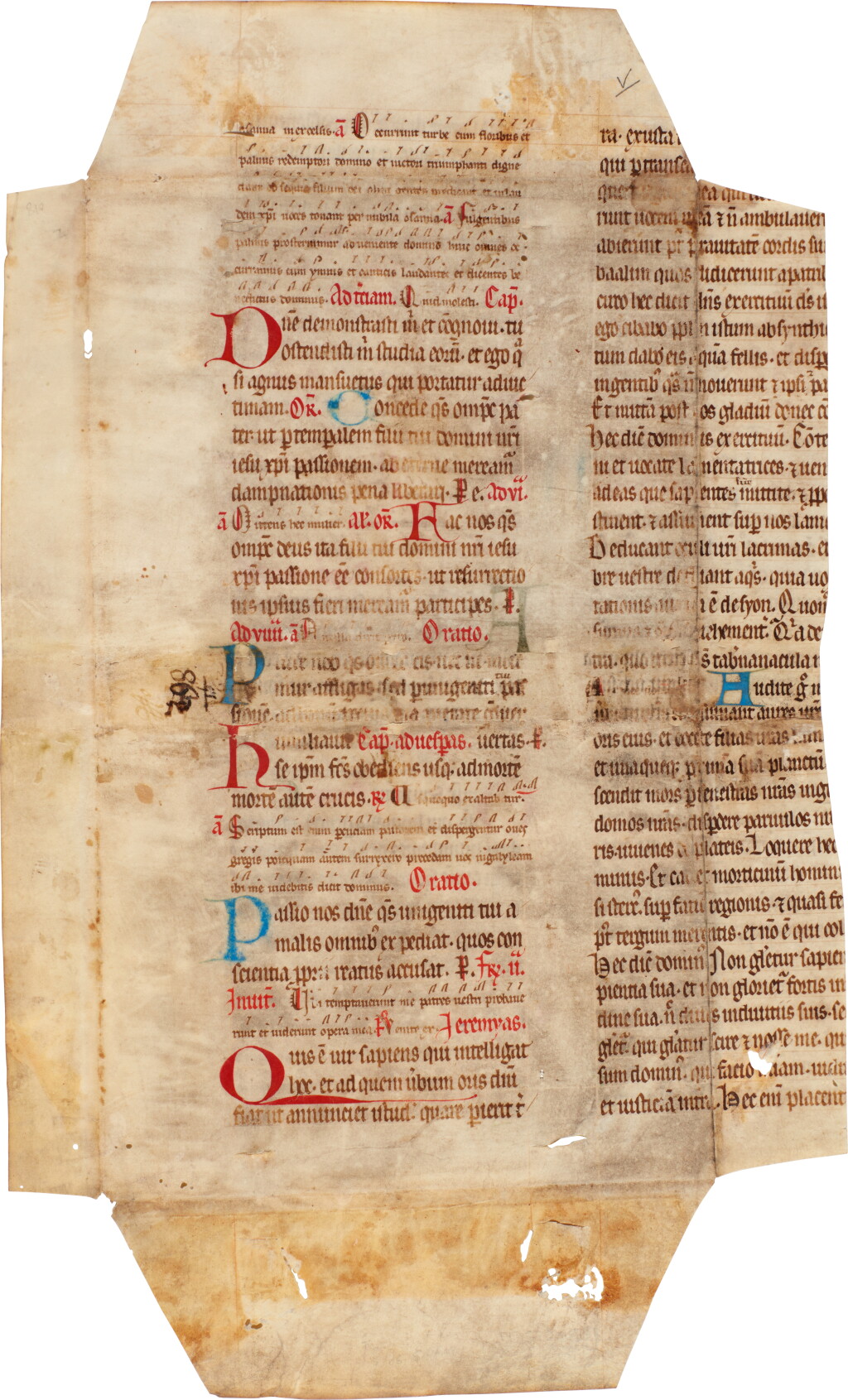
A collection of three leaves containing neumatic notation in the influential St Gall style, on vellum, in Latin
Lot Closed
July 9, 12:14 PM GMT
Estimate
5,000 - 7,000 GBP
We may charge or debit your saved payment method subject to the terms set out in our Conditions of Business for Buyers.
Read more.Lot Details
Description
A collection of three leaves containing neumatic notation in the influential St Gall style
The three fragments at hand are fine witnesses to the tradition of St Gall neumes developed during the 10th century. St Gall neumes are among the most influential forms of early medieval musical notation. Developed to guide the singing of liturgical chant before the standardisation of the fixed ruled staff in the 16th century, St Gall neumes belong to the earliest forms of Western notation; in their diastematic or “heightened” form, they register relative melodic rise and fall without fixing the exact pitch. The St Gall tradition is set apart from other early musical notational systems as it recorded not only basic neumes but additional information that conveyed nuances of rhythm, the sound of particular consonants, vocal inflection, and delivery. It was an ingenious system of capturing music before a standardised framework was agreed and bridged the gap between oral knowledge transmission and codification.
Medieval Europe did not have one single system of chant notation, but a plethora of local “dialects.” Some traditions — like the French notations, e.g. Messine, Breton, and Aquitanian — often broke melodic movement into more visibly distinct steps on the page. By contrast, St Gall notation tended to preserve neumes more compact, rather than separating them into graphical units. The result is a notation that appears fluid and calligraphic — a singer’s memory manifested on the page.
The present leaves — one from a Breviary for Holy Week, the others from a Missal for the period between Easter and Pentecost — show this notation in use across different liturgical books and demonstrate the far-reaching sphere of influence of the Abbey of St Gall.
1. A partial leaf from a noted Breviary, in Latin, manuscript on vellum (Eastern France, Alsace?), early 13th century
A HANDSOME LEAF FROM A NOTED BREVIARY WITH READINGS AND HYMS FROM PALM SUNDAY TO EASTER MONDAY
c.440 × 260 mm, 2 columns of 36 lines written in brown ink in an early formal Gothic bookhand, St Gall diastematic (heightened) staffless neumes, rubrics in red, large initials alternately red or blue, smaller initials touched in red, one elaborate line-filler in red ink; recovered from a binding and consequently trimmed, creased, and stained, the number “862” across the middle where the spine would have been, a few holes.
PROVENANCE
1. Ludwig Rosenthal Antiquariaat, Hilversum, acquired in May 1986 by:
2. Bernard Rosenthal (1920–2017). Acquired in 1989 by:
3. Schøyen Collection, MS 209/1.
TEXT
The leaf contains readings, prayers, and hymns for the Divine Office from Palm Sunday to Monday of Holy Week, beginning in Bede’s Homilia XXIII for Palm Sunday: “(Sed invidorum corda pri)ncipum in cunctis” to the reading from Jeremias for Monday of Holy Week: “et iustitiam in terra. Hec enim placent (mihi ait Dominus).”
2. Two consecutive leaves from a noted Missal, in Latin, manuscript on vellum (Germany), early 14th century
TWO HANDSOME LEAVES FROM A GERMAN NOTED MISSAL, FORMERLY IN THE COLLECTION OF DR GEORGE SALT
c. 200 × 150 mm, two leaves, 2 columns of 31 lines written in dark brown ink in a Gothic bookhand, late diastematic (heightened) staffless St Gall neumes (Early German neumes), rubrics in red, initials alternately in red or blue, contemporary foliation in red “cxxi” and “cxxx”, second leaf with gathering signature in red; recovered from a binding and consequently somewhat stained and soiled.
PROVENANCE
1. Dr George Salt, Cambridge, his MSS 12 and 13. Descriptions in his hand bound in with the leaves.
2. Sotheby’s, 17 December 1991, lot 7e.
3. Schøyen Collection, MS 1547.
TEXT
The leaves include text for the 5th Sunday after Easter, the following Rogation Day, and the Vigil of Pentecost, with readings, offertories, secrets, collects, etc., the first leaf beginning “scire debet quoniam qui converti fecerit peccatorem ab errore” to “et converterit quis eum (scire debet)”; the second leaf beginning “(Ora primum tu pro nobis virgo mater germinis et ministry) patris summi ordines angelici” and ending “Scripsit Moyses canticum (et docete).”
Taken together, these fragments were attractive witnesses to the refinement, geographical and cultural reach, and enduring legacy of the St Gall neumatic tradition.
LITERATURE
Floros, Constantin. The Origins of Western Notation. Revised and translated by Neil Moran. New York: Peter Lang, 2011.
University of Basel. “Close-up on St Gall Neumes.” In From Ink to Sound: Early Forms of Musical Notation. Accessed June 18, 2026.
University of Basel. “Notational Systems: The Chart of Neumes.” In From Ink to Sound: Early Forms of Musical Notation. Accessed June 18, 2026.