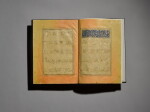
A monumental Qur'an in Bihari Script, India, Sultanate, late 15th/early 16th century
Estimate
400,000 - 600,000 GBP
Lot Details
Description
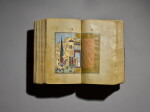
Arabic manuscript on paper, 697 leaves, 13 lines to the page written in Bihari script in black ink, Allah and other key phrases picked out in gold, the margins with commentary in small black naskh, verses separated by gold roundels with red and blue dots, surah divisions marked by polychrome illuminated panels, each juz' marked by a double page with text written in clouds in reserve against a hatched ground, alternating in red, green and dark blue, decorated with flowers, the opening bifolio illuminated in gold and polychrome framing text, in gilt and stamped brown leather binding
text panel: 36.5 by 20.5cm.
leaf: 61.4 by 35.7cm.
Ex-private collection, UAE, 1990s-2025
With leaves measuring over 61cm. in height and illuminated with innovative double-page juz’ markers throughout, this Qur’an was certainly an imposing commission for a patron of high rank. It must have served as a presentation manuscript with juz’ dividers, alternating in pink, green, and blue, resulting in an impressive chromatic display.
Though widely recognised as ‘Bihari’, the precise dating and placement of Qur’ans copied in this script remains under research with very few extant examples bearing a documentary colophon. The earliest dated Qur’an of the group is the Gwalior Qur’an in the Aga Khan Museum (inv. no.AKM281), dated 1399 AD during the Tughluq dynasty (1320-1413). It forms part of Brac de la Perrière’s ‘Pioneer’ group and together with a manuscript of Al‑hawi al‑saghir, dated 1379 AD, they show that production began as early as the late fourteenth century (2016, p.65). Another early example is a Qur’an dated 1435 sold at Christie’s, 28 October 2021, lot 38, while a further North Indian Qur’an in the Walters Art Museum (inv. no.563.5) has been attributed to the fifteenth century given that the manuscript must pre-date the seal impression of Sultan Bayezid (r.1481-1512) found on various pages of the manuscript.
The arrangement of the pages of this manuscript conforms to Brac de la Perrière’s ‘Classical’ group. They are defined by text pages with double, or triple, rules defining at least three text areas, see also MET Museum, acc. no.1977.374. The first comprises the Qur’an itself, the inner frame includes Qur’anic variants (qira’at) and the outer frame includes commentaries and glosses written on the diagonal (2016, pp.68-70). The stylistic homogeny of the group led the author to suggest that Qur’ans in this group were produced in the same area, perhaps in the same workshop (ibid.).
The Gwalior and Walters manuscripts mentioned above each display a remarkable originality and kaleidoscopic array of colour that is reprised here. The start of each juz’ is denoted by double pages where the text is set within clouds in reserve against a hatched floral ground. The ground colours alternate between a more commonly encountered pink (see a group of leaves sold in these rooms, 26 April 2023, lot 4), to an unusual midnight blue and forest green. Flowers of various forms grow throughout the page, seeming to burst energetically from the lines of text. A similar arrangement of gold flowers on a black ground is shown on the frontispiece of the Walters Art Museum manuscript. Brac de la Perrière suitably describes the Gwalior Qur’an as an “extraordinary garden” (Brac de la Perrière, et al. 2010, p.119), a sentiment that is reflected by the impressive decoration of these double page juz’ markers.
Illuminators in fifteenth-century India sought inspiration from other schools in the Near East and Iran, but adopted the imagery into a distinctive, and inventive, style (Brac de la Perrière et al. 2010, pp.114-5). The hatched decoration with flowers in reserve was a common decorative feature in the frontispieces of Qur’anic manuscripts produced in Ilkhanid Persia and Mamluk Egypt (see Khalili Collection, QUR 242). Here, the drawing of the flowers is less formal, imparting a sense of joyful and organic growth to the illumination. The illuminated marginal medallions also relate to Ilkhanid models. Many of the marginal medallions are formed of roundels with pointed terminals above and below, enclosing fleshy leaf motifs. A comparable arrangement is found in fourteenth century Shiraz Qur’ans, though more informally applied here (see Wright 2012, p.54, figs 29-31).
Fragments of large-scale Bihari Qur’ans have been recorded, see Sotheby’s, London, 26 April 2023, lot 25; Christie’s, London, 25 April 2024, lot 86, for groups of leaves measuring 53-54cm. height, and a single-volume Qur’an measuring 56 by 35cm. is published with Sam Fogg (see Fogg 2000, no.14 and Brac de la Perrière, 2008, pls.40-41). The present manuscript is even larger than those recorded examples with leaves measuring over 61cm. in height. The impressive scale coupled with the extensive illumination would undoubtedly suggest that it was a specially commissioned presentation copy for a high-ranking patron. In scale, it can be related to a Mamluk Qur’an, copied for Sultan Qaytbay sold at Christie’s, London, 2 May 2019, lot 11, which measured 68 by 45cm.
You May Also Like