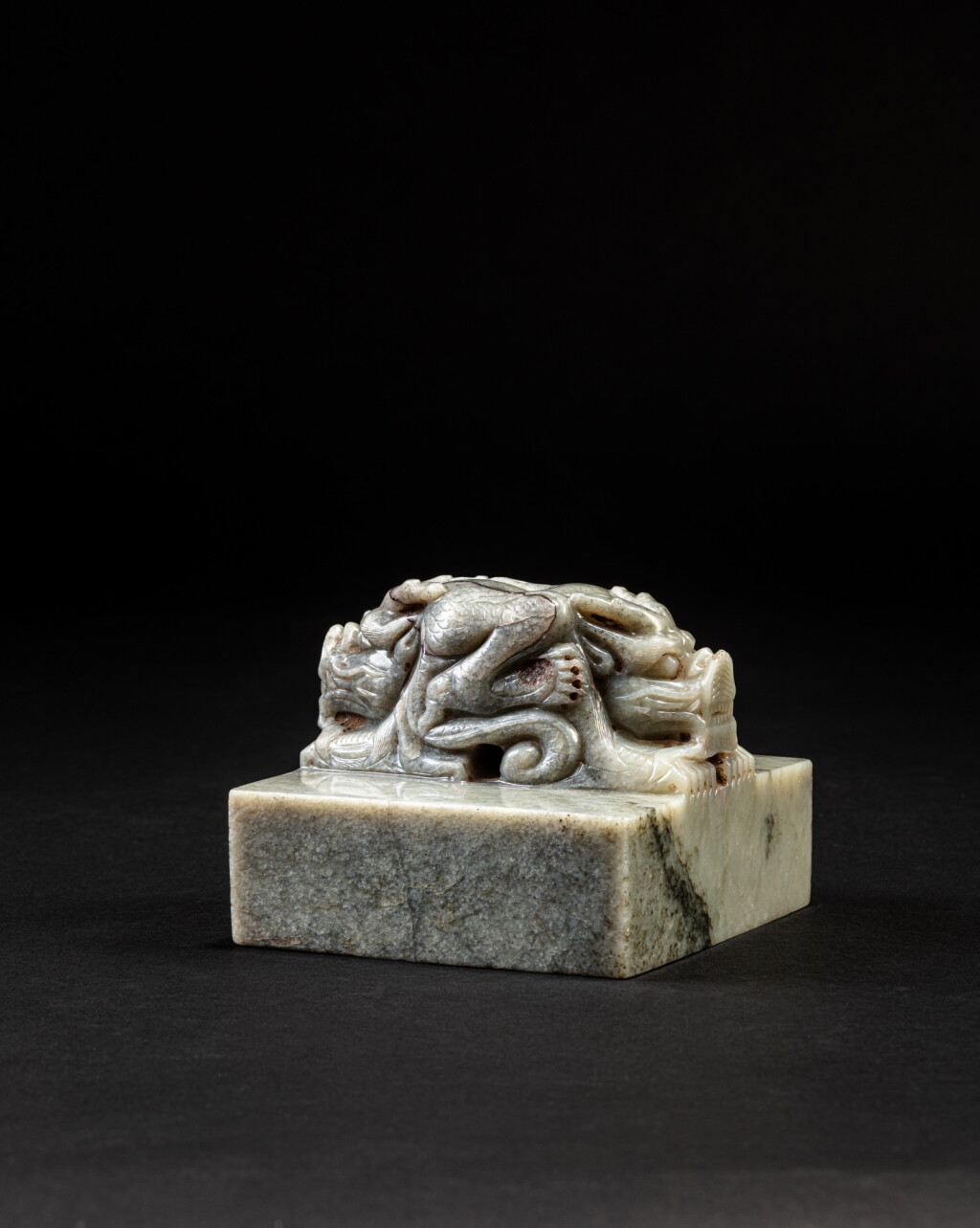
An important celadon jade 'Zhishan Daci Fawang' Buddhist seal, Ming dynasty
Auction Closed
June 11, 03:42 PM GMT
Estimate
60,000 - 80,000 EUR
Lot Details
Description
13.2 x 13.2 cm, 5¼ by 5¼ in.
French Private Collection.
Acquired at a professional antique fair in Montpellier in 2024.
The present seal appears to represent the official seal of the Zhishan Daci Fawang (至善大慈法王 , ‘Supremely Good Dharma King of Great Compassion’), a title afforded to Lama Shakya Yeshe (1354-1435), one of the eight great disciples of Tsongkhapa, the founder of the Gelug order.
According to imperial Ming and monastic Tibetan sources, during the early Ming dynasty, the imperial court conferred the title of Fawang or ‘Dharma King’ upon leading Tibetan Buddhist figures from the three most important schools of Tibetan thought and presented each with a corresponding jade seal: Dabao Fawang (‘Dharma King of the Great Treasure’) afforded to the head of the Karma Kagyu School; Dacheng Fawang (‘Dharma King of Mahayana) to the leader of the Sakya school; and Daci Fawang to Shakya Yeshe, representative of the Gelug.
Although no seal impressions of the Daci Fawang seal now appear to survive in Ming or Tibetan records, a kesi tapestry portrait of Shakya Yeshe reportedly from the Sera Monastery and now in the Norbulingka Palace Collection (fig. 1) includes a woven seal image closely related to the present seal face – included in Tibet: Treasures from the Roof of the World, Bowers Museum of Cultural Art, Santa Ana, 2003, cat. no. 10. The thangka depicts Shakya Yeshe at the height of his career draped in golden robes and wearing the black hat presented to him by the Yongle Emperor: on the one side flanked by his lengthy title in Tibetan and Chinese and, on the other, by the woven red seal mark; an enduring symbol of his great renown both in the imperial court and amongst his Tibetan followers.
Buddhist seals of this period – of Dharma Kings or otherwise – are exceedingly rare, almost exclusively preserved in the Tibet Museum in Lhasa and appear never to have previously come to market. Indeed, both other surviving seals attributed to the Dharma Kings remain in Tibet: that of the Dacheng Fawang of darker spinach-green tone and that of the Dabao Fawang of a somewhat paler celadon; the latter included in Treasures from Snow Mountains. Gems of Tibetan Cultural Relics, Shanghai Museum, Shanghai, 2001, cat. no. 2, and alongside the former in Xu Lin ‘Ming qianqi liyi yong yu yanjiu / The Study of Jade Objects for Ritual Use in Early Ming Dynasty’, Gugong xuekan, 2013, p. 180. Both seals similarly depict pairs of adorsed dragons entangled with one another, their legs and tails cloudlike and serpentine, their snouts curled and teeth bared and bear similarly ornate archaic scripts.
Beyond these two seals, almost no other Buddhist seals are attributed to early Ming imperial origins. A related Buddhist seal from the Yuan dynasty, bearing the aphorism hong chan fo zong (‘to spread the teachings of Buddhism’), has been sold twice at Sotheby’s: in our London rooms, 2nd December 1997, lot 97 and again in our Hong Kong rooms, 3rd October 2017, lot 3622.
You May Also Like