
PROPERTY FROM A SWISS PRIVATE COLLECTION
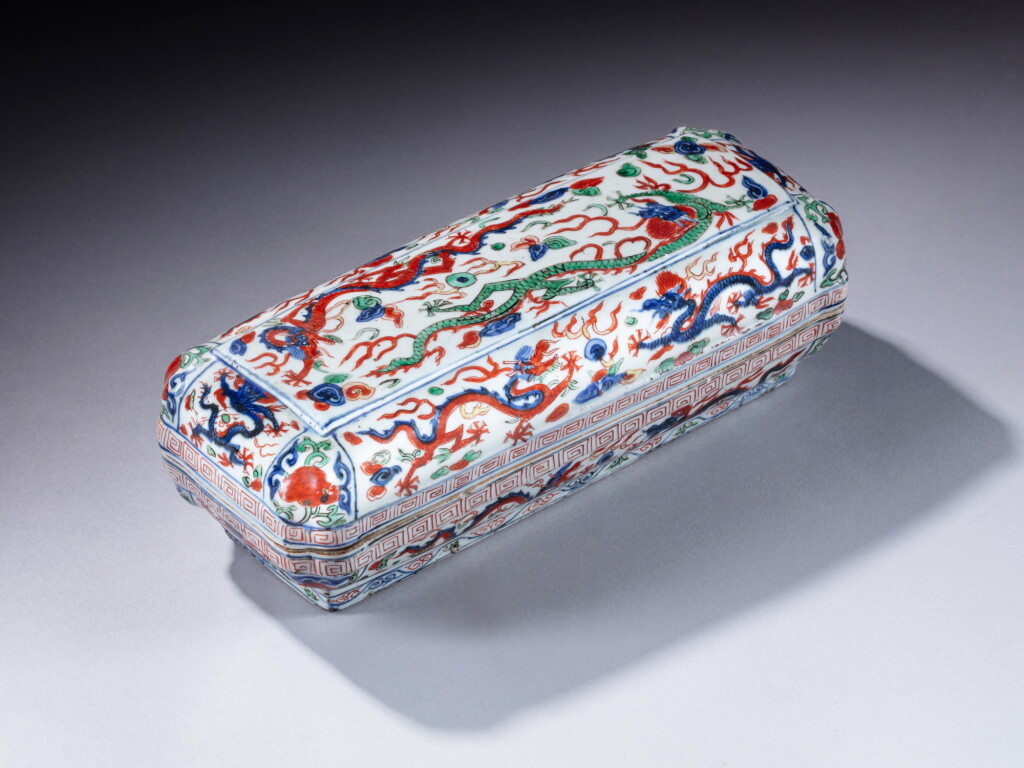
A wucai 'dragon' brush box and cover, Mark and period of Wanli
Auction Closed
June 11, 03:42 PM GMT
Estimate
40,000 - 60,000 EUR
Lot Details
Description
the base with a six-character mark in underglaze blue within a double rectangle (2)
Length 30 cm, 11¾ in.
Collection of Henri Auguste Siegfried (1830-1906), acquired from E. Vidis, 17 Avenue de la Gare, Nice, March 1884.
Wanli covered brush boxes of this type were usually painted in blue and white or wucai palette; the cover was decorated with either the 'dragon and phoenix' design, or with a 'double dragon' design as seen on the present piece. For similar wucai examples, compare a ‘double dragon’ brush tray preserved in the Tokyo National Museum, published in the Hirota Collection Catalogue, Tokyo National Museum, 1973, cat. no. 151; Another box from the Ise Collection, illustrated in The Enchanting Chinese Ceramics from the Ise Collection, Museum of Oriental Ceramics, Osaka, 2017, cat. no. 65; and a third example published in Masterpieces from Kurokawa Institute of Ancient Cultures, Hyogo, 1990, pl. 83. Compare also a related example with a ‘dragon-phoenix’ design preserved in the Shanghai Museum, illustrated by Lu Minghua in Mingdai guanyao ciqi [Imperial porcelains of Ming dynasty], Shanghai, 2007, pl. 173, fig. 3-105; and a further example painted in underglaze-blue in the Idemitsu Museum of Art, published in the 15th Anniversary Catalogue, Idemitsu Museum of Art, 1981, cat. no. 856.
Henri Auguste Siegfried (1830-1906) was a passionate collector whose life reflects the international circulation of objects and ideas in the late nineteenth century. After leaving his native Switzerland, he settled in Marseille, where he worked for the firm Naegely & Cie, an import-export company specializing in cotton, wool, silk, and hides. Alongside his commercial career, Siegfried developed an important collection, with a particular interest in both Eastern and Western ceramics and porcelains. His approach to collecting was shaped by close relationships within the European art world. Among his closest connections was Heinrich Angst (1847-1922), an art dealer, collector, and a central figure in the founding of the Swiss National Museum, of which he later became the first curator. From the early 1880s, Siegfried and Angst maintained a sustained correspondence, sharing insights on the antiques market and collaborating on acquisitions. This dialogue places Siegfried within a broader network of collectors and cultural actors engaged in defining taste and preserving material heritage at the turn of the century. After his death in 1906, his legacy endured through the auction of his collection in Zurich in 1909, organized by his widow in collaboration with Heinrich Angst. The sale, comprising German, Swiss, and Oriental porcelains as well as watercolours, stands as a testament to Siegfried’s refined eye and lasting engagement with the art of his time.
You May Also Like


