PROPERTY FROM THE PERSONAL COLLECTION OF JEAN-MARIE ROSSI
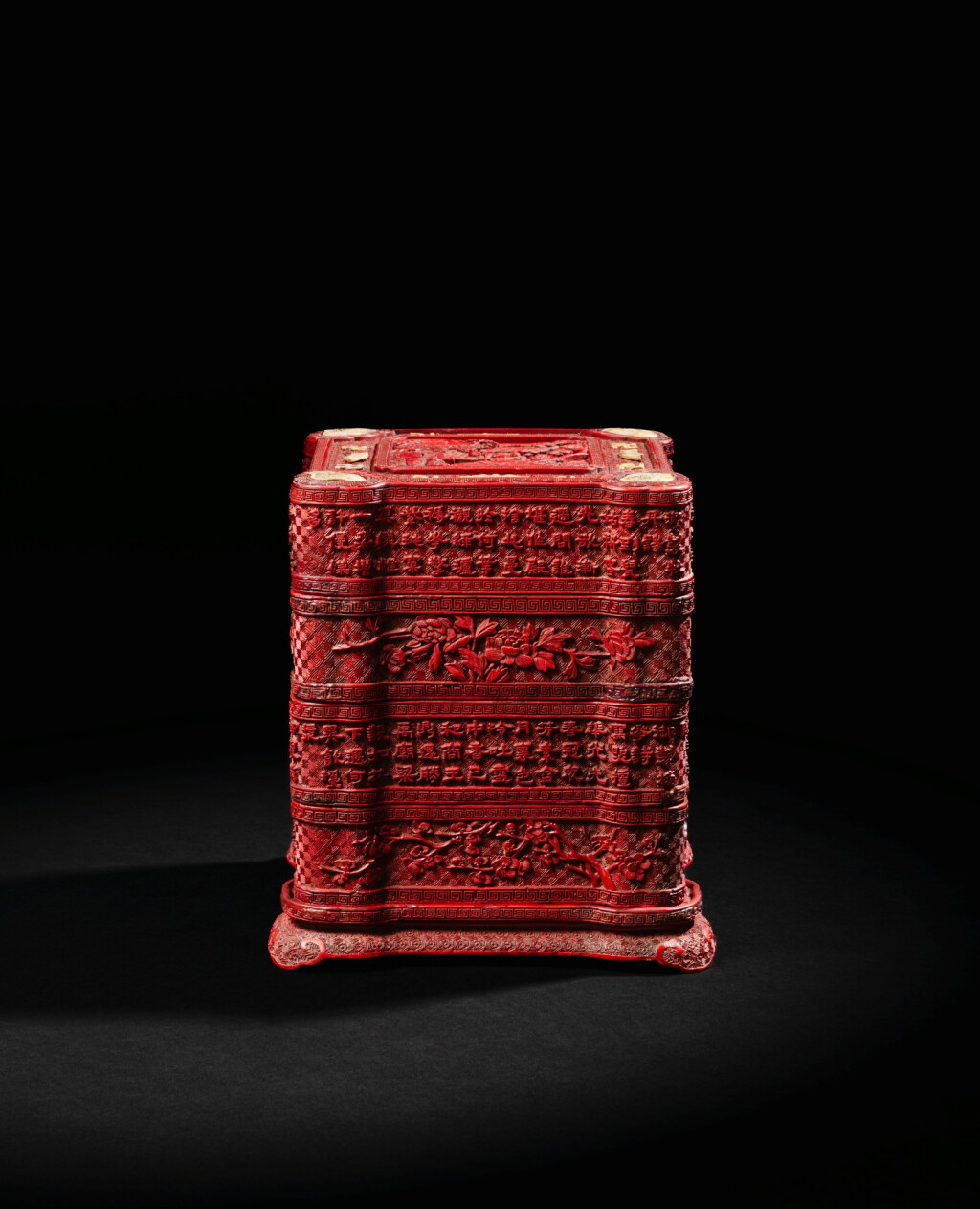
A rare imperially inscribed gilt-brass embellished cinnabar lacquer three-tiered box and cover, Qing dynasty, 18th / 19th century
Auction Closed
June 11, 03:42 PM GMT
Estimate
40,000 - 60,000 EUR
Lot Details
Description
each face carved with imperial poems on flowers (5)
21.5 x 17.3 x 17.3 cm, 8½ by 6¾ by 6¾ in.
Raised amidst the splendour of the imperial palaces, the Qianlong Emperor (r. 1736–1795) dedicated his reign as much to the arts as to the mundane affairs of state. A prolific poet, the emperor composed over forty thousand poems during his lifetime and frequently commissioned his craftsmen to incorporate his writings into works of art. His poems were also incorporated into works of art during the later reigns of the Qing dynasty.
The present box combines eight imperial poems, primarily those preserved in the third volume of the Yuzhi shiji [Compilation of Imperial Poems], with finely carved lacquer designs depicting the flora described.
The inlaid gilt-metal bats and wan ('myriad') symbols on the cover of the present box are unusual, although this type of embellishment on lacquer does exist in the decorative art repertoire at the Qing court. Other carved red lacquer works of art similarly embellished with gilt-metal insets include a wall vase, sold in our Hong Kong rooms, 5th October 2016, lot 21, from the collection of Roger Keverne. Compare also a jade-inset and gilt-bronze embellished cinnabar lacquer tiered box, from the Qing court collection, illustrated in The Complete Collection of Treasures of the Palace Museum. Lacquer Wares of the Qing Dynasty, Hong Kong, 2006, pl. 57; and a closely related Qing dynasty three-tiered lacquer box and stand similarly carved with a variety of flower cartouches, without poems, preserved in the National Palace Museum, Taipei (accession no. 故漆000070).
Imperial Poem on the Peony
When spring arrives, the peony blooms;
Yet springtime splendor soon begins to fade.
What flower could preside in the palace hall?
Beyond this one, what else could compare?
Its leaves spread like green jade carpets,
Its blossoms rise from purple jeweled nests.
Do not lament that there is but one flower—
If there were more, they would only seem excessive.
Imperial Poem on the Magnolia
Clusters of jade-like radiance flourish,
The orchid’s fragrance drifts softly and evenly.
It seems untouched by carving or artifice,
Yet within its simplicity lives true spirit.
Open and noble, rich in graceful charm,
Its beauty needs not rely upon spring.
Truly it deserves the name “wooden brush,”
Though others must paint its likeness.
Imperial Poem on the Peach Blossom
Its flowers alone are not merely for delight;
Its fruits also nourish the table.
How could the steward of the household forget it?
Nor would the young heirs admire it in vain.
Its flesh, when split, is smooth as green ice,
Its juices flow like cold emerald dew.
In the Jasper Pool there may be immortal peaches,
Yet they lie beyond vast and distant seas.
Imperial Poem on the Lotus
In tranquil thought I face the mirror-like pond,
With tender feeling beside the moonlit window.
Spring’s beauty recalls the banks of the Luo River,
Autumn waters awaken memories of the Xiang River.
I delight in flowers beyond all counting,
Nor care whether their ranks stand paired or alone.
Seated in contemplation and recitation alike,
I let sound and color resound freely around me.
———————
Imperial Poem on the Plum Blossom
Its painted likeness excels in radiant beauty,
Before spring it crowns all fragrant blooms.
Purely it holds the moon’s own color,
Coldly it exhales fragrance amid the snow.
It has already adorned King Shang’s cauldron,
And surpasses even the beams of Yu’s temple.
If one were to meet it beneath the forest shade,
It would be like drinking celestial nectar.
Imperial Poem on the Orchid
In the orchid garden of Chu I search and wander;
Jade-like leaves and golden buds cluster together.
In Qi, officials wore its fragrance upon themselves;
Returning to Lu, one found joy in playing the qin.
Spring gatherings recall the worthies of Jin,
Autumn winds echo Emperor Wu of Han’s songs.
Were it not for those who cherish and wear it,
Its fragrance would simply drift beyond the low wall’s shade.
Imperial Poem on Bamboo
Along the Wei River stretch thousands of bamboo groves,
Their jade-green stems striking the azure mist.
The stream recalls the retreat of the Six Recluses,
The forest gathers the writings of the Seven Sages.
Moonlight enters through the swaying shadows,
Wind overturns clouds of emerald feathers.
Though Xiangru arrived somewhat later,
He too was granted audience with Lord Liang.
Imperial Poem on the Chrysanthemum
Most fitting for the austerity of autumn,
It blooms especially in life’s later season.
Proud against frost, it is worthy to adorn the cap;
Drinking dew, it seems to raise a jeweled cup.
Li Shi praised it at Ci’en Temple,
Tao Qian loved it by Pengze’s banks.
All alike rejoice in what they encounter—
But who will come as a true kindred spirit?
御製牡丹詩
春到鼠姑科,春光欲漸過。問誰堪作殿,捨此更於何。
葉襯綠瓐褥,花擎紫玼窠。莫憐惟一朵,增許便嫌多。
御製玉蘭詩
簇簇玉光蔚。菲菲蘭氣勻。似中無刻畫。淡處有精神。
磊落偏饒韻。芳華不藉春。分明稱木筆。寫照倩他人。
御製桃花詩
不獨花宜玩,還饒果供餐。家丞那可忘,庶子未虛看。
瓤剖綠冰滑,液流翠露寒。瑤池有仙種,卻隔海漫漫。
御製荷花詩
澄思臨池鏡,含情對月窗。春光回洛浦,秋水憶湘江。
愛看花無萬,寧聞格有雙。坐參兼倚詠,聲色任摐摐。
---------------
御製梅花詩
寫照擅華光,先春冠眾芳。素含月裡色,冷吐雪中香。
已和商王鼎,還勝禹廟梁。設如林下遇,何異飲瓊漿。
御製蘭花詩
楚畹試披尋。葉瓊芽簇金。仕齊香竟體。返魯樂操琴。
春稧晉賢會。秋風漢武吟。不緣人莫服。芳散短墻陰。
御製竹詩
千畝渭川濆,琅玕戛碧氛。溪稱六逸隱,林會七賢文。
月入檀欒影,風翻翡翠雲。相如雖後至,也得見梁君。
御製菊花詩
最是禁秋質,偏於晚節開。傲霜宜插帽,飲露似擎杯。
李適慈恩寺,陶潛彭澤隈。一般欣所遇,知己問誰來。