
Property from an Important Private Collection, Monaco
Marino Marini
Cavallo
Auction Closed
April 16, 03:19 PM GMT
Estimate
50,000 - 70,000 EUR
Lot Details
Description
Property from an Important Private Collection, Monaco
Marino Marini
1901 - 1980
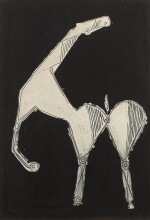
Cavallo
signed and dated 1953 (lower right)
tempera on cardboard mounted on canvas
63 x 44 cm ; 24 13/16 x 17 5/16 in.
Executed in 1953.
The authenticity of this work has been confirmed by the Fondazione Marino Marini.
Tornabuoni Art, Florence
Private collection, Monaco (acquired from the above in 1985)
Lorenzo Papi, Marino Marini pittore, Ivrea 1987, no. 294, p. 151, illustrated
“The taming of the wild horse marked a decisive stage in the evolution of human civilization. But beyond this symbolism, the horse, by virtue of its animal form… is in itself a thing of beauty that naturally appeals to the artist… By choosing this animal as his subject, Marini reveals a predilection as old as art itself. It is all the more remarkable that he succeeded in offering a new treatment of it.” (quoted in Herbert Read, Patrick Waldberg & Gualtieri di San Lazzaro, The Complete Works of Marino Marini, New York, 1970, p. 12)
Created in 1953, Cavallo by Marino Marini stands as a singular work within the artist’s career, in that it isolates a motif that is usually inseparable: here, the horse appears alone, deprived of its rider. This absence, far from being anecdotal, lends the composition a particular intensity, refocusing all attention on the animal itself, now the sole bearer of the symbolic and expressive charge sought by Marini.
The theme of the horse and rider occupies a central place in the artist’s work, where it traditionally embodies the fragile and shifting relationship between man and nature, while reinterpreting the long tradition of the equestrian portrait, from Antiquity to the great heroic effigies of the modern era. “For many centuries, the image of the rider retained an epic character. Its purpose was to pay homage to a conqueror, such as Marcus Aurelius, whose statue on the Capitol inspired the majority of equestrian statues of the Italian Renaissance, as well as that of Louis XIV, which adorns the Place des Victoires in Paris.” (quoted in Patrick Waldberg, Herbert Read & Gualtieri di San Lazzaro, Marino Marini, Complete Works, New York, 1970, p. 491).
But with Cavallo, this dialectic disappears, and the horse, freed from all human domination, becomes an autonomous, absolute figure, revealing a more archaic and essential dimension.
Marini himself emphasized the profound transformation of the relationship between man and beast during the twentieth century: “The nature of the relations that existed for so long between man and horse has greatly changed over the last half century… the horse has acquired a mythical character. Every artist is, in some way, a prophet… with Odilon Redon, Picasso and de Chirico, the horse has been transformed into a kind of dream, into a fabulous animal.” Deprived of its utilitarian functions and replaced by machines, the animal shifts into a symbolic register. In Marini’s work, it becomes an almost visionary being, at once the vestige of an ancient world and the projection of a contemporary anxiety.
In this work, the artist deploys a pictorial language of great freedom. The figure of the horse is reduced to its essence, its angular forms stripped down to the essential. Volumes are articulated through hatching in the mane and circular forms at the hooves and joints. Although the artist chooses to depict only three of the animal’s legs, it appears firmly grounded, yet its posture and its flat, unmodulated treatment convey real internal tensions. Through its slight rearing and the turn of its head in the opposite direction, Marini achieves an elegant contrapposto, expressing the pain (or perhaps the liberation) of the animal, which one can almost hear neighing. The bichromatic representation, this reduction to essentials, does not aim to describe but rather to condense an energy of movement in order to convey the animal’s inner state.
It is precisely this state—this loss of unity, this symbolic consecration of the animal’s freedom—that the artist seeks to express, with a certain pessimism: “As far as I am concerned, I no longer intend to celebrate the victory of a hero. I would like to express something tragic, a sort of twilight of unity, more a defeat than a victory. If you look at the equestrian statues I have made over the last twelve years, you will see that the rider is less and less able to control his horse, while the animal stiffens into an ever wilder state of fear, instead of rearing up. I sincerely believe that we are heading toward the end of a world.” (Marco Meneguzzo, Marino Marini, Cavalli e cavalieri, Milan, 1997, p. 22)
The absence of the rider thus reinforces this impression of both liberation and solitude. Where, in his equestrian compositions, Marini explored the gradual loss of human control over the animal—ultimately making it a sign of a world in crisis—Cavallo seems to bring this logic to its ultimate conclusion. The white horse is surrounded by black, which organizes the space around its figure. It is no longer contained, nor even confronted: it exists within a space entirely its own. By isolating the horse in this way, Marini achieves a form of purity in his central motif. Freed from any narrative function, the animal attains a timeless dimension. It embodies that primitive beauty which the artist recognized as inherent to its very form: “the horse (…) is in itself a thing of beauty that naturally appeals to the artist” (Herbert Read, Patrick Waldberg & Gualtieri di San Lazzaro, The Complete Works of Marino Marini, New York, 1970, p. 12).
In Cavallo, this appeal takes on a more solemn tone, expressed through a pictorial refinement and elegance of the highest order: that of a world in which former equilibria have dissolved, giving way to a solitary, powerful, and liberated figure.