From the Collection of the Kawamura Family, Japan
Friedensreich Hundertwasser
Trampoline into the Yellow
Auction Closed
April 17, 04:25 PM GMT
Estimate
100,000 - 150,000 EUR
Lot Details
Description
Friedensreich Hundertwasser
1928 - 2000
Trampoline into the Yellow
oil, egg tempera, indelible pencil on wrapping paper, primed with chalk and PV, mounted on Spanish canvas with PV
91.5 × 67.3 cm; 36 x 26 ½ in.
Executed en 1958.
This work is listed on the website of The Hundertwasser Non-Profit Foundation under no. 376.
Galerie H. Kamer, Paris
Docteur Audouin, Paris
Private Collection, Paris
Galerie Argos, Nantes
Mme Salomon, Paris
Galerie Paul Facchetti, Paris
G.A. Cavellini, Brescia
Galleria La Medusa, Rome (acquired in 1962)
Milan, Galleria Brera, 22 May 1962, lot 258
Collection J.J. Aberbach, New York (acquired in 1962)
Galerie Ariadne, Cologne (acquired in 1972)
Mr. Ilin, Geneva (acquired in 1973)
Minami Gallery, Tokyo (acquired in 1974)
Acquired from the above for the Kawamura family, Japan
Milan, Galleria Brera, 22 May 1962
Rome, Galleria La Medusa, Hundertwasser - Prima Mostra Personale a Roma, November 1962, no. 376, illustrated in colour
Cologne, Galerie Ariadne, 1972
Exh. Cat., Hanover, Kestner-Gesellschaft, Hundertwasser, 25 March - 3 May 1964, no. 376, pp. 78 and 172, illustrated in colour
Philip C. Rittersbush, Organic Forms, Washington 1968, pl. 17, illustrated
Exh. Cat., Alençon, Musée des Beaux-Arts et de la Dentelle, Hommage à Hundertwasser 1928–2000, 2 June - 30 September 2001, no. 376, p. 38
Andrea Christa Fürst, Hundertwasser 1928-2000, Catalogue Raisonné, Cologne 2002, vol. II, no. 376, p. 364, illustrated in colour
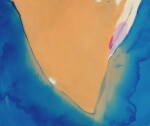
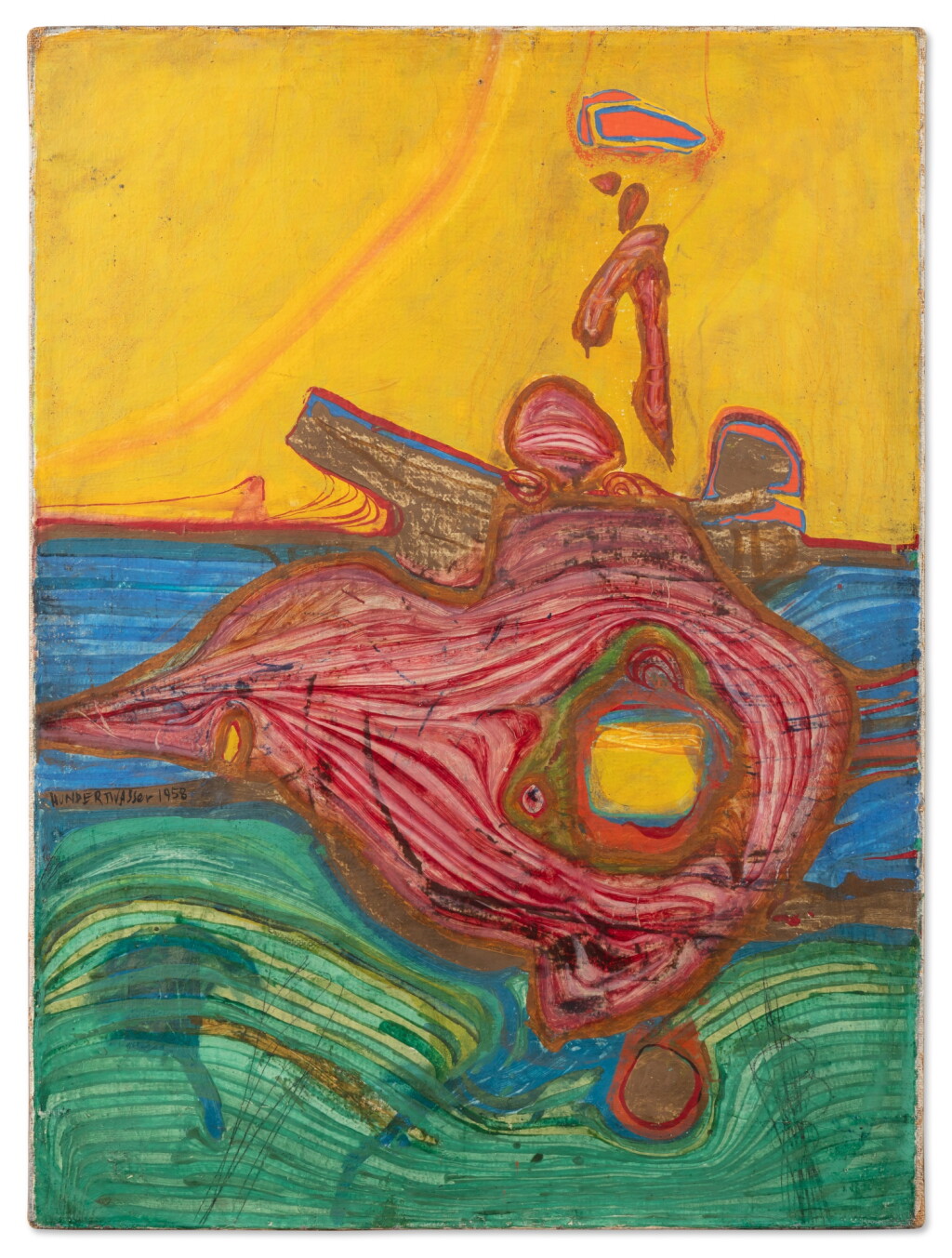
Painted at La Picaudière in 1958, Trampoline in the Yellow occupies a defining position within Hundertwasser's early maturity, at a moment when the artist was translating his theoretical convictions about organic form and autonomous pictorial growth into an increasingly assured painterly practice. The choice of wrapping paper as support — primed with chalk and polyvinyl, then mounted onto canvas, is not incidental but programmatic: Hundertwasser consistently privileged humble, absorbent grounds that would receive his layered media with a yielding, almost collaborative quality, the surface itself becoming a participant in the image's slow accumulation. Here, oil, tempera and indelible crayon are built up in laminar strata, producing a chromatic density that oscillates between luminous translucency and opaque materiality, the yellows and mauves pressing against one another with an intensity that no single medium could have achieved alone.
The formal architecture of the work belongs to the vocabulary Hundertwasser was elaborating in these years under the influence of Egon Schiele's contour intensity and Paul Klee's conviction that pictorial structure could mirror biological growth. The spiralling logic is neither decorative nor merely compositional: it enacts what Hundertwasser termed "transautomatism," a process by which the hand traces forms governed by an inner organic necessity rather than by conscious design. The yellow of the title functions less as description than as environment, an enveloping chromatic atmosphere against which the central organism both contrasts and belongs.
Trampoline in the yellow places itself in a discourse that extends well beyond painting; connecting Hundertwasser's spirals and membranes to a broader mid-century interrogation of the relationship between natural morphology, ornament and the structures of life itself. It is a work in which paint thinks biologically, and form insists on its own slow, irrefutable becoming.
You May Also Like