
A New Vista: The David and Shoshanna Wingate Collection
Tiffany Studios
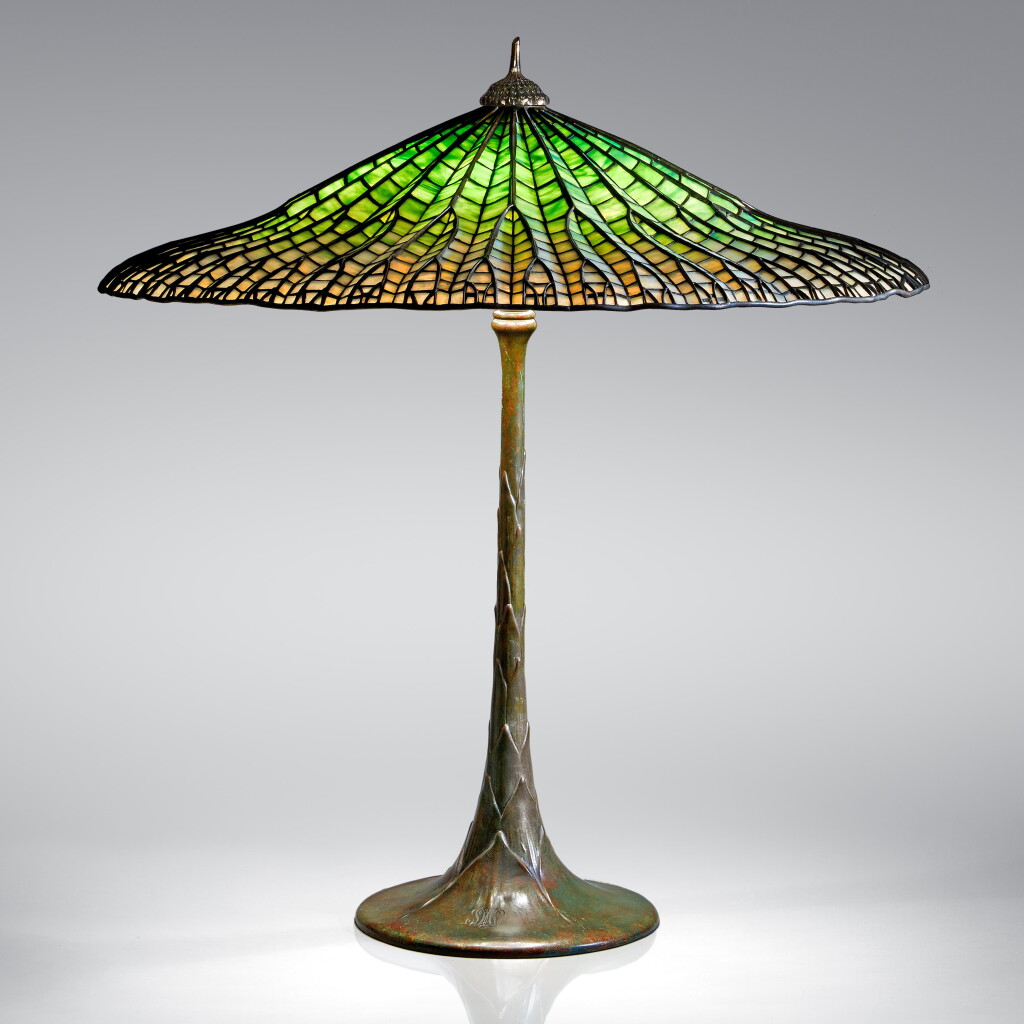
"Lotus" Table Lamp
Auction Closed
May 20, 02:46 PM GMT
Estimate
100,000 - 150,000 USD
Lot Details
Description
A New Vista: The David and Shoshanna Wingate Collection
Tiffany Studios
(1902-1932)
"Lotus" Table Lamp
with a "Tyler" base
shade with small early tag impressed TIFFANY STUDIOS/NEW YORK
base impressed TIFFANY STUDIOS/NEW YORK/S/336
top of base monogrammed SLM
leaded glass, patinated bronze
height: 28 ¼ in. 71.8 cm
diameter of shade: 26 ⅜ in. 67 cm.
Executed circa 1905.
Lillian Nassau, New York
Dr. Frank Stanton (acquired from the above)
Christie's, New York, 9 December 1995, lot 458 (consigned by the above)
Acquired at the above sale by the present owner
Martin Eidelberg, Alice Cooney Frelinghuysen, Nancy A. McClelland and Lars Rachen, The Lamps of Louis Comfort Tiffany, New York, 2005, p. 27 (for the shade)
Marilynn A. Johnson, Louis Comfort Tiffany: Artist for the Ages, London, 2005, p. 168, cat. 71 (for the shade)
Margaret K. Hofer and Rebecca Klassen, The Lamps of Tiffany Studios: Nature Illuminated, New York, 2016, p. 28 (for the shade)
Exh. Cat., Winter Park, Florida, The Charles Hosmer Morse Museum of American Art, Timeless Beauty: The Art of Louis Comfort Tiffany, 2016, p. 94 (for the shade)
Alastair Duncan, Tiffany Lamps and Metalware, Woodbridge, Suffolk, 2019, pp. 88, no. 339 and 181, no. 728 (for the shade); 104, no. 409 (for the shade and base pairing)
Louis Comfort Tiffany created numerous artificial ponds on his two Long Island estates, “The Briars” and later at “Laurelton Hall,” and enhanced many of them with a wide variety of aquatic plants including the lotus. Tiffany Studios incorporated lotus blossoms in some of their most magnificent leaded glass shades. Louis Tiffany, with his unrivaled artistic genius, also designed one of the firm’s earliest shades inspired by the most improbable of sources: the underside of a lotus leaf.
Introduced around 1903, the company listed the model as “1524. 25” LOTUS. Pagoda $125.” The angular undulating shade beautifully replicates the leaf’s unique structure, with its intricate network of hollow wax tubules that allow the plant to float and keep its top surface dry. In Tiffany’s brilliant interpretation, a multitude of geometrically shaped pieces of opalescent glass, in this instance gradually shading from a rich green to a delicate white, were intricately assembled using the copper-foil technique. In the meantime, the branching vertical ribs structurally reinforce the uniquely-shaped shallow, wide shade.
The model was discontinued less than 10 years after its first appearance, likely due to the time and expense required to create the complex motif. The design of the Lotus shade, a remarkable achievement for its time, is both ageless and universal. This is perhaps best demonstrated by noting that the model was beautifully integrated with the existing furnishings of Frank Lloyd Wright’s architectural masterpiece, “Fallingwater.”
PAUL DOROS
You May Also Like


