Jean-François Millet
Sheep Shearers (A Study)
Lot Closed
February 6, 07:14 PM GMT
Estimate
12,000 - 18,000 USD
We may charge or debit your saved payment method subject to the terms set out in our Conditions of Business for Buyers.
Read more.Lot Details
Description
Jean-François Millet
French 1814 - 1875
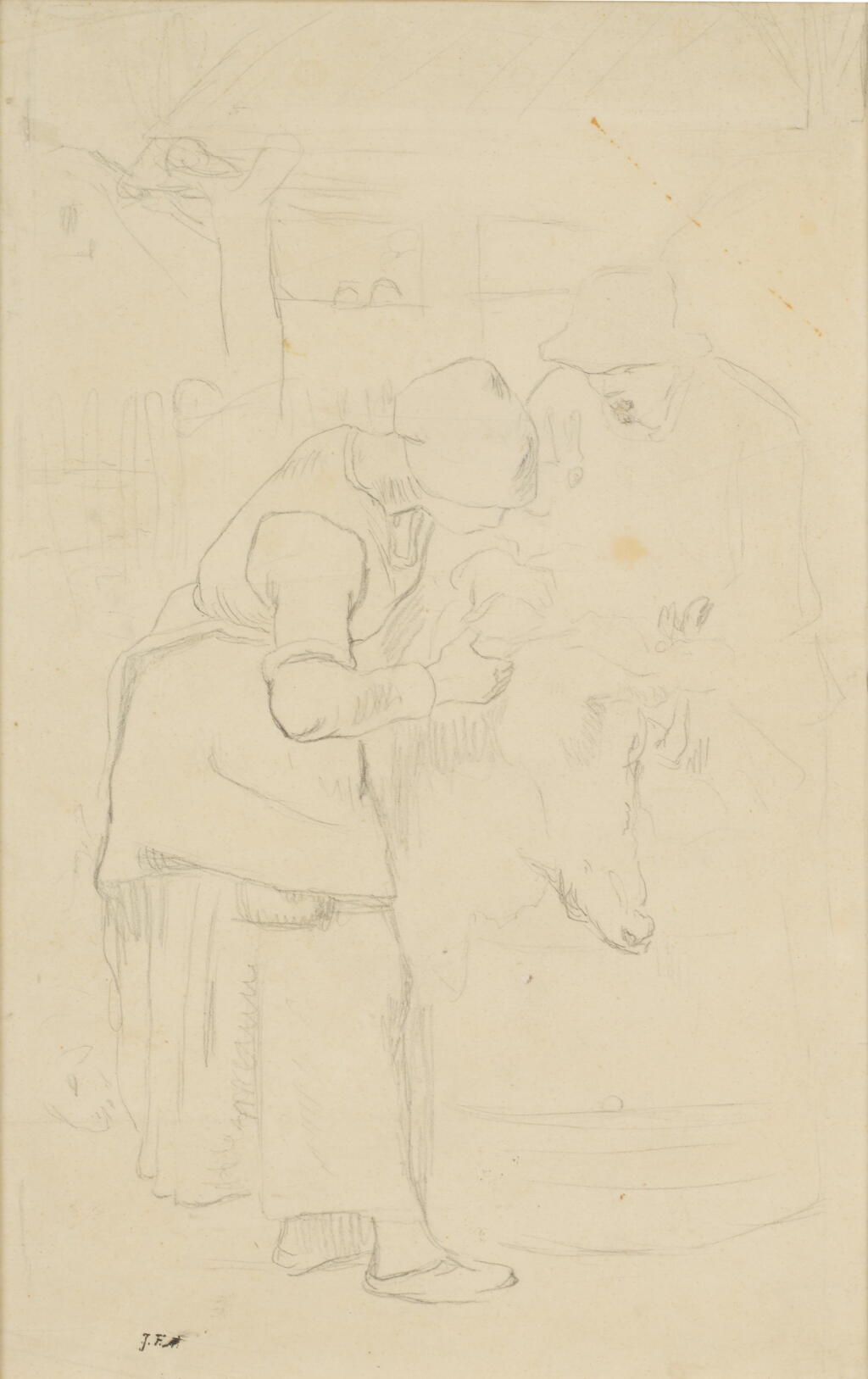
Sheep Shearers (A Study)
signed lower left: J. F. Millet.
pencil on tracing paper laid down on paper
sheet: 16 ⅜ by 10 ½ in.; 41.6 by 26.7 cm
framed: 27 ⅝ by 21 ⅝ in.; 70.2 by 54.9 cm
We would like to thank Alexandra Murphy for kindly confirming the authenticity of this lot and providing this catalogue entry.
Estate of the artist
Hotel Drouot, Paris, 10-11 May 1875, lot 26 (consigned by the above)
With John Morris Gallery (acquired by 1996)
Acquired from the above by the present owner
This drawing reprises the composition of Millet’s Sheepshearing, Spring, Summer, in the collection of the Museum of Fine Arts, Boston. The Boston picture painted between 1852-1853 was exhibited at the Paris Salon in 1853 and sold soon after to the American collector and painter, William Morris Hunt.
According to Alexandra Murphy, Sheepshearing had caught Millet’s eye at an earlier date when he sketched a very different composition of two men shearing sheep in a barn. Millet’s 1852–1853 Shearing Sheep, which begins a series of several drawings and paintings that culminates in Sheepshearing of 1860, was probably suggested by reflections on one of the large Paris or the western edge of the Barbizon. The sheepherders work crouched in a small hut that shelters them and a stack of grain. A placid farmer works nearby, flinging fence, and a distant farm building provides a specific note of place that is quite modern, and sets these shepherds apart from the more emblematic workers of preceding years, whose surroundings were subordinated to their task. (Murphy, Jean-François Millet, Boston, 1984, p. 89)
It has been suggested that the present work was executed from an etching or engraving after the above-noted work.
You May Also Like