
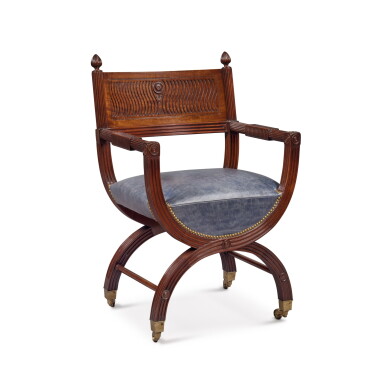
A Victorian Mahogany X-Frame Armchair attributed to Marsh, Jones & Cribb after a design by Thomas Hope, Circa 1880
No reserve
Lot Closed
February 11, 04:39 PM GMT
Estimate
5,000 - 7,000 USD
We may charge or debit your saved payment method subject to the terms set out in our Conditions of Business for Buyers.
Read more.Lot Details
Description
the concave strigilated crest tablet between reeded uprights terminating in reeded pinecone finials, on a fluted X-frame support joined by stretchers with brass caps and castors; stencilled 65385 to the left inside rail
height 39 in.; width 24 in.; depth 23 in.
99 cm; 61 cm; 58.5 cm
Carlton Hobbs, London;
Christie's London, 20 November 2008, lot 565;
Where acquired by Aso O. Tavitian
The curule chair, alongside its close relative the X-frame stool, is one of the most overt innovations of the form of Neoclassicism adopted during the Regency. A form practically unseen during the preceding George III and Louis XVI period, its revival was born of a new desire to revive the furniture forms of Antiquity with greater historical accuracy than had previously been the case. The curule chair had, in Ancient Rome, been the seat upon magistrates sat, and can be seen on coins of the era as a symbolic marker of great power. In the early 19th century, they feature in the drawings of the leading furniture designer in the Empire style, Charles Percier, but this particular curule chair model is drawn directly from an English source. It is based on a Roman-style curule armchair designed by the antiquarian and connoisseur Thomas Hope for the Breakfast Room of his Duchess Street House in London, published in his Household Furniture and Interior Decoration, London 1807, pl. XX, nos. 3 and 4. A variation of this chair with slightly different decoration also appears in the Aurora & Cephalus Room of the same house, illustrated in plate VII.
A very similar mahogany curule armchair sold Christie’s London, 24 April 2008, lot 52 bears a paper label MARSH, JONES, & CRIBB/ (Late 'Kendell & Co.') No. 9337 Feb,. 4th 1890. The Leeds-based firm of John Marsh and Edward Jones acquired the established London business of John Kendell in 1864 and opened a showroom in Cavendish Square, subsequently entering into partnership with Henry Cribb in 1872. During the 1860s and 70s they were particularly associated with work produced in the Gothic Revival taste fashionable during the High Victorian period.