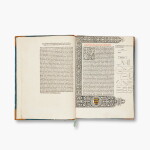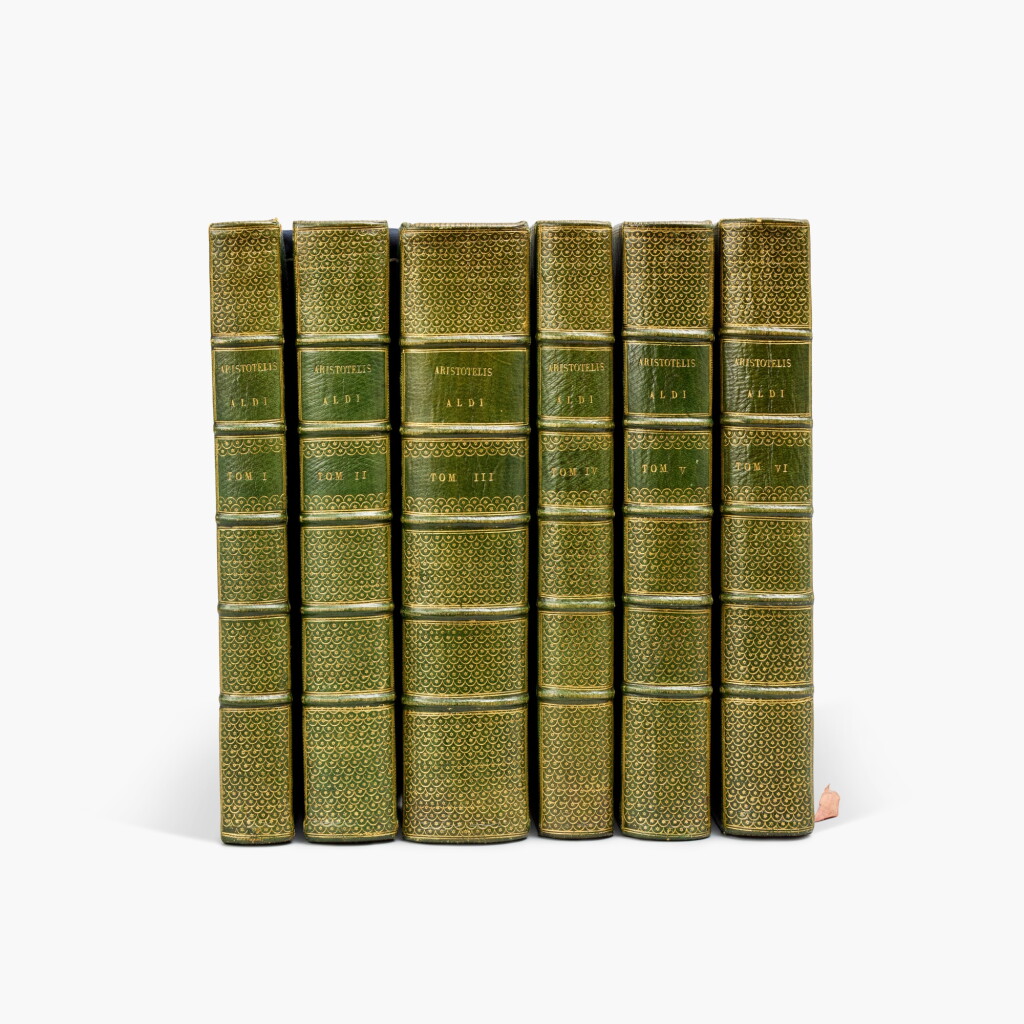
Aristotle | The fine Doheny set of Aldo's editio princeps, Venice, 1495–1498
Auction Closed
December 9, 09:48 PM GMT
Estimate
400,000 - 600,000 USD
Lot Details
Description
Aristotle
Opera [Greek]. Contains also works of Galenus (II); Philo Judaeus (II); Theophrastus (II-IV); Alexander Aphrodisaeus (IV). Venice: Aldus Manutius, 1495–1498 [the five volumes dated dated: I) 1 November 1495; II) February 1497; III) 29 January 1497; IV) 1 June 1497; V) June 1498]
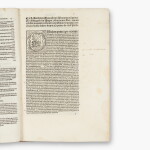
5 volumes in 6 (volume 4 bound in 2), Super-Chancery folio (305 [vol. 1] or 310 [vols. 2–6] x 200 mm). Greek types with Roman, 30 lines plus headline (no headlines in vol. 1), woodcut floral and interlaced headpieces and Greek initials, woodcut diagram in vol. 1 (I1r). Collation: (Please note: vol. I has quires conventionally signed according to the Roman alphabet; vols. 2–5 were signed by a complex mixture of Roman and Greek letters; for ease of reference, in the following collation the quires for vols. 2–5 are numbered): Vol. 1 (Organon): A–K8 L–N6 a–c8 d–e6 f–q8 r–s6: 234 leaves; s6r colophon. — Vol. 2 (Natural Philosophy, part I): 1–48 5–158 16–308 316 32–378 386: 300 leaves; 38/6r colophon. — Vol. 3 (Natural Philosophy, part II): 1–1010 (cancel-strip mounted on 10/10v containing last line and catchword) 11–3910 4010 (+10* signed PP, printed on recto, verso blank, uncancelled blank conjugate follows PP10) 41–4510 468 478: 468 leaves (47/8 blank); 47/7v colophon. — Vol. 4 (Natural Philosophy, part III, bound in 2 vols.): 12 2–288 2910 30–418 42–4310 44–478 4810 49–506 51–648 6510: 520 leaves (vols. divided after fo. 228); 65/10r colophon. — Vol. 5 (Ethics, Economics, and Politics): 1–910 104 11–2110 226 2312 24–2610 276 28–3310 3412: 330 leaves; 34/12r colophon. Seeming flaw on e5v (vol. I) is an original paper overlay, very occasional light foxing to margins.
Eighteenth-century French green straightgrain morocco gilt, covers with a gilt French fillet border with tiny rosettes at the corners, spines gilt in six compartments, lettered in the second and third, the others densely gilt with a semé of stars within compartments formed by repeated ranks of small curvilinear rules, purple silk linings, turn-ins gilt with foliate roll, endpapers, gilt edges, pink silk ribbon-markers; slightest hint of the most minor rubbing.
A very fine and complete set of the editio princeps: the first edition of Aristotle in Greek, as also of the other ancient texts included, by Theophrastus, Porphyry, and others. The Aristotle was the major production of Aldus's shop. Aldus's dedication in the first volume to his patron Alberto Pio da Carpi outlines his plan for providing the world (“despite the turbulence of the times, more favorable to arms than to books”) with an entire corpus of ancient Greek learning: Aristotle's logic (i.e., vol. 1); his natural philosophy (vols. 2–4) and moral philosophy (part 5); the major commentators on Aristotle; and all the grammarians, poets, orators and historians whose work may profit the studious.
The Aldine Aristotle was, in terms of scholarly enterprise and vision, the greatest printing project of its century: the complete Opera represented more leaves of Greek type than had cumulatively been printed since the time of Gutenberg. Aldus recorded that he and his humanist friends searched widely across Europe for Greek manuscripts to be consulted or copied—as far as to Britain. Cardinal Bessarion's great collection of Greek manuscripts, which had been bequeathed to the city of Venice, still remained unpacked. Three manuscripts that were used as printer's copy survive at Harvard and in the Bibliothèque Nationale de France. Editors and learned consultants for the project included Francesco Cavalli of Padua, the Greek emigrés Marcus Musurus and Aristobulus Apostolis, and the English physician-humanist Thomas Linacre. The Greek fonts, with separate characters for accentuation, were cut by the goldsmith Francesco Griffo (who also created the Aldine italic), based on the calligraphic hand of Immanuel Rhusotas. Each volume of the Aristotle contains a printed notice that Aldus held a special privilege for Greek printing granted by the Venetian senate.
“Aristotle is not only one of the great classical philosophers, the master of every branch of ancient knowledge: his method still underlies all modern thinking. His works include the six logical treatises that make up the Organon, a score on scientific subjects, the 'Metaphysics', 'Ethics' and 'Politics', works on rhetoric and poetry, and the tract 'On the Constitution of Athens' (the only one of one hundred and fifty or more on different constitutions which has survived). … Most of Aristotle's ideas were originally delivered in the form of lectures, and the texts we have are probably the lecture-notes of his pupils, which he may or may not have edited. … Unlike other classical writers Aristotle retained his fame throughout the Middle Ages, largely through the works of Thomas Aquinas, Albertus Magnus and Averroes; the last of whom provided the Latin translation and the extensive commentary to his works as published in Padua in the 1470s. But the great Aldine editio princeps, issued in five folio volumes between 1495 and 1498, was the first major Greek prose text to be reintroduced in the original to the western world by the intervention of the printing press” (Printing and the Mind of Man).
REFERENCES
UCLA 4, 11, 21, 23, 24; BMC V 553 (IB.24392–5), 556 (IB.24431–3), 555 (IB.24423–5), 556 (IB.24435–7), 558 (IB.24463–5); Goff A959; GW 2334; ISTC ia00959000; Grolier/Aldus 11 (Vol. 4 only; “often bound in two because of its great length”); Dibner, Heralds 73; Norman 70; Osler 229; Printing and the Mind of Man 38; Renouard 7/5, 10/1, 11/2, 11/3, 16/1; cf. Nicolas Barker, Aldus Manutius and the Development of Greek Script and Type in the Fifteenth Century (Fordham University Press, 1992); cf. for the printer’s copies used by Aldus, Martin Sicherl, Griechische Erstausgaben des Aldus Manutius (Paderborn, 1997); cf. for the paper size, Paul Needham, “Aldus Manutius’s Paper Stocks: The Evidence of Two Uncut Books,” in Princeton University Library Chronicle 55 no. 2 (Winter 1994):287–307. Not in Bibliotheca Brookeriana
PROVENANCE
Thomas Payne the younger (1752–1831, bookseller, sold for 40 guineas to) — Rev. Henry Drury (inscriptions; Evans, 20 February 1827, lot 388, to) — Samuel Butler, Bishop of Lichfield (this copy not in his sales 1840–41, nor in the Payne & Foss catalogue) — Ambroise Firmin-Didot (bookplates; Drouot-Delestre, G. Pawlowski and A. Labitte experts, 27 May 1879, lot 199; binding there attributed to Padeloup, to Ellis for) — Sir Thomas Brooke (bookplate; private library catalogue, 1891, vol. 1, p. 28) — Bernard Quaritch Ltd. (collation-mark 27 May 1921) — Alice Millard, April 1934, commission sale to the Papal Countess Estelle Doheny (morocco label; Christie's New York, 22 October 1987, lot 105, to) — Bernard Quaritch Ltd. — Christie’s New York, 11 November 2004, lot 3 (undesignated consignor; “The Property of a Gentleman”)
We are grateful to Paul Needham for his consultation on this lot.

![Kepler, Johannes | Harmonices Mundi Libri V, Linz, 1619, first edition, [bound with:] Prodomus dissertationum cosmographicum …, Frankfurt, 1621–1622](https://sothebys-md.brightspotcdn.com/dims4/default/d54d010/2147483647/strip/true/crop/2000x2000+0+0/resize/150x150!/quality/90/?url=http%3A%2F%2Fsothebys-brightspot.s3.amazonaws.com%2Fmedia-desk%2Fwebnative%2Fimages%2F63%2F0b%2Fa27794664ee78085e15afe3c5535%2Fn12451-58tmv-t1-05.jpg)