View full screen - View 1 of Lot 12. La Mère Ubu.

The Cindy and Jay Pritzker Collection

Joan Miró

La Mère Ubu

Auction Closed

November 20, 11:43 PM GMT

Estimate

4,000,000 - 6,000,000 USD

Lot Details

Description

The Cindy and Jay Pritzker Collection

Joan Miró

(1893 - 1983)


La Mère Ubu

inscribed Miró, numbered 3/4 and stamped with the foundry mark SUSSE FONDEUR. PARIS

bronze

height: 66 ½ in. 169 cm.

Conceived in 1975 in a numbered edition of 4 plus 1 artist's proof; this example cast circa 1977 by Susse Fondeur.

Please note this lot will be available for collection from Dun-Rite following the auction and the successful purchaser will be responsible for collection, shipping, and release fees. Please contact Bridget.Quinn@sothebys.com with any questions.

Pierre Matisse Gallery, New York (acquired directly from the artist in March 1977)

Acquired from the above on 25 April 1980 by the present owner

Exh. Cat., New York, Pierre Matisse Gallery, Miró, 1976, no. 26, frontispiece, illustration of another cast

Exh. Cat., Musée d'art moderne de la ville de Paris, Miró, cent sculptures, 1962-1978, 1978, no. 97, illustration in color of another cast on the cover; p. 79, illustration of another cast

Exh. Cat., Saint-Paul-de-Vence, Fondation Maeght, Joan Miró: Peintures, sculptures, dessins, céramiques, 1979, no. 306, p. 94, illustration of another cast; p. 190

Alain Jouffroy and Joan Teixidor, Miró Sculptures, Paris, 1980, no. 282, p. 203, illustration of another cast; p. 246

Exh. Cat., Milan, Palazzo Dugnani, Miró Milano, Pittura, Scultura, Ceramica, Disegni, Sobreteixims, Grafica, 1981, no. 249, p. 104, illustration of another cast

Jacques Dupin, Miró, New York, 1993, no. 406, p. 381, illustration in color of another cast

Barbara Catoir, Miró on Mallorca, New York, 1995, p. 92, illustration in color of another cast

Emilio Fernández Miró and Pilar Ortega Chapel, Joan Miró, Sculptures. Catalogue raisonné, 1928-1982, Paris, 2006, no. 333, p. 314; p. 315, illustration in color of another cast

Jacques Dupin, Miró, Paris, 2012, p. 381, illustration in color of another cast

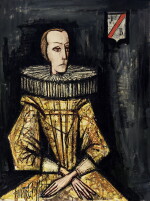
There are few works wherein that aspiration finds a more articulated form than in La Mère Ubu. Conceived in 1975 and cast shortly after in 1977, the imposing bronze makes a most wondrous transgression from Miró’s imagination into the natural world. A paradigmatic approach to the theme of the female figure (see fig. 2)—among the most prolific motifs within Miró’s painted and sculptural output—and a beautifully narrative reimagining of the French playwright Alfred Jarry’s Ubu roi—Miró’s oft-revisited creative manifesto—La Mère Ubu is animated by the lifesource of Miró’s idiosyncratic Surrealist vision.


La Mère Ubu arises from the late creative wellspring largely inspired by the artist’s time in Mallorca. Jacques Dupin, the French poet and art critic, and friend-turned-biographer of Miró, marvels of the fecund period which was brought about by the environment of his new studio there: "The sculptures from the last two decades of Miró's productive life took on a broad place and force. For Miró, sculpture became an intrinsic adventure, an important means of expression that competed with the canvas and sheet of paper—the domains and artistic spaces proper to Miró—without ever simply being a mere derivative or deviation from painting. Miró's approach and conception of sculpture offered him an immediate contact with a reality that, in painting, was attainable through the screen of an elaborately constructed language" (Jacques Dupin, Miró, Barcelona, 2004, pp. 361 and 367).


Miró’s sculptural oeuvre is distinguished by two distinct approaches: the first were composed of found materials, whose inherent and uncanny visual associations informed the arrangements which Miró constructed. The second were those brought to life entirely by Miró’s hand—biomorphic figures, indebted to Miró’s fascination with the folk ceramics of Mallorca and Catalunya, which were modeled in clay, enlarged and then cast in bronze. It was this second category of sculpture which offers the most contiguous and perhaps profound extension of Miró’s painterly practice. While painting remained a process of pure invention, sculpture was one of embodied creation.


This sense of self-possession is undeniably felt within La Mère Ubu. In her towering scale she stands with a conviction that seems a greater reflection of her own conscious mind than of the materialization of the artist. The smoothly hewn surface of her form rejects the postulation that she was constructed by the human hand, but rather sprouted from earth out of the trunk-like base on which she stands.


In conceiving of this “world of living monsters,” there is perhaps no more apt source material than Jarry’s Ubu roi. First performed in 1896, the play is an absurdist reimagination of Shakespeare’s Macbeth which, in its commentary, satirizes the complacency towards the greed and self-gratification which characterized the political class in France at the time. The opening night performance was met with riotous derision, the audience incensed by the farcical display of actors dressed in cardboard costumes reciting Jarry’s drama, written in a dialect of slang, puns and words of the author’s own invention. The outrage and uproar was precisely the response Jarry hoped to elicit: “I intended that when the curtain went up the scene should confront the public like the exaggerating mirror in the stories of Madame Leprince de Beaumont, in which the depraved saw themselves with dragons' bodies, or bulls' horns, or whatever corresponded to their particular vice. It is not surprising that the public should have been aghast at the sight of its other self, which it had never before been shown completely.”


Jarry’s play was an incendiary point of reference for the Dadaists and later the Surrealists, for whom it served as a touchstone in their foray into the irrational and the absurd. In his 1923 canvas Ubu Imperator, Max Ernst conceives of Jarry’s titular character as the physical embodiments of his imperialist ambition—his body conceived as a fortress, his head the tower, and his hands, raised as if in benediction, the only human feature (see fig. 3). The figure’s body tapers to resemble a spinning top, balanced precariously on a needle-point—a metaphor or premonition of the instability of the king’s ego. Miró variously adopted Ubu as protagonist within his own work, dedicating a number of drawings and sketches, and three suites of lithographs to the character.


Within the present work, Miró takes Ubu’s wife, Mère Ubu, as his subject. Within the play, it is Mère Ubu who initially convinces her husband to incite a revolution, leading him to kill the King of Poland and thus setting off the devolution of the drama. Once Ubu has taken to the throne, Mère Ubu—her lust for power heightened by her new role as Queen—is caught attempting to steal the treasures from the palace and in turn disguises herself as the angel Gabriel to coerce her husband into forgiving her.


Though Mère Ubu, French for “mother Ubu”, is her given name within the play, in the context of Miró’s sculpture, it introduces a notion of motherhood which complicates the figure’s role as a woman. That complication is perhaps most succinctly visualized in the violent protrusion which seems to puncture her body. It can, on the one hand, be understood as a narrative allusion to her husband, an abstraction of the conical hat which Jarry envisioned as a characteristic accessory of Ubu. At the same time, it can also be understood as a biomorphic appendage of a kind often employed by Miró to endow potential sexual meaning to his figures. In its placement, however, along her proper left side, it also calls to mind the canonical posture of the mother and child.


It is at once a symbolic and a distinctly formal evocation of the notion of motherhood, one which was widely approached by Miró’s contemporaries working within a similarly biomorphic mode of abstraction. In Barbara Hepworth’s totemic Parent I, it is the void within the torso element which confers on the work its name. An evocation of the womb, this physical absence created by the tunneling through of the solid form likewise suggests a sense of incompleteness, a bifurcated sense of self which the state of parenthood imparts. Within the canonized iconography, the child becomes an extension of the mother, held within her arms. In Hepworth’s work the necessity of that togetherness is expressed through an extraction—the visualization of a literally missing piece. In La Mère Ubu, Miró conceives of the relationship between mother and child as something inextricable—something physically, and in turn metaphysically, intrinsic. At the same time, it makes pertinent allusion to the female body as a receptacle and as host, even to a violent inhabitant.


This intrusion on her form is the only instance within the work where Miró’s hand is distinctly legible. From the matte patination of the surface, to the organic slope of her right arm, to the perfectly concave socket and spherical protrusion from her head, there is little trace of Miró’s intervention. Yet the deep, engraved line which demarcates her figure from the foreign presence within it records the decisive movement of his tool—a reminder of Miró’s presence within the form.


Art historian William Jeffett eloquently expounds on the phenomenon at play: “Unlike the other Surrealists, Miró situated the source of inspiration outside himself, in nature. The experience he expressed was that of receptive wakefulness, rather than of sleeping; the daydream rather than the nightmare” (Exh. Cat., Southampton City Art Gallery and traveling, Joan Miró: Sculpture, 1989-90, p. 9). La Mère Ubu stands as a striking invocation of this concept of day dream. Poised to occupy a space between the lived and supernatural, she is an animation of the signs and figures which occupy his painted Surrealist world and here make a decisive interjection into our own.