Marten van Cleve
The Bedding Ceremony
Auction Closed
June 11, 01:34 PM GMT
Estimate
30,000 - 50,000 EUR
Lot Details
Description
Marten van Cleve
Antwerp 1527 - 1581
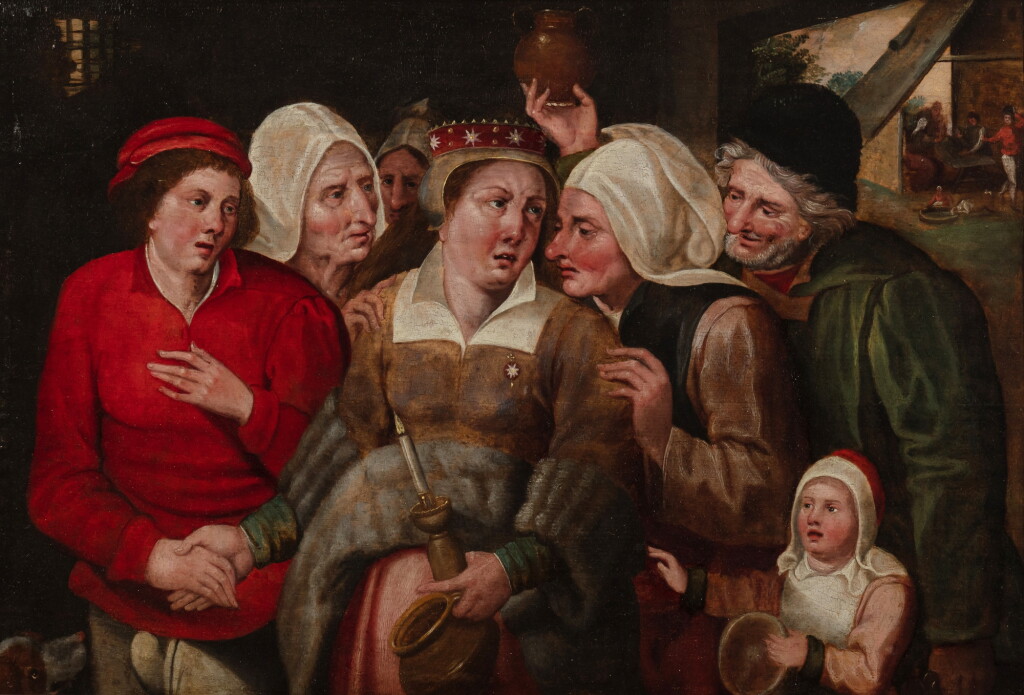
The Bedding Ceremony
Oil on panel
45,7 x 67 cm ; 18 by 26⅜ in.
Anonymous sale, Galerie Moderne, Brussels (as per a label on the reverse);
Private collection, Brussels.
A contemporary of Pieter Brueghel the Elder, with whom he was admitted to the Guild of St Luke in Antwerp as a master between 1551 and 1552, Marten van Cleve (1527–1581) trained with his father and then probably with Frans Floris. Specializing in genre painting, he became known above all for his lively village scenes featuring weddings, dances, fairs and brawls, but he also painted religious and historical subjects.
In the Ceremony of the Marriage Bed, Marten van Cleve returns to one of the most popular themes in his oeuvre: the peasant wedding, introduced into Dutch iconography in the sixteenth century. A topical subject at the time, it was particularly favoured in the southern commercial centres such as Bruges and Antwerp – this is evidenced by similar works produced by Pieter Brueghel the Elder and followers including Pieter Brueghel the Younger, Peeter Baltens, Jan Massys and Pieter Huys.
Van Cleve here illustrates the last episode in the series: the young bride is led to her bedroom by the guests. Her right hand holding that of the man who must be her husband, with a candlestick and a chamber pot in her left hand – commonly given as wedding gifts – she wears a nuptial crown, the oldest form of decorative head covering for women in the history of clothing and a symbol of purity and social status. To the bride’s left, a female figure, probably her mother, is supporting her, accompanied by a man who could be her father. Between them, a child is trying to touch her apparel. Two further female figures, presumably guests, attend the scene, while in the background, through an open door in the top right-hand corner of the composition, a lively banquet is taking place. In the lower left-hand corner, there is a dog, symbol of faithfulness.
A dendrochronological analysis has revealed that the painting was probably made after 1578, late in the painter’s career. Two years earlier, he had produced a similar monogrammed and dated composition, in a smaller size, which was with De Boer, Amsterdam, in 1934. Another version, of comparable size (53 x 66 cm), was in the Hartveld gallery, New York.
Finally, the work is known from the many engravings which were produced after such scenes, such as one by the Antwerp artist Peeter Baltens (1540–1584) in about 1576, now in the Rijksmuseum, Amsterdam (inv. RP-P-1887-A-11494). Here, the bride is in tears, symbolizing her virginity or her fear, perhaps alluding to the serious nature of the marriage consummation.
You May Also Like