Property from a Spanish Private Collection
Frans de Momper
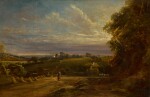
An animated village scene
Auction Closed
June 11, 01:34 PM GMT
Estimate
26,000 - 35,000 EUR
Lot Details
Description
Frans de Momper
Antwerp 1603 - 1660
An animated village scene
Oil on panel
Signed lower left F. d. momper.
82,5 x 113,2 cm ; 32½ by 44⅝ in.
Anonymous sale, Phillips, London, 8 December 1992, lot 15;
Rafael Valls, Maastricht, 1996 (as per a label on the reverse);
Private Collection, Spain.
Best known for his picturesque scenes animated with figures from rural life, Frans de Momper (1603–1660) became a member of the Guild of St Luke in Antwerp in 1629. He moved between The Hague, Haarlem and Amsterdam in the 1630s and 1640s before finally settling in Antwerp.
His work is characterized by landscapes with an almost monochrome palette, in which the restricted and harmonious use of colours creates a unified atmosphere. Each painting is often characterized by a principal colour – browns, grey-greens or ochres – in subtle gradations. This approach speaks of the influence of Jan van Goyen and his circle, but also that of his uncle Joos de Momper, visible in his panoramic compositions. Frans de Momper produced many variations on the themes of the river landscape and village life. He combines the low horizon and luminous skies of the Dutch School with the finely drawn figures and trees inherited from the Italo-Flemish tradition, giving his scenes of ordinary Flemish life a realistic atmosphere.
In Village Fair, Momper depicts a large and lively village with scenes of dancing, fishing, religious life and gatherings, showing a glimpse of contemporary life. The composition is structured around a central road and the figures, vegetation, architecture and ford are organized so as to give a panoramic and detailed view. It recalls the work of Pieter Brueghel the Elder, but with a more pictorial and less moralistic treatment. The large expanse of sky, crossed by birds, gives prominence to a cloudy vista of changing colours, reflecting the effects of sunlight. Van Goyen’s influence is also evident in the luminous treatment and use of warm tones, adding to the unity of colour in the scene.
This composition may be compared to Village with Dancing Peasants (Musées Royaux des Beaux-Arts de Belgique, Brussels, inv. 6046) where the light also plays an important part in the organization of the scene. Numerous figures are arranged in small groups, drinking, dancing and chatting in a scene that combines nature, meticulously rendered Flemish architecture and a slightly cloudy sky.