
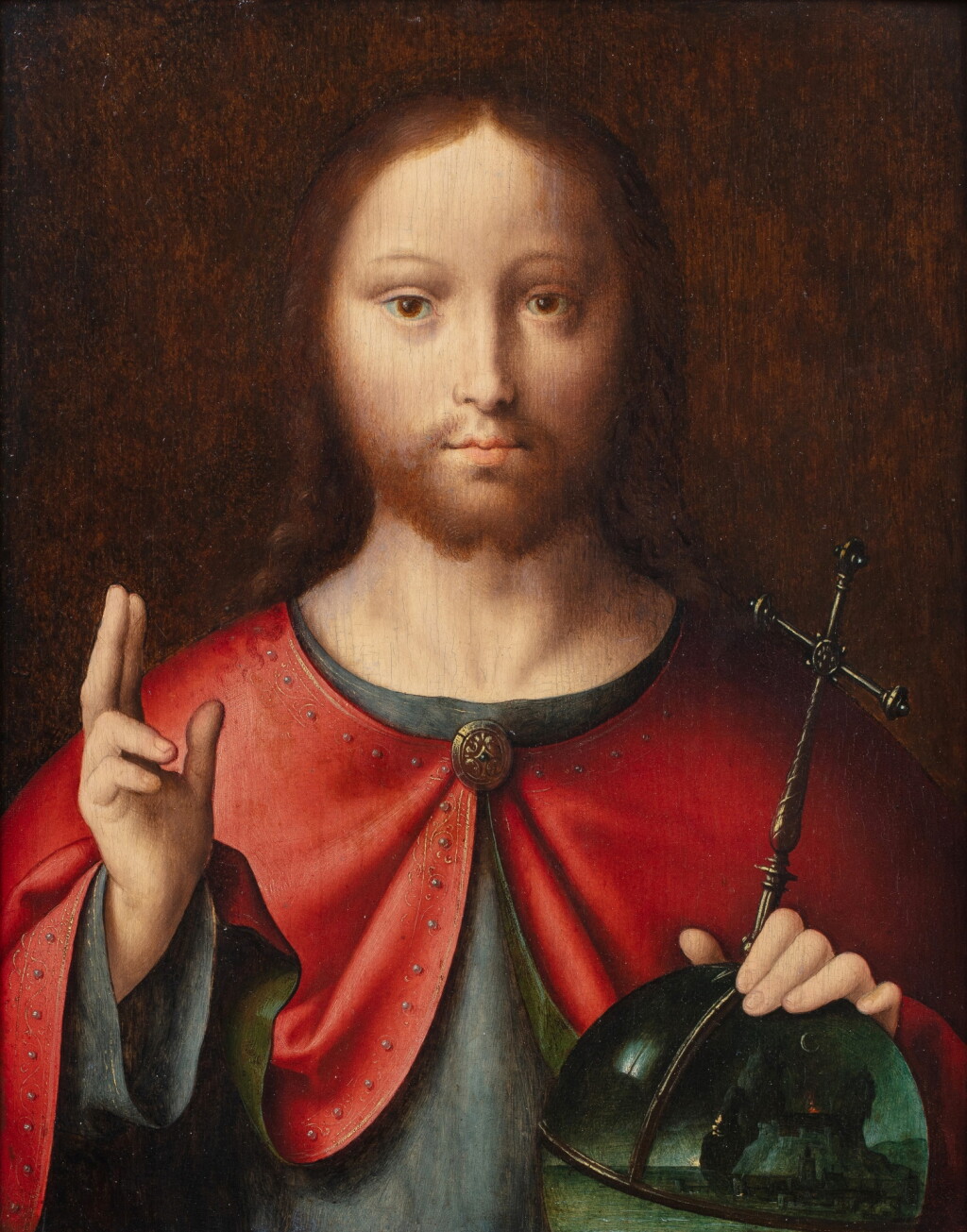
Workshop of Joos van Cleve
Salvator Mundi
Lot Closed
June 13, 01:12 PM GMT
Estimate
12,000 - 18,000 EUR
We may charge or debit your saved payment method subject to the terms set out in our Conditions of Business for Buyers.
Read more.Lot Details
Description
Studio of Joos van Cleve
Kleve 1485 - 1541 Antwerp
Salvator Mundi
Oil on panel
29,5 x 23,3 cm ; 11⅝ by 9⅛ in.
Collection Baron Coppée, Brussels;
Private Collection, Belgium.
Tokyo, Tōbu Bijutsukan, The world of Bruegel : the Coppée Collection and eleven international museums, 1995, March-June 1995, no. F6 (as Circle of Quentin Mestys).
Catalogue de la collection Coppée, Liège, 1991, p. 14.
Once attributed to the circle of Quentin Metsys, this fine panel should actually be assigned to the workshop of Joos van Cleve. Confusion between the two artists is unsurprising. Both Metsys and Van Cleve produced paintings of the Salvator Mundi a few years apart, which show many similarities to the present panel. One of the most famous versions by Metsys and his workshop is particularly close to our panel: it was painted in about 1495–1505 and is now in the North Carolina Museum of Art in Raleigh (inv. no. GL.60.17.62). The painting by Joos van Cleve, about ten years later, is in the Louvre (inv. no. RF 187).
The present work is at the intersection of two traditions, as is the case for Joos van Cleve’s art: on the one hand Netherlandish painting of the fifteenth century, with models of the Salvator Mundi derived from Dirk Bouts and Rogier van der Weyden; on the other the Italian influence, perfectly apparent here, which was absorbed through the example of Leonardo’s Salvator Mundi, a widely disseminated model (ill. 1).
The more supple treatment of the flesh and the less stiff appearance of contours and fabrics, associated with the influence of Italian art, tend to swing the balance in favour of Joos van Cleve rather than Quentin Metsys. Additionally, the underlying drawing, which can be seen when the panel is examined under infra-red light (ill. 2), is typical of the practice of Van Cleve and his workshop, except for the hatching normally used to describe shadows and volumes, which seems to be missing in this case.
The background of the work, against which Christ stands out, has probably been modified in the past. Meanwhile the globe, which is particularly well preserved, testifies to the influence of Bosch and Patinir on the art of Van Cleve and his circle.
We are grateful to Dr. Micha Leeflang for her help in writing this notice, and to Dr. Maryan Ainsworth for providing helpful information for this notice.